Fluid Multipolarity in the Contemporary International Order: How Russia as a Swing Power Adds a Bipolar Dimension
Discover how fluid multipolarity shapes the contemporary international order and how Russia’s emergence as a swing power introduces a bipolar character into this evolving global system.
Introduction:
- The contemporary international system is witnessing a transition from the post–Cold War unipolar moment to a more complex distribution of power often described as “fluid multipolarity.” Unlike classical multipolar systems marked by stable alliances and clearly demarcated spheres of influence, today’s order is characterised by shifting alignments, issue-based partnerships, and strategic hedging by both great and middle powers.
- Despite the United States retaining its position as the world’s most powerful military and economic actor, the relative rise of China as a systemic challenger and the persistence of Russia as a militarily consequential power have diluted exclusive American primacy.
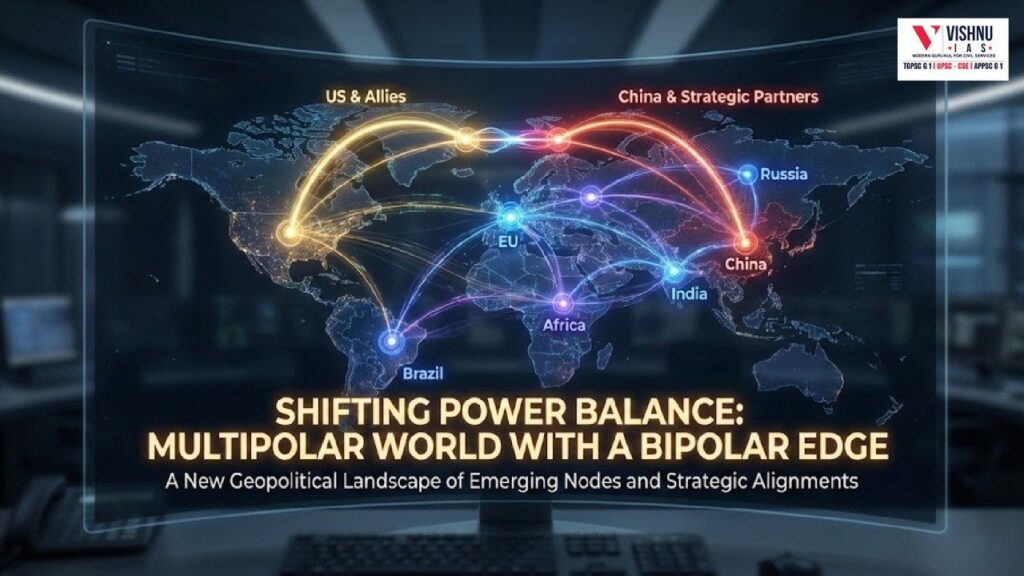
- This evolving balance, reflected in changes to alliance commitments, defence postures, and economic interdependence patterns, has generated a system that is multipolar in structure but bipolar in strategic gravity, particularly due to Russia’s role as a swing power between the two dominant poles.
I. Fluid Multipolarity: Meaning and Structural Characteristics
Absence of a single centre of authority
- The international system today lacks a universally accepted hegemon capable of enforcing rules across regions, unlike the U.S.-led order of the 1990s.
- Power is distributed among multiple actors—primarily the U.S., China, and Russia—while middle powers such as India, Brazil, Germany, and Japan exercise growing autonomy through strategic hedging.
- EXAMPLE: India’s simultaneous participation in the Quad with the U.S. and in BRICS with China and Russia reflects adaptive alignment rather than bloc politics.
Issue-based and region-specific alignments
- States increasingly cooperate selectively—security with one partner, trade with another—rather than committing to rigid alliance structures.
- Economic interdependence between rivals, especially between the U.S. and China, underscores the fluidity absent in Cold War bipolarity.
- CASE STUDY: European dependence on Chinese trade even as it aligns with the U.S. on security matters highlights fragmented alignment patterns.
Erosion of post-war institutional consensus
- Institutions like the UN Security Council, WTO, and Bretton Woods bodies face legitimacy and effectiveness challenges amid great power rivalry.
- Competing visions of order—rules-based, revisionist, or alternative—coexist without a settled hierarchy.
- EXAMPLE: Competing infrastructure initiatives such as the Belt and Road Initiative and Western-led connectivity frameworks reflect contestation rather than consensus.
II. Russia as a Swing Power in a Three-Great-Power System
Strategic autonomy amid relative economic weakness
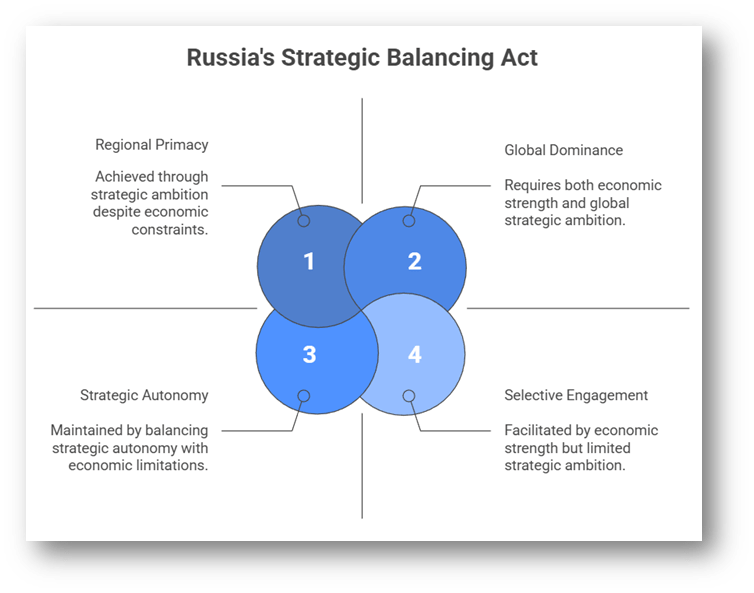
- Despite a smaller economic base compared to the U.S. and China, Russia retains disproportionate influence through nuclear capabilities, energy resources, and geographic depth.
- Its willingness to use military force to secure perceived core interests enhances its bargaining leverage.
- EXAMPLE: Military interventions in Georgia and Ukraine demonstrated Russia’s resolve to reshape regional security dynamics despite economic constraints.
Balancing rather than bandwagoning
- Russia maintains a close strategic partnership with China but resists being subsumed as a junior ally, preserving room for manoeuvre.
- Simultaneously, it signals openness to selective engagement with the U.S., particularly on arms control and strategic stability.
- CASE STUDY: Continued Russia–China cooperation alongside Moscow’s periodic outreach to Washington on nuclear risk reduction illustrates calibrated balancing.
Reassertion of sphere-of-influence politics
- Russia’s strategic objective centres on restoring primacy in its near abroad rather than global dominance.
- This limited but focused ambition allows Russia to oscillate between confrontation and accommodation with other powers.
- EXAMPLE: Russia’s opposition to NATO expansion while avoiding direct military confrontation with NATO members underscores selective assertiveness.
III. Bipolar Pull within a Multipolar Structure
U.S.–China rivalry as the system’s main axis
- The defining contest of the 21st century is between the established U.S. power and the rising Chinese power, spanning trade, technology, military, and ideology.
- Most global strategic calculations ultimately align with this central rivalry.
- EXAMPLE: Competition over semiconductor supply chains and maritime influence in the Indo-Pacific reflects this overarching bipolar dynamic.
Russia’s alignment choices amplify bipolarity
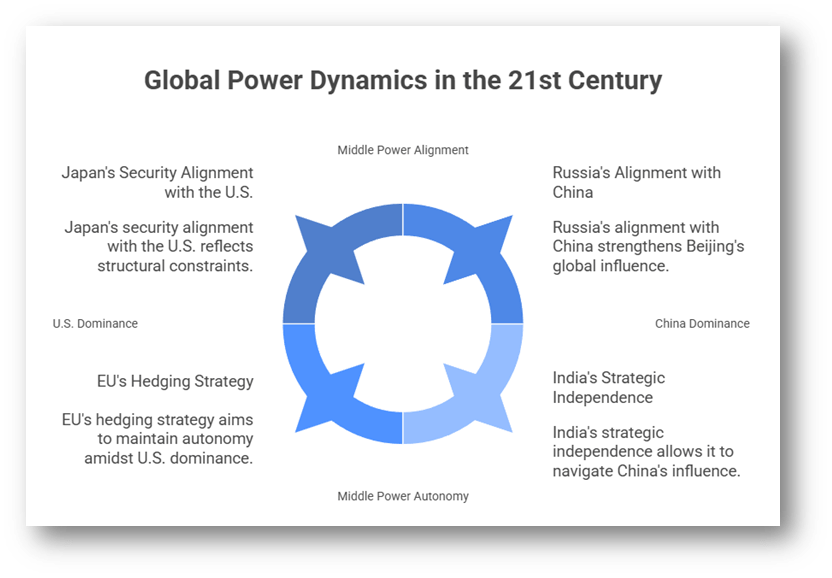
- Russia’s tilt towards China strengthens Beijing’s position vis-à-vis Washington, while any U.S.–Russia rapprochement would rebalance the system.
- Thus, Russia’s orientation significantly shapes the broader equilibrium.
- CASE STUDY: Energy and defence cooperation between Russia and China during periods of Western sanctions has reinforced a de facto counter-pole to the U.S.
Constraints on middle powers
- Although the system is formally multipolar, the gravitational pull of the two dominant poles limits the strategic space of others.
- Middle powers hedge but cannot remain entirely insulated from U.S.–China competition.
- EXAMPLE: Japan’s deepening security alignment with the U.S. despite economic ties with China reflects this structural constraint.
Conclusion:
- Fluid multipolarity captures the transitional and unsettled nature of the current international order—one marked by dispersed power, flexible alignments, and strategic uncertainty. Yet, the presence of two overwhelmingly influential actors ensures that this multipolarity operates under a bipolar shadow.
- Russia’s emergence as a swing power accentuates this dynamic by injecting volatility into the balance between the United States and China, thereby preventing the crystallisation of a stable multipolar system.
- The way forward lies in adaptive multilateralism, greater responsibility-sharing by regional actors, and strengthened crisis-management mechanisms, as global surveys on conflict trends and defence spending indicate a steady rise in geopolitical risk.
- For countries like India, this fluid order presents both challenges and opportunities, demanding strategic autonomy, issue-based partnerships, and sustained investment in diplomatic and military capabilities to navigate an increasingly complex world.
- Fluid multipolarity captures the transitional and unsettled nature of the current international order—one marked by dispersed power, flexible alignments, and strategic uncertainty. Yet, the presence of two overwhelmingly influential actors ensures that this multipolarity operates under a bipolar shadow.
- Russia’s emergence as a swing power accentuates this dynamic by injecting volatility into the balance between the United States and China, thereby preventing the crystallisation of a stable multipolar system.
- The way forward lies in adaptive multilateralism, greater responsibility-sharing by regional actors, and strengthened crisis-management mechanisms, as global surveys on conflict trends and defence spending indicate a steady rise in geopolitical risk.
- For countries like India, this fluid order presents both challenges and opportunities, demanding strategic autonomy, issue-based partnerships, and sustained investment in diplomatic and military capabilities to navigate an increasingly complex world.
Recap: