
FCRA Amendment Bill 2026: Key Provisions and Impact on Civil Society Organisations
FCRA Amendment Bill 2026 marks a significant shift in India's regulatory framework governing foreign contributions and civil society organisations. It raises critical questions regarding autonomy, transparency, and constitutional safeguards.
Introduction
- The Foreign Contribution (Regulation) Act (FCRA) is a legislative framework governing the acceptance and utilisation of foreign contributions by individuals and organisations in India, aimed at safeguarding national security, sovereignty, and public interest.
- First enacted in 1976 and comprehensively re-enacted in 2010, it has undergone successive tightening, including the 2020 amendments, reflecting increasing regulatory scrutiny over foreign-funded entities. As per recent government disclosures, thousands of organisations have faced cancellation or non-renewal of FCRA licences over the past decade, significantly impacting the operational landscape of civil society.
- The FCRA Amendment Bill, 2026 proposes a new institutional and legal architecture, particularly empowering the state to exercise enhanced control over assets and operations of organisations receiving foreign funds, raising important questions regarding transparency, accountability, and constitutional safeguards.
1. Key Provisions of the FCRA Amendment Bill, 2026
a) Creation of a “Designated Authority” for Asset Control
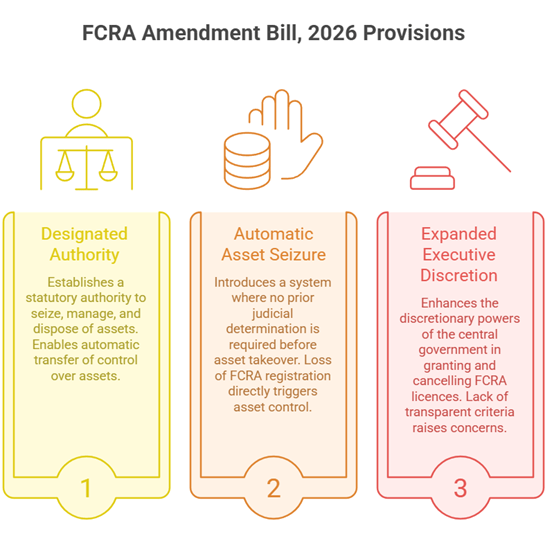
- Proposes establishment of a statutory authority empowered to seize, manage, and dispose of assets of organisations whose FCRA registration is cancelled or lapses.
- Enables automatic transfer of control over assets such as schools, hospitals, and charitable institutions built using foreign funds.
- Example: Educational institutions run by faith-based organisations that rely on foreign donations may face sudden state takeover, affecting service delivery.
b) Automatic and Non-Adjudicatory Asset Seizure Mechanism
- Introduces a system where no prior judicial determination or adjudicatory process is required before asset takeover.
- Operates on the principle that loss of FCRA registration directly triggers asset control, bypassing due process safeguards.
- Case Study: Instances of NGOs losing licences in the past (e.g., environmental advocacy groups) indicate how administrative discretion can have immediate operational consequences.
c) Expansion of Executive Discretion in Granting and Cancelling Licences
- Enhances the discretionary powers of the central government in granting, renewing, or cancelling FCRA licences.
- Lack of transparent criteria and limited parliamentary oversight raises concerns about selective enforcement.
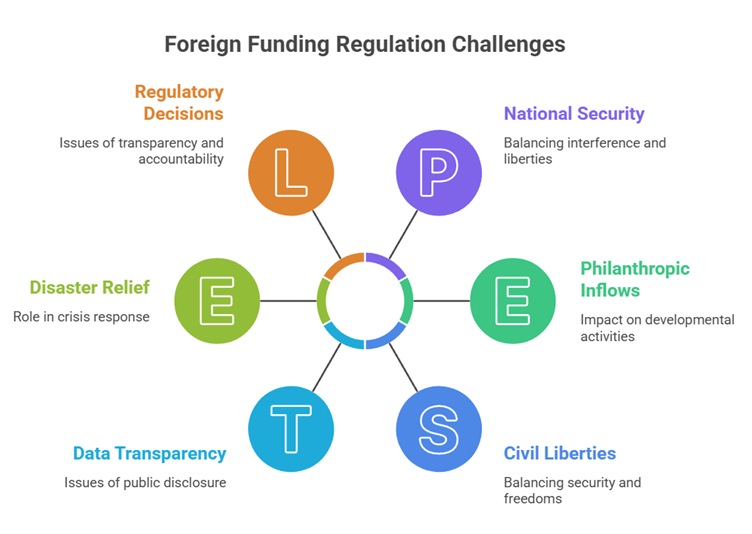
- Example: Data on cancellations and non-renewals not being publicly accessible in recent years has raised issues of opacity and accountability.
2. Implications for Civil Society Organisations (CSOs)
a) Impact on Autonomy and Operational Viability
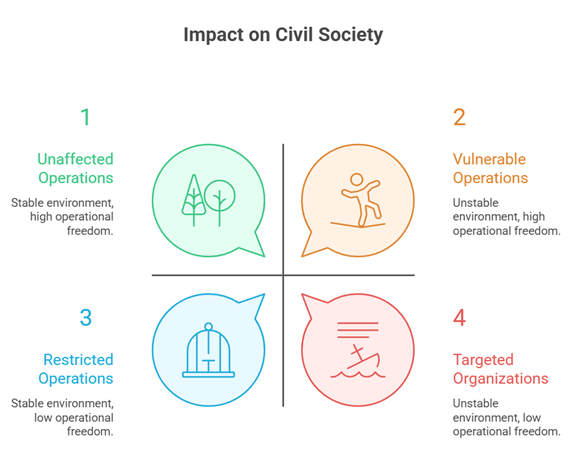
- CSOs may face uncertainty and instability due to the risk of abrupt licence cancellation and asset seizure.
- Could discourage long-term investments in social infrastructure such as healthcare and education.
- Case Study: NGOs working in rural health funded by international donors may reduce outreach due to regulatory unpredictability.
b) Concerns Regarding Principles of Natural Justice
- The absence of prior hearing, appeal mechanisms, or judicial review in asset seizure raises issues related to fair procedure and rule of law.
- Violates core legal principles such as audi alteram partem (right to be heard).
Recap: