
Introduction:
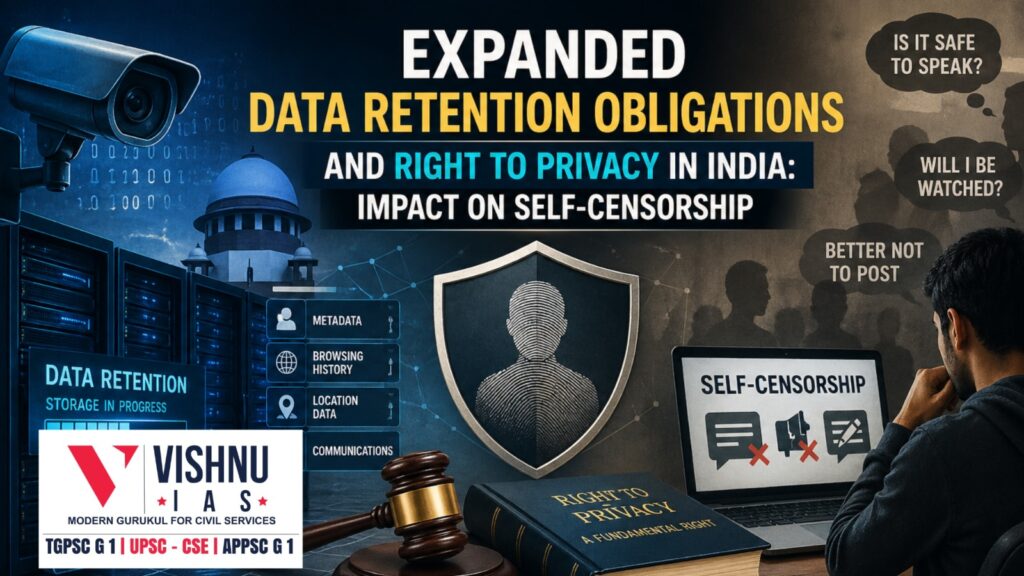
- Data retention obligations refer to the legal requirement imposed on digital platforms and intermediaries to store user data (such as personal information, metadata, browsing activity, and communications) for a specified period for regulatory, security, or investigative purposes. In India, this intersects with the right to privacy, recognised as a fundamental right under Justice K.S. Puttaswamy vs Union of India, which mandates that any restriction must satisfy the tests of legality, necessity, and proportionality.
- With India hosting over 850 million internet users and rapid digitalisation through initiatives like Digital India, expanded data retention frameworks are increasingly shaping the state–citizen–platform relationship. Simultaneously, global surveys such as those by civil society organisations have indicated rising concerns that pervasive surveillance and prolonged data storage contribute to “chilling effects”, where individuals consciously limit their speech online.
Body:
1. Implications for the Right to Privacy
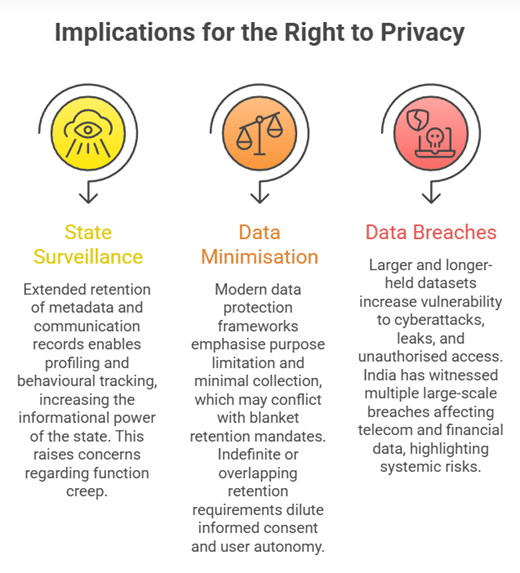
a) Expansion of State Surveillance Capacity
- Extended retention of metadata and communication records enables profiling and behavioural tracking, increasing the informational power of the state.
- This raises concerns regarding function creep, where data collected for one purpose (e.g., security) is later used for unrelated objectives.
- Example – Aadhaar Case Debate: The Justice K.S. Puttaswamy vs Union of India highlighted risks of surveillance through aggregation of personal data across systems.
b) Tension with Principles of Data Minimisation
- Modern data protection frameworks, including the Digital Personal Data Protection Act, 2023, emphasise purpose limitation and minimal collection, which may conflict with blanket retention mandates.
- Indefinite or overlapping retention requirements dilute informed consent and user autonomy.
- Example – Global Practice: The European Union’s GDPR mandates strict limits on storage duration, reflecting a contrasting approach.
c) Increased Risks of Data Breaches and Misuse
- Larger and longer-held datasets increase vulnerability to cyberattacks, leaks, and unauthorised access.
- India has witnessed multiple large-scale breaches affecting telecom and financial data, highlighting systemic risks.
- Case Study – Data Breach Incidents in India: Repeated leaks of user databases demonstrate how retained data becomes a liability rather than a safeguard.
2. Impact on Self-Censorship Among Digital Users
a) Chilling Effect on Freedom of Expression
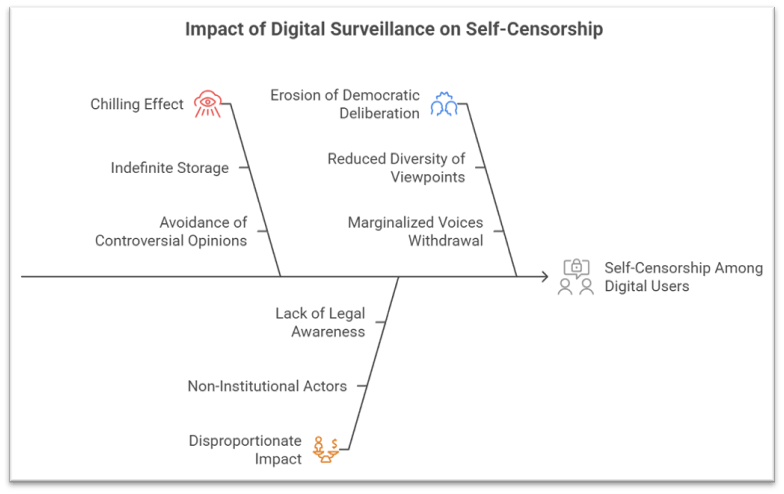
- Awareness that communications may be stored indefinitely leads individuals to avoid expressing controversial or critical opinions.
- This undermines Article 19(1)(a) by creating indirect restrictions without explicit censorship.
- Example – Social Media Behaviour Trends: Studies have shown users refrain from political commentary when surveillance is perceived to be high.
b) Disproportionate Impact on Ordinary Users
- Expansion of regulatory oversight to include non-institutional actors (e.g., individuals sharing news) increases fear of scrutiny.
- Unlike media organisations, ordinary users lack legal awareness or institutional safeguards, amplifying self-restraint.
- Case Study – Content Takedown Experiences: Instances where users’ posts are removed without explanation often lead to reduced participation in public discourse.
c) Erosion of Democratic Deliberation
- Self-censorship reduces the diversity of viewpoints in the digital public sphere, weakening participatory democracy.
- Marginalised voices, already underrepresented, may withdraw further due to perceived risks.
- Example – Online Activism Trends: Activists often shift to encrypted or private channels, limiting public engagement.
3. Balancing Regulatory Objectives with Civil Liberties
a) Legitimate State Interests and Security Concerns
- Data retention aids in law enforcement, counter-terrorism, and cybercrime investigations, providing evidentiary trails.
- Governments argue that timely access to stored data is essential for national security.
- Example – Cybercrime Investigations: Retained logs have been crucial in tracing digital fraud networks.
b) Risks of Executive Overreach and Lack of Safeguards
- Absence of clear limits, judicial oversight, and transparency mechanisms may lead to arbitrary use of retained data.
- The principle of proportionality, emphasised in constitutional jurisprudence, requires that restrictions be narrowly tailored.
- Case Study – Judicial Scrutiny of Intermediary Rules: Courts have previously questioned excessive executive control over online content regulation.
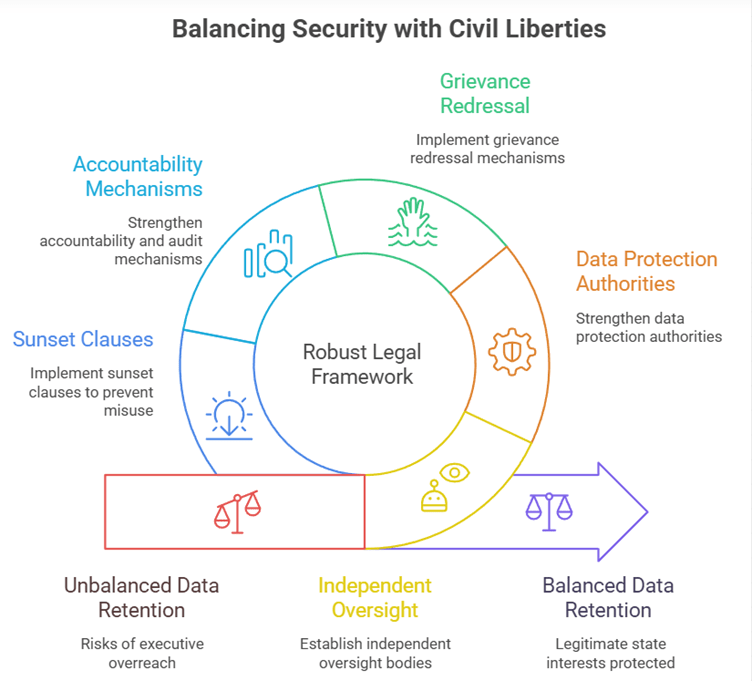
c) Need for Robust Institutional and Legal Frameworks
- Effective balance requires independent oversight bodies, data protection authorities, and grievance redressal mechanisms.
- Strengthening accountability, audit mechanisms, and sunset clauses can prevent misuse.
- Example – Institutional Mechanisms: The proposed Data Protection Board under Indian law aims to regulate processing and ensure compliance.
Conclusion:
- Expanded data retention obligations represent a critical juncture in India’s digital governance trajectory. While they serve legitimate objectives such as security and regulatory enforcement, their design and implementation significantly influence the right to privacy and behavioural freedoms of citizens. Evidence from global and domestic experiences suggests that unchecked retention frameworks tend to normalise surveillance and induce self-censorship, thereby narrowing democratic spaces.
- A balanced approach requires aligning retention policies with constitutional safeguards, proportionality standards, and evolving data protection norms. Strengthening judicial oversight, transparency, and user rights, alongside leveraging frameworks like the Digital Personal Data Protection regime, can ensure that India’s expanding digital ecosystem remains both secure and open, preserving trust and participation in the long run