
Introduction
RTE Act Section 12(1)(c) is a transformative provision under the Right of Children to Free and Compulsory Education Act, 2009, which operationalises the fundamental right under Article 21A, mandating universal elementary education. A key provision requires private unaided schools to reserve 25% seats for children from Economically Weaker Sections (EWS) and Disadvantaged Groups (DG), thereby fostering social integration through shared classrooms.
Over the past decade, this provision has enabled millions of children to access private schooling, with high retention rates exceeding 90% in several states, reflecting its transformative potential.
However, despite a robust legal framework, the realization of substantive equality hinges on overcoming persistent administrative inefficiencies and hidden exclusionary practices.
1. Constitutional Vision and Social Integration through Section 12(1)(c)
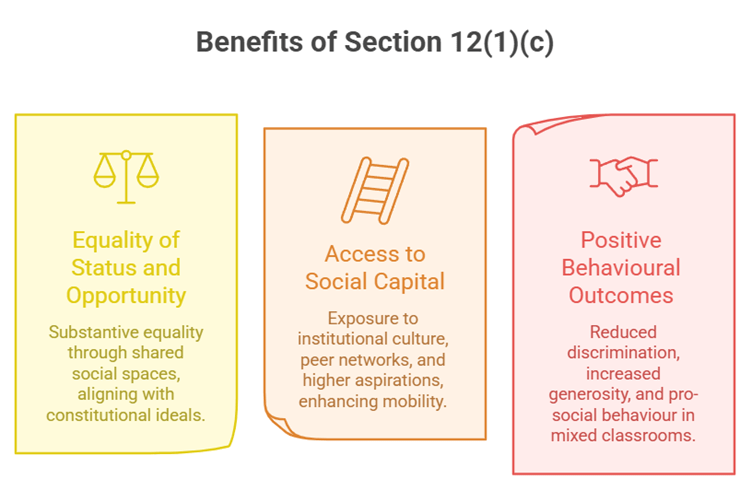
Equality of Status and Opportunity
The provision embodies substantive equality, moving beyond formal equality by creating shared social spaces where children from diverse socio-economic backgrounds interact. It aligns with constitutional ideals of fraternity and dignity, ensuring that birth-based disadvantages do not define life trajectories.
Example: In urban centres like Delhi, classrooms with mixed socio-economic composition have normalised inclusive peer interactions, reducing social distance.
Access to Social Capital and Aspirational Mobility
Students gain exposure to institutional culture, peer networks, and higher aspirations, which are often absent in segregated schooling systems. This enhances self-confidence, ambition, and long-term mobility.
Case Insight: A child from a low-income family entering a reputed private school benefits academically while also gaining soft skills, language proficiency, and exposure to extracurricular activities.
Evidence of Positive Behavioural Outcomes
Empirical studies show reduced discrimination, increased generosity, and pro-social behaviour in mixed classrooms without harming academic outcomes.
Example: Inclusive classrooms foster empathy and collaborative learning cultures in urban schooling ecosystems.
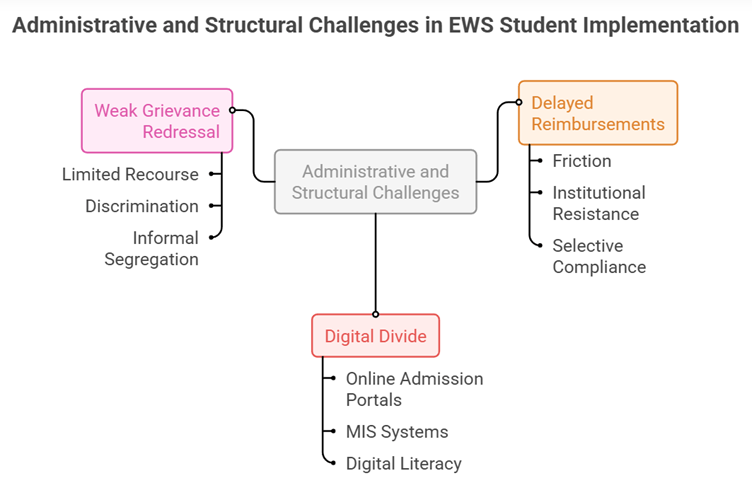
2. Administrative and Structural Challenges in Implementation
Delayed Reimbursements and Financial Bottlenecks
States often delay reimbursements to private schools, creating institutional resistance to admitting EWS students. This affects sustainability and leads to selective compliance.
Example: Backlogs in several states discourage full implementation of the policy.
Digital Divide and Uneven State Capacity
While online admission portals have improved transparency, disparities in digital literacy limit access for marginalised families. Implementation varies significantly across states.
Case Study: Rajasthan and Gujarat have improved outcomes through centralised digital lottery systems, while other states lag behind.
Weak Grievance Redressal and Monitoring
The absence of strong grievance redress mechanisms leaves parents with limited recourse against discrimination. Monitoring systems often fail to ensure compliance.
Example: Instances of informal segregation and differential treatment highlight enforcement gaps.
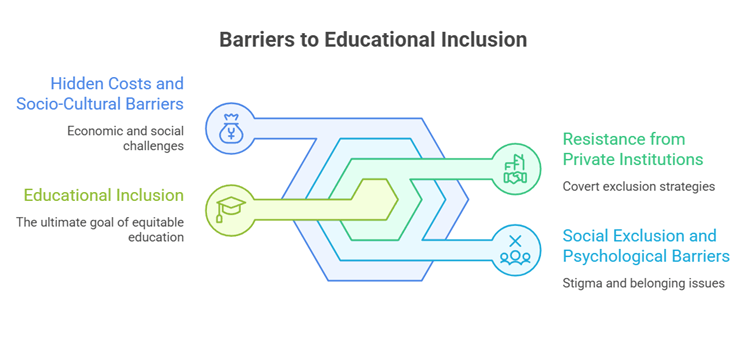
3. Hidden Costs and Socio-Cultural Barriers to Inclusion
Economic Burden beyond Tuition
Although tuition is covered, families must bear costs of uniforms, books, transport, and activities, creating indirect exclusion.
Example: Low-income families struggle with ancillary expenses, leading to reduced enrolment or dropouts.
Social Exclusion and Psychological Barriers
Children may face subtle discrimination, stigma, and adjustment issues due to differences in language and lifestyle.
Case Study: Reports indicate that some EWS students experience peer isolation and reduced participation.
Resistance from Private Institutions
Some schools adopt indirect exclusion strategies such as discouraging applications or imposing hidden barriers.
Example: Practices like “voluntary contributions” limit access for eligible students.