Significance of the Supreme Court’s Stand on “Evasive Inaction by Governors” and No Fixed Deadline for Assent to Bills
In India’s quasi-federal structure, the office of the Governor plays a critical constitutional role as a link between the Union and the States. The Supreme Court’s recent observation that while “evasive inaction by Governors” is impermissible, no fixed deadline can be imposed for granting assent to Bills, has revived debates on federal balance, constitutional morality, and the discretionary space of constitutional authorities.
With more than 15,000 Bills passed across State legislatures since Independence and recurrent delays in gubernatorial assent forming the basis of litigation in several States, the Court’s stance acquires significance. It highlights the need for both constitutional restraint and accountability, reaffirming that the Constitution functions not only through formal rules but also through democratic conventions and mutual respect.
1. Ensuring Constitutional Accountability and Preventing Misuse of Office
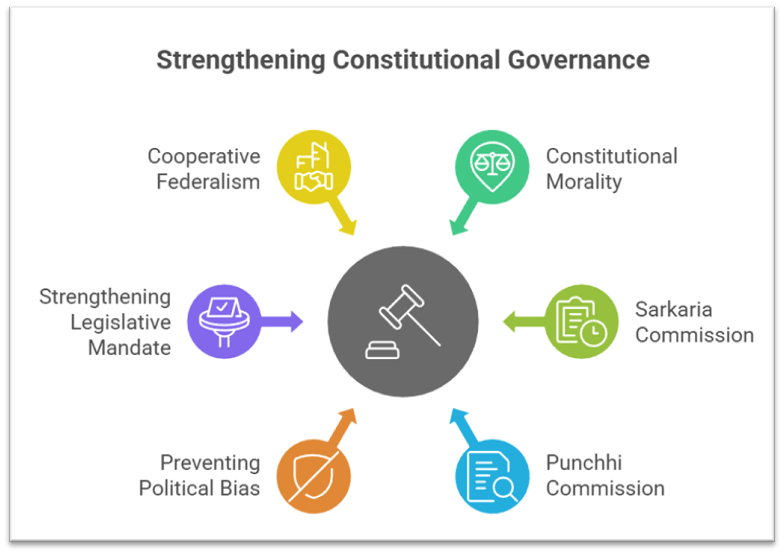
Upholding Constitutional Morality
- The Supreme Court’s disapproval of evasive inaction ensures that Governors cannot indirectly stall the legislative process by remaining silent. This reflects the principle of constitutional morality wherein authorities are expected to act in good faith, similarly reflected in examples like K.R. Narayanan returning Article 356 recommendations purely on constitutional grounds.
- It reinforces the expectation that discretionary powers be exercised sparingly, echoing the norms shaped since the Sarkaria Commission and Punchhi Commission emphasised time-bound, reasoned actions even though deadlines were not prescribed.
Preventing Political Bias and Executive Overreach
- Governors acting as de facto political agents rather than neutral umpires has been a recurring challenge in Centre-State relations. The judicial emphasis on impermissibility of inaction prevents situations like delayed oath-taking in certain States or extended pendency of Bills, which often become political flashpoints.
- Case studies such as the Arunachal Pradesh crisis (2016) show how unilateral decisions or deliberate hold-ups can distort democratic functioning, making the Court’s insistence on “action, not avoidance” essential.
Strengthening the Legislative Mandate
- A legislature’s democratic mandate becomes ineffective if its Bills are indefinitely stalled. By disallowing evasive inaction, the Court ensures that Governors must either assent, reject, or return Bills, thereby preserving the people’s mandate.
- Government initiatives promoting cooperative federalism, such as Inter-State Council revitalisation and NITI Aayog’s collaborative forums, gain meaning only when constitutional offices act with responsibility.
2. Balancing Federalism Through Separation of Powers
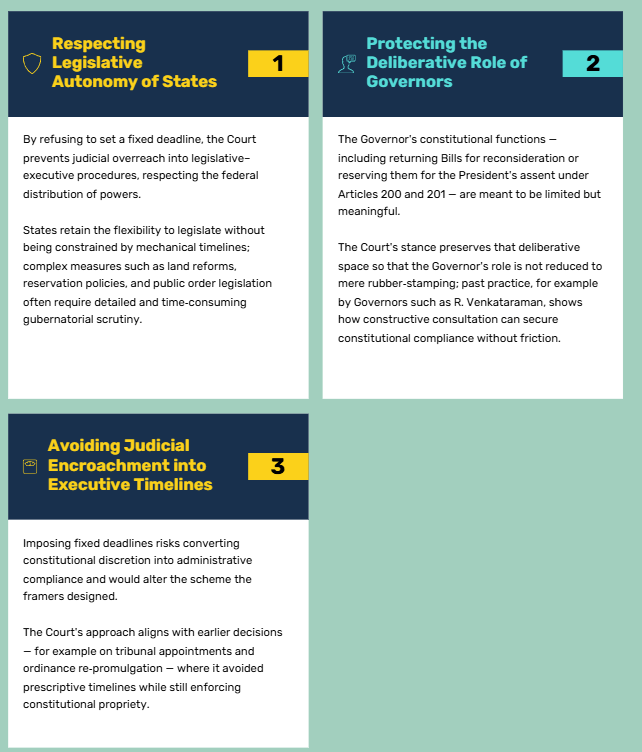
Respecting Legislative Autonomy of States
- By refusing to set a fixed deadline, the Court prevents judicial overreach into legislative–executive procedures, respecting the federal distribution of powers. States retain the flexibility to legislate without feeling constrained by mechanical timelines.
- Examples include complex Bills on land reforms, reservation policies, and public order-related legislation where detailed gubernatorial scrutiny, though time-consuming, remains essential.
Protecting the Deliberative Role of Governors
- The Governor is expected to exercise a limited but significant role, such as returning Bills for reconsideration or reserving them for presidential assent under Article 200 and 201. The Court’s stance ensures that this role is not diluted into mere rubber-stamping.
- Historically, Governors like R. Venkataraman used detailed consultations to ensure constitutional compliance without friction, illustrating the value of independent but responsible scrutiny.
Avoiding Judicial Encroachment into Executive Timelines
- Establishing fixed deadlines could convert constitutional discretion into administrative compliance, altering the scheme envisaged by the framers. The Court’s refusal respects the delicate balance between constitutional offices and judicial review.
- The principle aligns with earlier positions in cases concerning tribunal appointments and ordinance re-promulgation, where the Court avoided prescriptive timelines while upholding constitutional propriety.
3. Reinforcing Good Governance, Transparency, and Cooperative Federalism
Promoting Accountability and Transparency
- When the Court states that excessive delay can be questioned, it places a moral and constitutional burden on Governors to justify actions. This indirectly introduces transparency in functioning, similar to good governance norms promoted under various administrative reforms initiatives.
- Contemporary examples include recent State challenges to prolonged withholding of Bills, where courts demanded explanations for gubernatorial delay, encouraging more transparent functioning.
Strengthening Cooperative Federalism
- The observation promotes cooperation between the State executive and the Governor’s office, preventing adversarial standoffs. It supports frameworks like GST Council functioning, Sectoral Councils of NITI Aayog, and centrally sponsored schemes requiring coordinated action.
- Real-life experiences during disaster response and pandemic management demonstrated the necessity of mutual trust between State and Central institutions, reinforcing the impact of timely constitutional action.
Enhancing Public Trust in Institutions
- The judiciary’s articulation ensures citizens perceive constitutional offices as impartial custodians rather than political actors. This is vital as surveys on institutional trust often show declining confidence in political processes.
- Examples such as timely assent to welfare Bills in various States reflect how procedural efficiency directly impacts governance outcomes in health, education, and welfare sectors.
Conclusion:
The Supreme Court’s balanced approach—rejecting fixed deadlines yet disallowing evasive inaction—reaffirms that constitutional offices must function with responsibility, integrity, and respect for democratic mandates. It strengthens India’s federal structure by encouraging constitutional behaviour rather than coercive timelines.
Moving forward, India needs stronger conventions, improved consultation mechanisms, and routine intergovernmental dialogue to minimise friction. As governance surveys note rising citizen expectations for transparency and efficiency, timely and principled action by Governors becomes essential.
Ensuring such accountability not only enhances cooperative federalism but also reinforces the foundational ethos that the Constitution must be worked with trust, not suspicion.
Recap: