Why India Needs a Tectonic Shift in Earthquake Management Strategy: From Reaction to Resilience
India's earthquake management strategy needs urgent reform. With 59% of its landmass prone to seismic activity and urban infrastructure underprepared, there is an immediate need to shift from reactive relief to risk reduction in disaster management. This blog analyses the vulnerabilities and outlines a proactive path forward.
Introduction:
India is among the world’s most seismically vulnerable nations, with 59% of its landmass prone to earthquakes of varying intensities. According to the National Disaster Management Authority (NDMA) and Bureau of Indian Standards (BIS), the country is divided into four seismic zones—Zone II (low) to Zone V (very high risk). The recent 4.4 magnitude tremor in Delhi on July 10, 2025, with its epicentre just 20 km away and a depth of only 5 km, highlights a pressing reality: India’s urban and rural infrastructure remains dangerously underprepared for seismic threats.
The need for a “tectonic shift” from reactive relief to proactive risk reduction is underscored by recurring tragedies such as the 2001 Bhuj earthquake, 2015 Nepal quake, and recent tremors across Myanmar, Tibet, and Northeast India. Despite early warning systems like IndiaQuake, the gap lies in implementation, public awareness, and resilient infrastructure development.
India’s Seismic Vulnerability: Patterns, History, and Risks
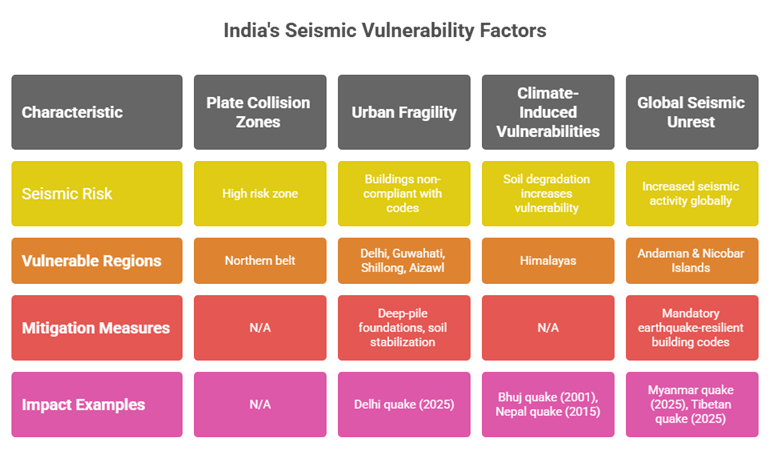
- Tectonic Setting and Hazard Mapping
- India sits on the Indian Plate, colliding with the Eurasian Plate, creating the Himalayas and high seismic risks from Kashmir to Arunachal Pradesh.
- About 11% of the country lies in Zone V, including the Northeast and parts of Kashmir, Himachal, Uttarakhand, and Gujarat.
- Urban Fragility and Infrastructure Risks
- The 2025 Delhi quake exposed seismic code violations in 80% of buildings.
- East Delhi and Guwahati have liquefaction-prone soils needing deep-pile foundations.
- Zone V cities like Guwahati, Shillong, Aizawl lack retrofitting or preparedness plans.
- Climate-Induced Vulnerabilities and Migration
- Urban migration pressures fragile cities like Patna, Dehradun, and Gangtok.
- Bhuj (2001) and Nepal (2015) quakes displaced lakhs, proving high social costs.
- Climate change exacerbates seismic risks through soil degradation and landslides.
- Global Seismic Unrest and India’s Position
- Recent global quakes (Myanmar, Tibet, Indonesia) highlight increased regional risk.
- The Andaman & Nicobar Islands are vulnerable to tsunamis in subduction zones.
- India lags in adopting global best practices seen in Japan and Chile.
From Reaction to Prevention: Policy and Systemic Gaps
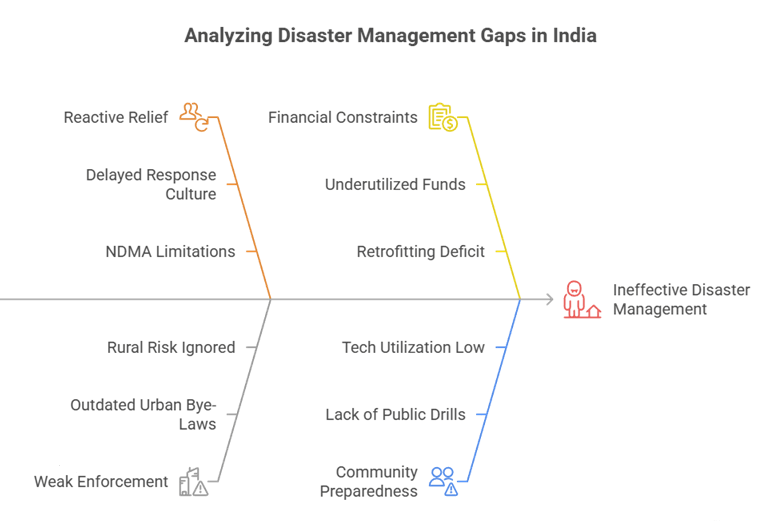
- Reactive Relief Dominates Disaster Strategy
- NDMA’s planning is weakly enforced by underfunded SDMAs.
- No penalties exist for non-compliance with seismic codes like IS 1893:2016.
- Weak Enforcement of Building Codes
- Outdated bye-laws and lack of shear walls in high-rises.
- Rural areas still use unsafe kutcha constructions.
- Financial Constraints and Retrofitting Deficit
- ₹50,000 crore annually needed for retrofitting; most SDRF funds go unused.
- States lack models like Gujarat's GSDMA to address seismic risks.
- Community Preparedness and Awareness Gaps
- Lack of drills, low IndiaQuake app usage, and weak public training.
The Path to Proactive Earthquake Risk Reduction
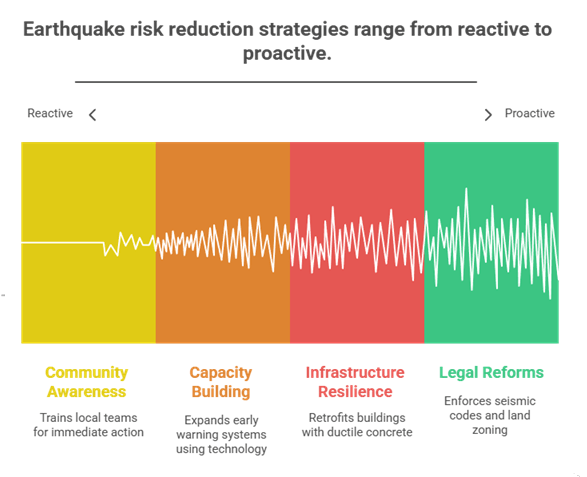
- Infrastructure Resilience and Retrofitting
- Mandatory ductile concrete, base isolation, and shear walls in Zones IV & V.
- Incorporate resilience audits in AMRUT and Smart Cities Mission.
- Capacity Building and Tech-Based Early Warnings
- Upgrade IndiaQuake with AI, IoT, and satellite monitoring via ISRO and NCS.
- Strengthen SEOCs and DEOCs with training and connectivity.
- Community Awareness and Education
- Mandatory school drills and PPPs for public education.
- Create grassroots volunteer disaster forces at panchayat levels.
- Legal, Policy, and Institutional Reforms
- Enforce seismic codes with penalties through Model Bye-Laws.
- Launch a National Seismic Retrofitting Mission (NSRM).
- Risk-based micro-zonation in all urban Master Plans.
Conclusion:
India stands at a critical juncture. With over 300 million people living in high-risk seismic zones and infrastructure vulnerabilities rising, a reactive, relief-driven earthquake management strategy in India is unsustainable. The 2025 Delhi tremor must be treated as a call to action.
A National Earthquake Risk Reduction Strategy should combine scientific mapping, engineering reforms, disaster education, and strict policy enforcement. Investing ₹50,000 crore annually in retrofitting, enforcing IS 1893:2016, and building public awareness will transform India's resilience.
This is not just a technical upgrade—it is a moral and civic necessity to protect millions. Let Delhi’s tremor be our wake-up call, not a forgotten aftershock.
Recap