
Digital Vigilantism and Lateral Surveillance: Ethical and Legal Challenges in the Indian Context
Introduction:
In the digital era, surveillance is no longer the sole domain of states and corporations; it is now practiced horizontally by individuals upon one another, a phenomenon termed lateral surveillance. Within this context, digital vigilantism—defined as the act of individuals or groups using the internet to shame, expose, or punish others—has gained prominence.
This shift is underpinned by Mark Andrejevic's idea of participatory surveillance and Shoshana Zuboff’s theory of surveillance capitalism, which explains how digital platforms exploit human curiosity and outrage to drive engagement.
According to Statista 2024, India had over 900 million internet users, and 70% of digital content engagement in India now involves user-generated posts on social media. The widespread use of smartphones and social platforms like Instagram, TikTok, and X (formerly Twitter) has blurred the lines between content sharing and moral policing. From viral metro videos to fabricated controversies, digital vigilantism has raised urgent ethical, legal, and societal questions.
Ethical Challenges in Digital Vigilantism
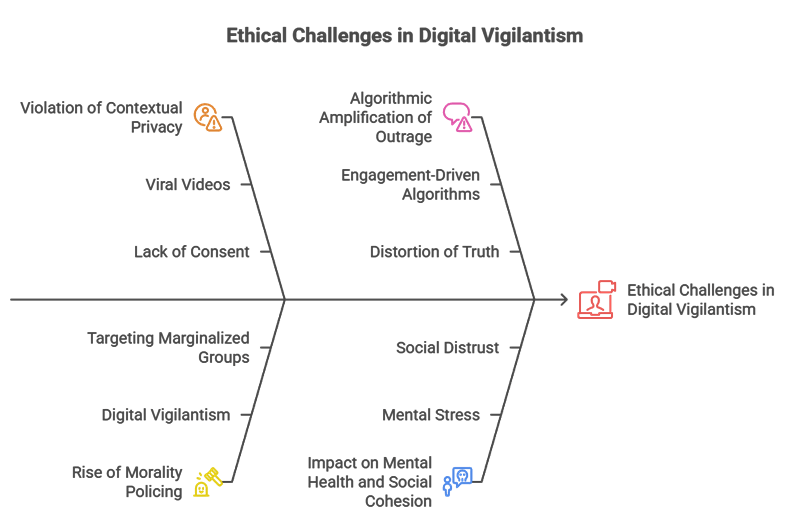
- Violation of Contextual Privacy: Helen Nissenbaum’s theory of "Contextual Integrity" emphasizes that privacy involves control over information flow within a context. Viral videos violate this principle.
- Example: A 2023 Delhi Metro video of a couple went viral, resulting in mass trolling of the woman, stripping her of digital privacy.
- Case Study: A tribal woman in Madhya Pradesh faced public shaming after a protest video was shared without consent.
- Rise of Morality Policing: As noted by Daniel Trottier, users often bypass due process by acting as online judges.
- Example: TikTok creators from marginalized groups have been targeted post-viral fame. A trans creator in Kerala was driven offline due to moral backlash.
- Algorithmic Amplification of Outrage: Engagement-driven algorithms promote provocative content, regardless of ethical concerns.
- Research: Mozilla Foundation (2023) revealed 68% of ethically questionable content was algorithmically promoted.
- Example: The Coldplay incident saw rampant speculation overtaking facts.
- Impact on Mental Health and Social Cohesion: Victims often suffer emotional trauma and public shame that is digitally permanent.
- Example: A teacher in Rajasthan resigned after an edited classroom video went viral, causing public backlash.
Legal Challenges and Gaps
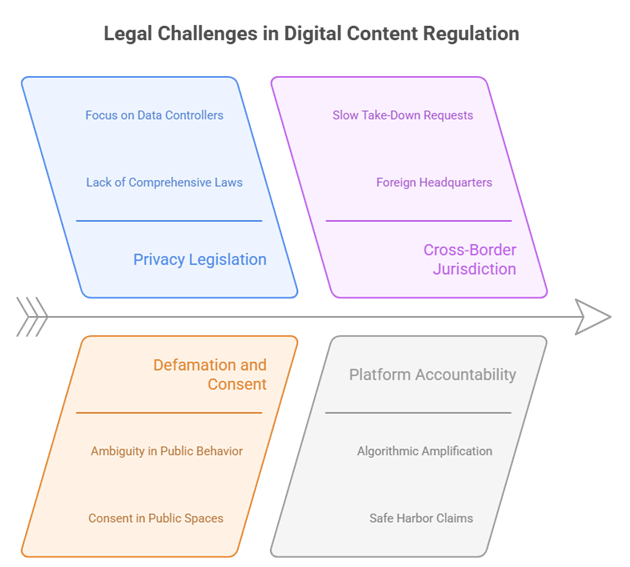
- Lack of Comprehensive Privacy Legislation: The Digital Personal Data Protection Act, 2023 focuses more on institutional data control than user-generated peer violations.
- Example: Coldplay-related content circulated globally, making enforcement across jurisdictions weak.
- Defamation and Consent Grey Zones: Legal frameworks such as Section 499 IPC and 354C IPC offer limited scope when content lacks explicit sexual intent or intent to harm.
- Cross-Border Platform Jurisdiction: Platforms like X and YouTube often delay or ignore take-down requests from Indian authorities.
- Example: Despite requests under IT Rules 2021, flagged content often remains online due to jurisdictional challenges.
- Platform Accountability and Algorithmic Transparency: While IT Rules (2021) require platforms to moderate content, algorithms that amplify outrage aren't regulated.
Broader Societal and Institutional Implications
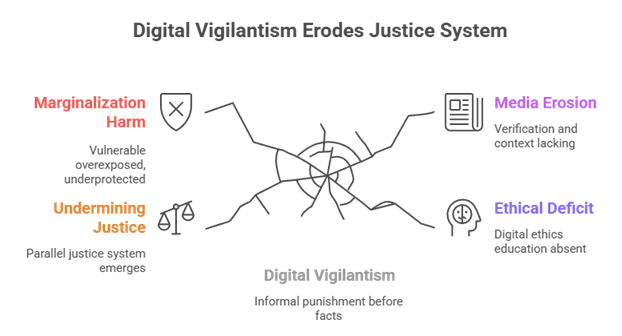
- Undermining Legal Mechanisms: Digital vigilantism can act as a parallel justice system, based on viral sentiment rather than legal facts.
- Example: In Hyderabad, a man falsely accused in a viral video was later proven innocent by CCTV footage—but public trust was lost.
- Marginalisation and Disproportionate Harm: Vulnerable communities are more exposed online and lack legal knowledge or access to justice mechanisms.
- Study: IFF (2024) found that 70% of victims were from socio-economically disadvantaged backgrounds.
- Role of Media and Erosion of Journalistic Standards: Legacy media often republish viral content without verification, amplifying misinformation.
- Digital Citizenship and Behavioural Ethics: Despite growing internet access, India lacks digital ethics education. Government schemes focus more on security than awareness.
- Example: Finland's integration of empathy training and media literacy in schools offers a model for India.
Conclusion:
Digital vigilantism, powered by lateral surveillance, poses serious ethical and legal challenges in the algorithmic age. While it has some benefits in exposing hidden wrongs, more often it bypasses fairness and law. Victims suffer lasting trauma and reputational damage, while justice systems and journalism are undermined.
India must take urgent steps to reinforce privacy legislation, mandate transparency from platforms, and introduce digital ethics education in schools and communities. As the 2024 UNESCO report suggests, respectful digital engagement is vital for safeguarding democracy. The time has come to evolve from a digitally reactive society to a digitally responsible one.
Recap: