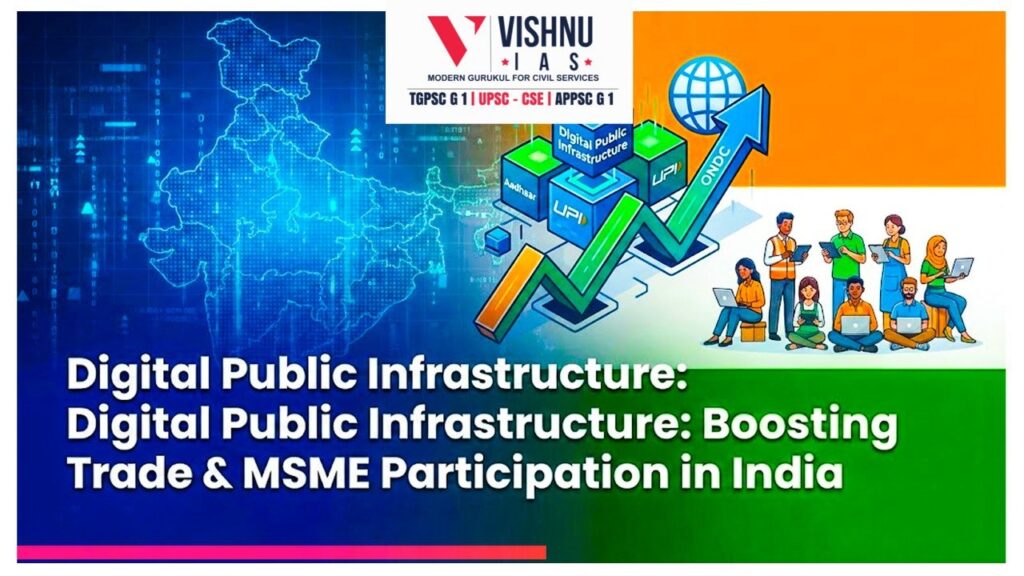
How Digital Public Infrastructure Enhances India’s Trade Competitiveness and MSME Participation
Digital Public Infrastructure is playing a defining role in reshaping India’s trade competitiveness and expanding MSME participation in the economy. Platforms like the Government e-Marketplace (GeM), ONDC, and Trade Connect are improving efficiency, widening market access, and embedding transparency into India
Introduction:
- Digital Public Infrastructure (DPI) refers to population-scale, interoperable digital systems built as public goods that enable markets, governance, and service delivery to function efficiently. In India, platforms such as the Government e-Marketplace (GeM), Open Network for Digital Commerce (ONDC), and Trade Connect ePlatform exemplify DPI applied to trade and enterprise.
- As India crossed $4 trillion in nominal GDP and expanded exports to over $825 billion, the emphasis has shifted from episodic reforms to continuous, process-driven competitiveness. Surveys by multilateral institutions and domestic policy assessments increasingly highlight that trade efficiency, MSME integration, and transparency-driven trust are decisive factors in sustaining growth.
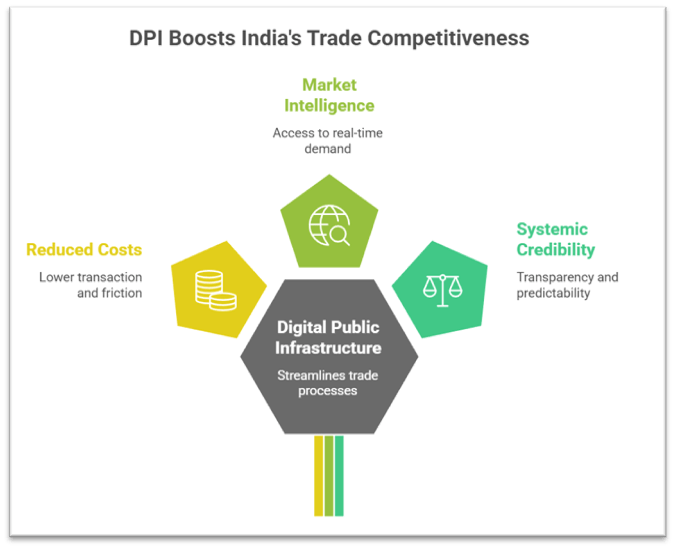
- Within this context, DPI has emerged as a structural lever that reduces transaction costs, expands market access, and converts policy intent into measurable economic participation.
1. Digital Public Infrastructure as a Driver of Trade Competitiveness
Reduction of transaction costs and procedural friction
- Platforms like Trade Connect and the Trade Intelligence and Analytics system replace fragmented, opaque export procedures with time-bound, predictable digital workflows, reducing delays that historically eroded India’s price competitiveness.
- This aligns with real-life trade facilitation outcomes where digitisation shortens export cycles, improves contract certainty, and enhances India’s credibility as a reliable supplier in global value chains.
- Government initiatives such as the National Single Window System reinforce this effect by integrating approvals across ministries, translating ease-of-doing-business reforms into export performance.
Improved market intelligence and export diversification
- DPI-enabled analytics democratise access to real-time global demand data, allowing smaller firms to move beyond traditional markets into higher-value destinations.
- Case Study: MSME exporters using digital trade intelligence tools have diversified from commodity exports toward specialised engineering goods and services, reflecting a qualitative shift in India’s export basket.
- This complements India’s newer generation trade agreements, where competitiveness increasingly depends on responsiveness, standards compliance, and speed rather than tariff advantages alone.
Systemic credibility in a volatile global trade environment
- Digitally rule-bound trade systems reduce discretion and uncertainty, addressing long-standing concerns about procedural arbitrariness that deter long-cycle private investment.
- By embedding transparency into trade processes, DPI reinforces India’s macroeconomic stability narrative, supporting sovereign credibility and investor confidence.
- The cumulative effect strengthens India’s negotiating position in trade forums, where predictability is as valuable as market size.
2. Expanding MSME Participation through Platform-Based Market Access
Democratisation of procurement and market entry
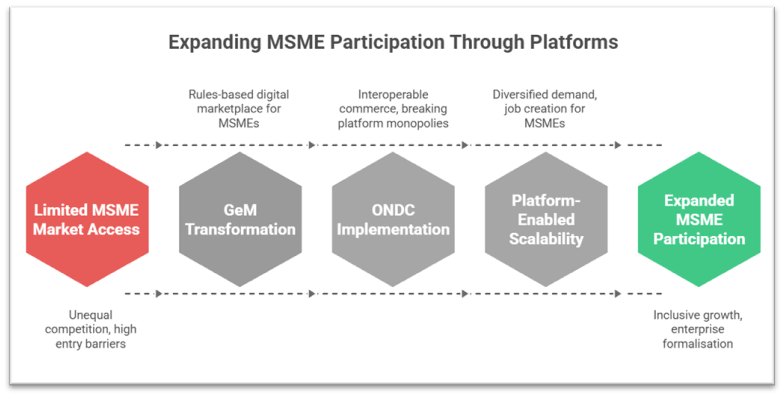
- GeM has transformed public procurement from a relationship-driven process to a rules-based digital marketplace, enabling micro and small enterprises to compete on equal footing.
- Case Study: District-level MSMEs securing government contracts through GeM demonstrate how digital platforms reduce entry barriers without requiring scale or political proximity.
- This directly supports inclusive growth objectives by converting state demand into a tool for enterprise formalisation.
ONDC and the restructuring of digital commerce power dynamics
- ONDC breaks platform monopolies by enabling interoperable commerce, allowing small sellers to reach consumers without surrendering margins or data control.
- Examples: kirana stores and small manufacturers integrating into digital commerce ecosystems while retaining autonomy, countering concentration trends seen in private e-commerce.
- The initiative complements schemes like Startup India and Digital India by embedding competition and openness into the digital economy’s architecture.
Employment generation and enterprise scalability
- Platform-enabled MSMEs scale faster by accessing diversified demand without proportionate increases in overheads, translating digital reach into job creation.
- Case Study: Government-recognised startups leveraging ONDC and GeM ecosystems demonstrate how DPI converts innovation into employment-intensive growth rather than speculative valuation.
- This supports India’s broader labour formalisation agenda, especially when aligned with recent labour code reforms.
3. Governance, Transparency, and Long-Term Structural Transformation
Trust-based governance and compliance simplification
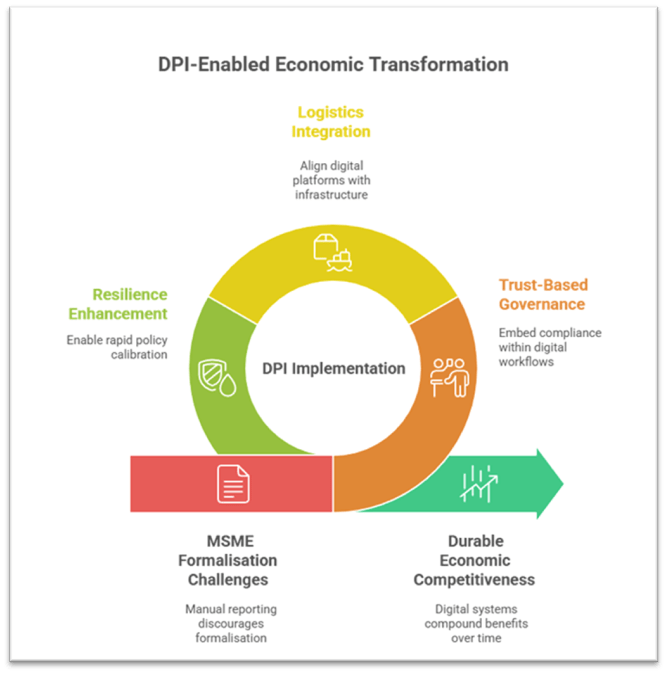
- DPI embeds compliance within digital workflows, reducing the burden of manual reporting and discretionary enforcement that historically discouraged MSME formalisation.
- This operationalises the broader reform agenda of decriminalisation and statute rationalisation, ensuring that legal reforms translate into lived ease for entrepreneurs.
- Government initiatives focused on compliance reduction find tangible expression through DPI-enabled governance.
Integration with logistics and infrastructure reforms
- Digital trade platforms become more effective when aligned with physical infrastructure modernisation, such as port reforms and logistics digitisation.
- Case Study: Export-oriented MSMEs benefit most where digital documentation is synchronised with improved port turnaround times and multimodal logistics planning.
- This convergence strengthens India’s competitiveness by addressing both cost and coordination failures in trade.
Resilience and adaptability of the economic system
- DPI enhances resilience by enabling rapid policy calibration, real-time monitoring, and decentralised participation during global disruptions.
- Unlike episodic reforms, digital systems compound benefits over time, making competitiveness durable rather than cyclical.
- This institutional depth distinguishes India’s reform trajectory from economies reliant on short-term stimulus or protectionism.
Conclusion:
- Digital Public Infrastructure has moved beyond being a technological add-on to become a core economic institution shaping India’s trade competitiveness and MSME integration. By lowering transaction costs, widening market access, and embedding transparency, platforms such as GeM, ONDC, and Trade Connect convert governance reform into everyday economic opportunity.
- As India aims to sustain high growth while expanding its share in global trade, the next phase lies in deeper integration of DPI with logistics, finance, and skilling ecosystems. With MSMEs contributing a substantial share to exports and employment, and digital adoption continuing to rise across districts, strengthening DPI interoperability and global alignment can help India move from scale-driven growth to productivity-led, inclusive competitiveness in the coming decade.
Recap: