Crop Diversification in India: Challenges, Opportunities & the Path to Nutritional Security
Crop diversification refers to the strategic shifting of agricultural land from dominance of a few cereal crops (particularly rice and wheat) toward a more diverse mix of pulses, oilseeds, horticulture, millets, and high-value crops. In India, this approach has gained urgency due to structural distortions: annual rice procurement exceeding 520–550 lakh tonnes against an offtake of 390–420 lakh tonnes, buffer stocks nearly 2–3 times the prescribed norms, and simultaneous import dependence of about 55 per cent in edible oils and sizable imports of pulses valued at over ₹30,000 crore annually. While assured procurement under MSP and PDS strengthened food security in the past, the resulting cereal-centric system today poses risks to nutritional security, environmental sustainability, and fiscal prudence. Thus, crop diversification presents both complex challenges and transformative opportunities for India’s agri-food system.
1. Structural And Systemic Challenges in Promoting Crop Diversification
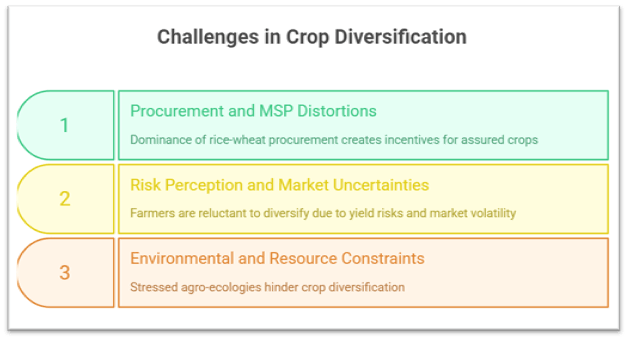
a) Procurement and MSP Distortions
- The dominance of rice-wheat procurement backed by MSP, particularly in States such as Punjab, Haryana, and parts of Tamil Nadu, creates strong incentives for farmers to continue cultivating assured crops. Wheat utilisation exceeding procurement in some years under PDS highlights systemic pressure, yet diversification remains unattractive without similar institutional support for pulses, oilseeds, or millets.
- Case Study: Punjab–Haryana Green Revolution belt shows how long-term assured procurement led to monocropping cycles, discouraging switches even when soil degradation and groundwater depletion intensified.
- Government Interventions: Schemes like PM-AASHA, Price Support Scheme (PSS) and Bhavantar Bharpai Yojana (Madhya Pradesh) attempt to ensure remunerative prices for non-cereals, but coverage remains limited and inconsistent.
b) Risk Perception and Market Uncertainties
- Farmers’ reluctance to diversify stems from yield risks, variable market prices, inadequate storage, and absence of reliable buyers, especially for perishable crops. This behavior is reinforced by past experiences where diversification attempts led to volatile returns, unlike cereals with predictable procurement.
- Case Study: Blackgram growers in Tamil Nadu and Maharashtra frequently face sharp price crashes due to import competition and lack of processing linkages.
- Government Interventions: e-NAM, Operation Greens, and Integrated Scheme for Agricultural Marketing (ISAM) aim to stabilize markets, but penetration and farmer awareness remain uneven.
c) Environmental and Resource Constraints
- Crop diversification is hindered by stressed agro-ecologies where soil health and water tables have already collapsed under continuous cereal cultivation. Adoption of alternative crops requires restoration of soil organic carbon, balanced fertilization, and micro-irrigation.
- Case Study: Central Ground Water Board assessments show critical-level groundwater exploitation in over-extracted blocks of Punjab and Haryana, reducing adaptability to pulses or oilseeds which require different agronomic conditions.
- Government Interventions: PMKSY–Per Drop More Crop, Soil Health Card Scheme, National Mission on Sustainable Agriculture (NMSA) support ecological restoration, but implementation gaps persist.
2. Operational And Governance Barriers in The Current Foodgrain System
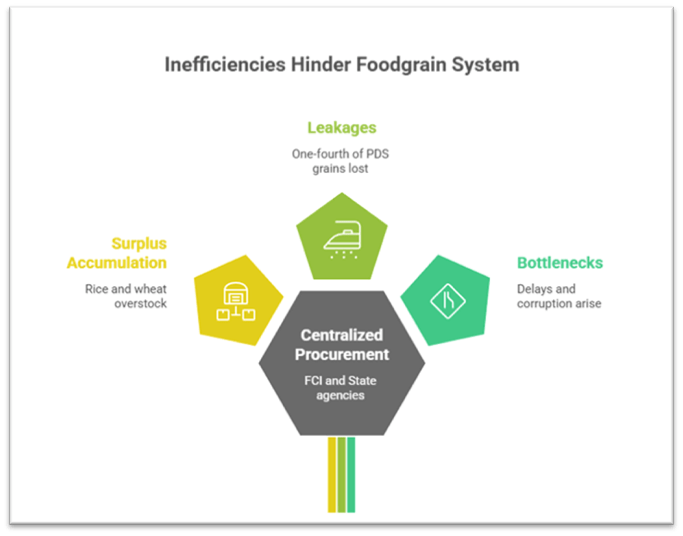
a) Inefficiencies in Procurement, Storage, and Distribution
- Over-centralised procurement through FCI and State agencies results in surplus accumulation of rice and wheat, with limited capacity to procure and store pulses and oilseeds scientifically. Reports highlight leakages up to one-fourth of PDS grains, indicating inefficient food movement.
- Case Study: Tamil Nadu’s recent kuruvai paddy procurement delays and corruption allegations underscore systemic bottlenecks that arise when cereal production overshoots expected coverage.
- Government Interventions: End-to-End Computerisation of PDS, One Nation One Ration Card, and Decentralised Procurement (DCP) attempt to improve efficiency.
b) Inadequate Institutional Support for Diversification
- Farmer Producer Organisations (FPOs), cooperatives, and local processing industries remain underdeveloped. With FPOs still nascent, aggregation, value addition, and assured supply chains for pulses and oilseeds are weak.
- Case Study: West Bengal using FPOs for paddy procurement demonstrates the potential of diversifying procurement channels if institutional capacity is strengthened.
- Government Interventions: 10000 FPO Scheme, Cooperative Sector reforms, and capacity-building programs aim to fill these gaps.
c) External Dependence and Policy Volatility
- Despite being the largest global producer of pulses, India remains import dependent due to fluctuating domestic output and policy decisions such as export bans or sudden tariff changes. Such volatility discourages long-term crop planning.
- Case Study: Edible oil import surge post-1990s liberalization altered domestic production incentives, with oilseed cultivation stagnating despite nearly constant acreage for decades.
- Government Interventions: National Food Security Mission (NFSM)–Pulses & Oilseeds, Oil Palm Mission, and Agriculture Infrastructure Fund target long-term capacity creation.
3. Opportunities For Nutritional Security and Agri-Economic Resilience Through Diversification
a) Addressing Malnutrition and Nutritional Security
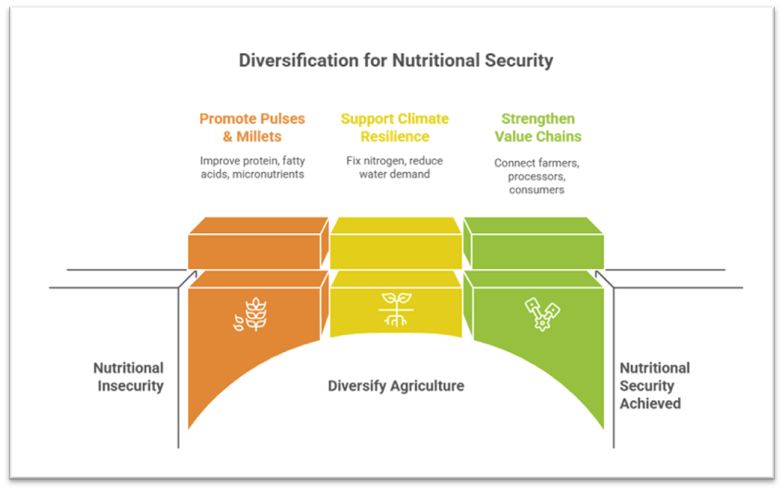
- Diversifying towards pulses, millets, oilseeds, fruits, vegetables can directly strengthen India’s nutritional profile by improving availability of proteins, essential fatty acids and micronutrients. Millets declared as 'Shree Anna' and global spotlight on the International Year of Millets has expanded domestic and export markets.
- Case Study: Karnataka’s millet mission demonstrated increased household consumption, PDS incorporation, and income diversification for farmers.
- Government Interventions: PM-POSHAN, ICDS, and National Millet Mission integrate diversification into nutrition programs.
b) Climate Resilience and Sustainable Agriculture
- Pulses and oilseeds contribute to soil nitrogen fixation, reduce water demand, and support crop rotation benefits, enhancing long-term productivity. Diversification also reduces dependence on high-input cereals and mitigates risks from climate variability.
- Case Study: Rajasthan’s bajra–legume rotation improved soil fertility and farm incomes in arid regions.
- Government Interventions: Climate Resilient Agriculture (CRA) initiatives, Paramparagat Krishi Vikas Yojana (PKVY), and Bharat Krishi Satellite Programme can support diversification with precision advisory.
c) Market and Value Chain Opportunities
- Domestic processing industries (dal mills, oil extraction units, nutraceuticals, ready-to-eat millet foods) offer high value addition and employment generation. Strengthened linkages between farmers, processors, and consumers can create stable demand beyond cereals.
- Case Study: Successful blackgram–papad industry linkages in Gujarat and Mahila Udyog Mandals illustrate how contract-based procurement can ensure stable markets for farmers.
- Government Interventions: PM-FME, ODOP under PM-Gati Shakti, and Agri Export Policy offer new opportunities for diversified crops.
Conclusion:
Promoting crop diversification is essential to address India’s structural cereal surplus, reduce fiscal burden, and ensure nutritional and ecological security. With cereal stocks often exceeding buffer norms by over double, while India still imports over half of its edible oil needs, the need for rebalancing is urgent.
A way forward includes stabilising MSP support for pulses and oilseeds, strengthening FPOs and decentralised value chains, enabling predictable trade policies, and integrating diversified crops into PDS, mid-day meals and institutional demand. Complementing these with investments in soil health restoration, micro-irrigation, and digital market linkages can create a sustainable, nutrition-sensitive agri-food system.
A coordinated effort involving farmers, experts, market actors, and government institutions can transform diversification from a policy aspiration into a nationwide agricultural renaissance.
Recap: