Contractualization in India’s Formal Manufacturing Sector: Implications for Labour Productivity and Worker Welfare
Introduction:
Contractualization refers to the increasing reliance on temporary or contract-based workers, often hired through third-party contractors, in place of permanent workers within the formal sector. In recent decades, India’s formal manufacturing sector has witnessed a significant surge in the use of contract labour. As per the Annual Survey of Industries (ASI), the share of contract labour doubled from 20% in 1999–2000 to 40.7% in 2022–23, cutting across all industrial segments.
This transformation, often termed informalisation within the formal sector, reflects a structural shift in labour-management practices. It aims at enhancing operational flexibility but raises critical concerns about worker exploitation, wage disparity, and long-term productivity losses. This analysis explores the dynamics, implications, and policy responses related to this shift in India’s manufacturing ecosystem.
Rising Contractualization in Formal Manufacturing: Trends and Causes
- Statistical Rise and Structural Trends
- Doubling of Contract Labour Share: According to ASI data, contract labour's share in manufacturing employment rose from 20% in 1999–2000 to 40.7% in 2022–23.
- Prevalence Across Industries: Labour-intensive (textiles, leather, food processing) and capital-intensive (automobile, cement).
- Labour Market Dualism: A core of regular workers and a large periphery of contract workers create inequity and inefficiency.
- Drivers Behind Contractualization
- Cost Avoidance Strategy: Contract workers earn 24% less and receive no statutory benefits.
- Regulatory Rigidities: The Industrial Disputes Act incentivizes temporary hiring.
- Global Competition: Cost-competitiveness forces manufacturers to hire flexibly.
Conclusion
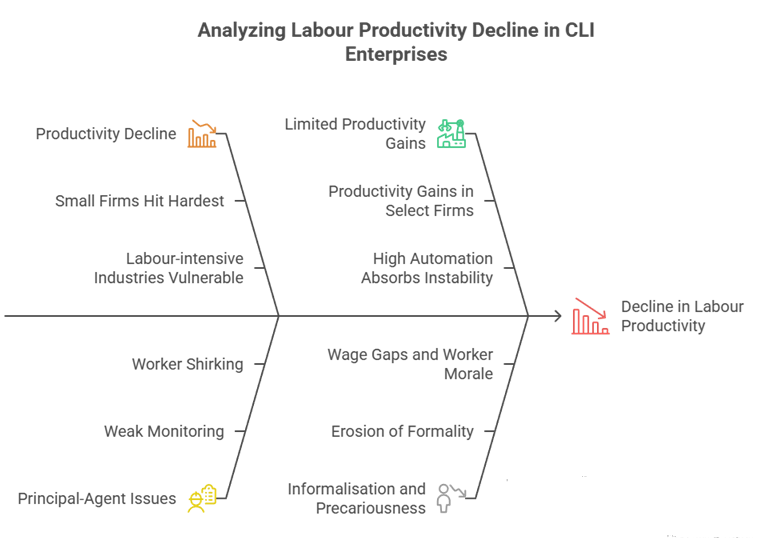
The shift towards contractualization in India’s formal manufacturing sector, while ostensibly a cost-saving and flexibility-enhancing mechanism, has proven to be a double-edged sword. While certain capital- and skill-intensive firms have extracted marginal gains, the broader ecosystem—comprising over 80% of enterprises—has seen stagnating productivity, deepening inequality, and weakening of worker welfare.
In sum, contractualization without adequate legal and social safeguards may provide short-term cost savings but undermines long-term goals of formalisation, productivity enhancement, and inclusive economic growth. A nuanced, well-regulated approach is essential to convert India’s manufacturing ambitions into a true demographic dividend.
Recap: