Continuing Mandamus and Environmental Governance in India: Judicial Activism vs Regulatory Capacity
Continuing mandamus environmental governance India has emerged as a defining feature of judicial intervention in recent decades, raising critical questions about the balance between constitutional oversight and the autonomy of specialized environmental regulators.
Introduction
Environmental governance in India operates within a complex constitutional and statutory framework where Articles 48A and 51A(g) impose duties on the State and citizens to protect the environment, while enforcement is primarily entrusted to specialized regulators such as the Ministry of Environment, Forest and Climate Change (MoEFCC), Central and State Pollution Control Boards (CPCB/SPCBs), and statutory appraisal committees.
Over the last decade, however, the Supreme Court has increasingly relied on “continuing mandamus”—a judicial technique involving ongoing supervision through interim orders, committees, and periodic compliance reports—to address persistent regulatory failures. This evolution has occurred against the backdrop of mounting environmental stress, reflected in India hosting over 20 of the world’s most polluted cities, declining forest and groundwater quality in several regions, and repeated findings by audit institutions that enforcement agencies suffer from staff shortages, weak monitoring capacity, and delayed decision-making.
While judicial intervention has often been justified as a response to executive inertia, its long-term implications for environmental governance and institutional capacity remain contested.
I. Continuing Mandamus as a Corrective Tool: Addressing Regulatory Failure
Filling governance vacuums during administrative breakdowns
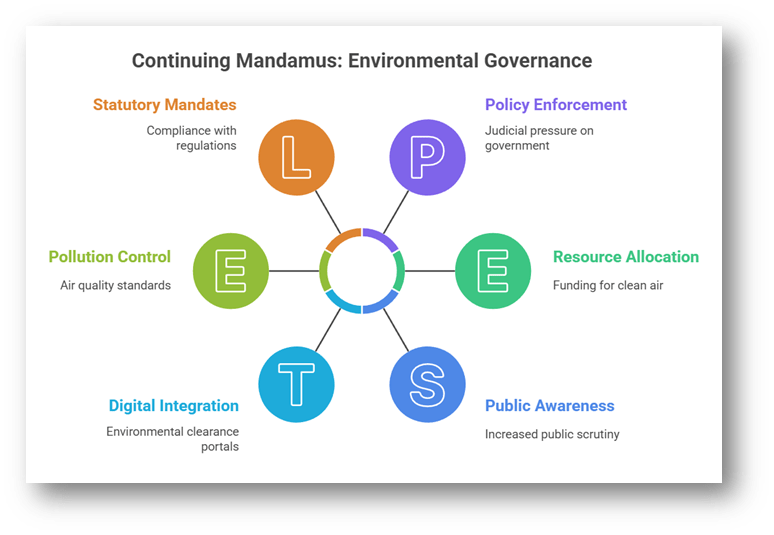
Continuing mandamus has enabled courts to step in where regulators failed to act despite clear statutory mandates, such as chronic non-enforcement of air quality standards in the National Capital Region. Judicial monitoring of pollution control measures in the NCR led to time-bound directions on fuel standards, industrial shutdowns, and vehicle regulation when agencies were unable to meet targets under national clean air commitments.
Government initiatives like the National Clean Air Programme (NCAP), which aims for substantial reductions in particulate pollution across non-attainment cities, gained momentum partly due to sustained judicial pressure that compelled coordination across ministries and States.
Accelerating environmental decision-making in urgent contexts
The judiciary’s proactive stance has often been driven by precautionary logic, especially where environmental harm was imminent or irreversible. Interim bans or restrictions on environmentally harmful activities, such as mining or construction in ecologically fragile zones, were justified to prevent irreversible degradation while regulatory processes lagged.
This approach aligns with India’s international commitments under global biodiversity and climate frameworks, reinforcing urgency in domestic implementation.
Enhancing visibility and accountability in environmental governance
Continuing mandamus has increased public scrutiny by placing environmental issues under sustained judicial oversight, compelling regulators to submit data, affidavits, and compliance reports.
This has indirectly strengthened transparency norms and forced regulators to articulate reasons for decisions, complementing broader governance reforms such as digital environmental clearance portals and public disclosure mechanisms.
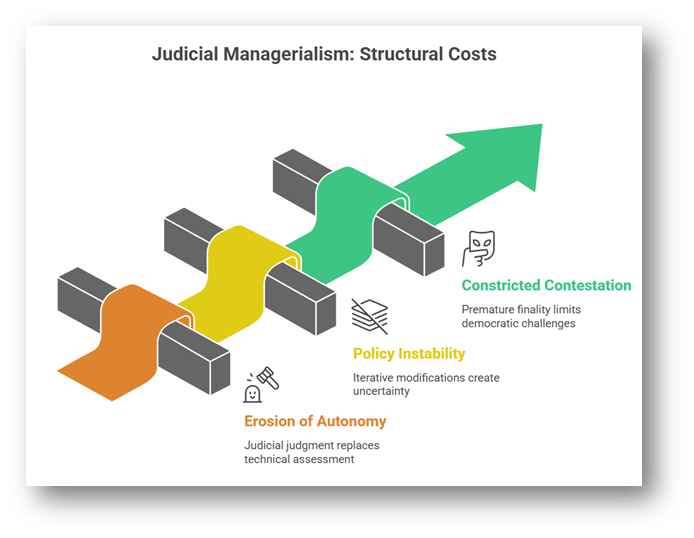
II. Structural Costs of Judicial Managerialism: Institutional and Legal Distortions
Erosion of regulatory autonomy and expertise-based decision-making
When courts issue forward-looking, quasi-regulatory directions—such as prescribing uniform buffers, blanket bans, or technology-specific standards—they risk substituting judicial judgment for technical assessment.
Uniform eco-sensitive prescriptions initially appeared decisive but later required dilution when ecological diversity and socio-economic feasibility across landscapes became apparent. This tendency can weaken regulators’ confidence and capacity, as agencies begin to anticipate judicial intervention rather than exercising independent statutory discretion.
Policy instability arising from iterative modifications
Continuing mandamus often operates through serial interim orders that are later modified, relaxed, or reversed in response to implementation challenges.
Shifts from broad prohibitions on certain vehicle categories to narrower compliance-based restrictions illustrate how rules evolve reactively, creating uncertainty for citizens, industry, and enforcement agencies. Such instability undermines long-term planning and discourages investment in cleaner technologies.
Constriction of democratic and legal contestation
Early judicial entry into approval or regulatory processes can confer premature finality on projects or policies, discouraging challenges before statutory authorities or specialized tribunals.
Project proponents increasingly seek judicial clearances or endorsements at initial stages, limiting the scope for public objections or scientific reassessment. This risks marginalizing participatory mechanisms embedded in environmental laws, including public hearings and expert appraisal processes.
III. Implications for Institutional Capacity of Specialized Regulators
Short-term compliance versus long-term capacity-building
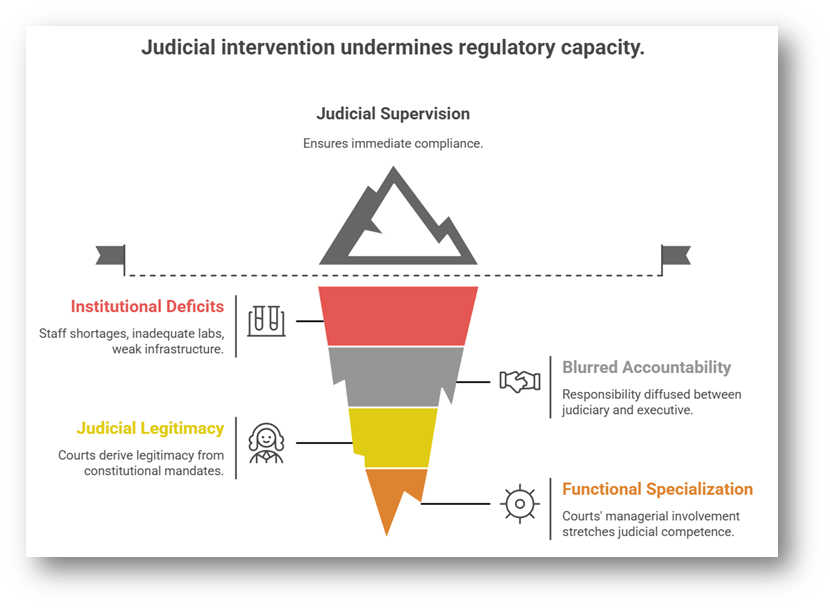
Judicial supervision may ensure immediate compliance but does little to address chronic institutional deficits such as staff shortages, inadequate laboratories, and weak enforcement infrastructure in pollution control bodies.
Capacity-building schemes risk being overshadowed by court-driven micro-management rather than systemic reform.
Blurred accountability between judiciary and executive
Continuing mandamus can diffuse responsibility, allowing regulators to attribute inaction or rigid compliance to judicial directions rather than statutory judgment.
When courts modify earlier environmental positions citing economic disruption or feasibility concerns, accountability for outcomes becomes unclear, complicating parliamentary and public oversight.
Judicial legitimacy versus functional specialization
While courts derive legitimacy from constitutional mandates to protect fundamental rights, sustained managerial involvement in environmental regulation stretches judicial competence.
Repeated committee reconstitutions and policy reversals reveal the limits of adjudicatory institutions in governing complex environmental systems.
Conclusion:
Continuing mandamus has undeniably played a critical role in preventing environmental backsliding during periods of regulatory inertia, reinforcing constitutional environmentalism and compelling action in high-risk contexts.
However, its prolonged and expansive use risks weakening regulatory institutions, generating policy uncertainty, and constraining democratic contestation.
A recalibrated approach—where courts discipline regulators back into effective governance rather than substituting for them—combined with strengthened institutional capacity, offers the most sustainable path for India’s environmental governance.
Recap: