Conditional MSP Procurement and Price Stabilisation Measures in Ensuring Long-Term Food and Nutritional Security in India
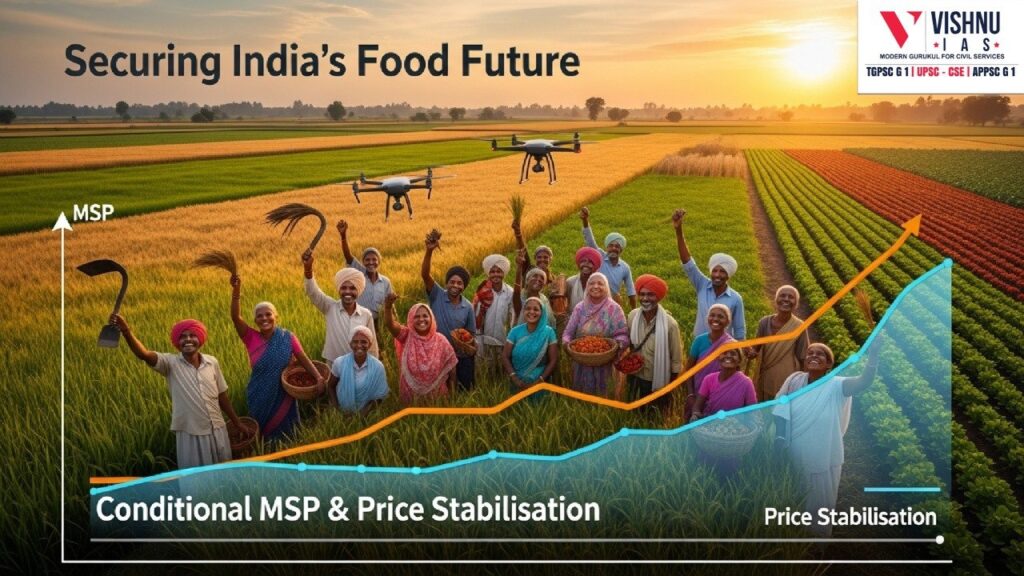
Conditional MSP procurement and price stabilisation measures play a crucial role in ensuring food and nutritional security in India. Their effectiveness must be assessed in terms of production incentives, farmer welfare, price stability, and nutritional outcomes.
Introduction
- Food and nutritional security implies assured physical, economic and social access to adequate, safe and nutritious food to meet dietary needs for an active and healthy life. In India, pulses occupy a central place in this framework as they account for nearly one-fourth of the country’s non-cereal protein intake, support around five crore farmers and their families, and contribute to soil fertility through biological nitrogen fixation.
- Yet domestic production has hovered around 2.5 crore tonnes against an estimated demand of about 3 crore tonnes in recent years, leading to recurring import dependence. To bridge this gap, the government relies on a mix of conditional Minimum Support Price (MSP) procurement, Price Stabilisation measures, and calibrated import policy.
- The long-term effectiveness of these instruments must be assessed in terms of production incentives, farmer welfare, price stability, and nutritional outcomes.
I. Effectiveness in Supporting Production and Farmer Incentives
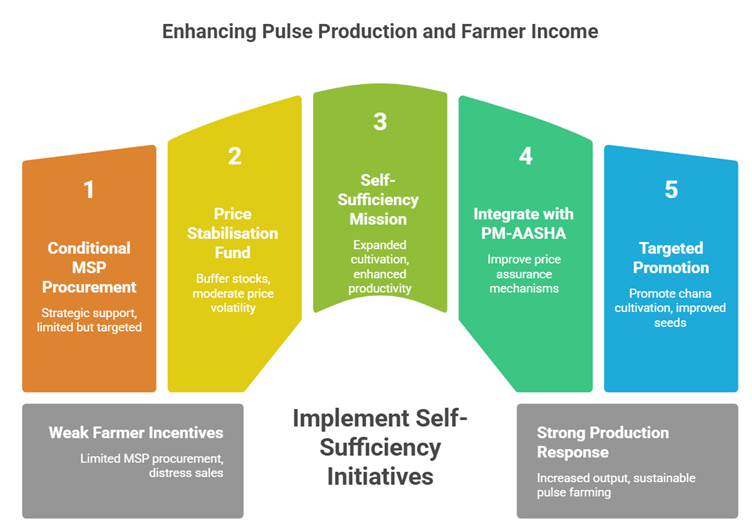
1. Conditional MSP Procurement: Limited but Strategic Support
- Under the Price Support Scheme (PSS) operated by agencies such as NAFED (National Agricultural Cooperative Marketing Federation of India Ltd.), procurement of pulses has fluctuated between roughly 3% and 12% of total output in recent years, unlike rice and wheat where procurement is open-ended; this conditionality reduces fiscal burden but weakens income certainty for pulse growers.
- The absence of a legally assured procurement mechanism compels farmers in many States to sell below MSP to private traders due to inadequate procurement centres, thereby discouraging investment in high-quality seeds and irrigation.
- Example – Tur procurement in Maharashtra: During bumper harvests, procurement delays and quantitative caps led to distress sales despite MSP announcements, revealing structural gaps in procurement logistics.
2. Price Stabilisation Fund and Buffer Stocks: Moderating Volatility
- The Price Stabilisation Fund (PSF) has enabled the creation of buffer stocks of pulses, which are released during supply shocks to cool retail inflation, thereby protecting consumers from sudden price spikes.
- Government agencies have intervened through calibrated imports and stock limits under the Essential Commodities Act, helping to prevent extreme volatility during drought years.
- Case Study – 2015–16 Pulse Inflation Episode: After sharp increases in tur and urad prices due to crop failure, buffer stock creation and subsequent imports helped moderate retail prices, though farmers’ gains were short-lived.
3. Recent Self-Sufficiency Initiatives: Long-Term Orientation
- The launch of a self-sufficiency mission in 2025 with an outlay exceeding ₹11,000 crore targeting expanded cultivation and enhanced productivity signals recognition that procurement alone cannot ensure sustainability.
- Integration with schemes such as PM-AASHA (Pradhan Mantri Annadata Aay SanraksHan Abhiyan) aims to improve price assurance mechanisms, though operational challenges remain.
- Example – Madhya Pradesh’s pulse expansion drive: Targeted promotion of chana cultivation with improved seed varieties increased productivity, demonstrating that technology and extension services can complement price policy.
- Evaluation: Conditional MSP provides partial protection but does not generate the strong production response seen in cereals; without robust infrastructure, its long-term impact on output expansion remains constrained.
II. Role in Ensuring Consumer Welfare and Nutritional Security
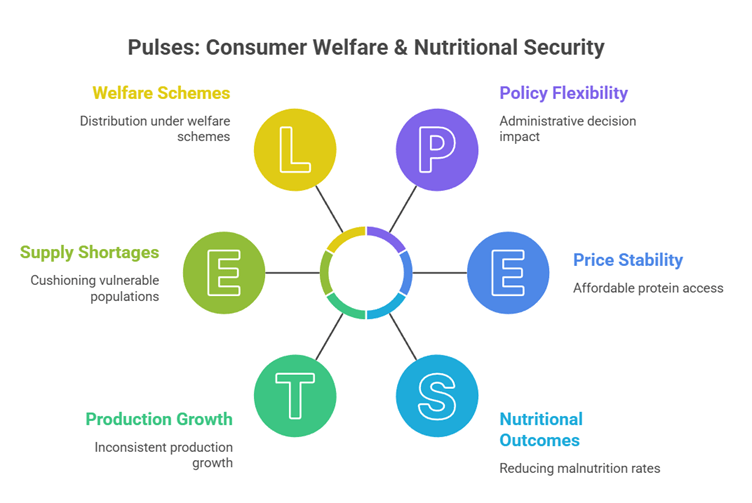
1. Stabilising Retail Prices for Protein Security
- Pulses are critical for affordable protein in predominantly vegetarian diets; price spikes directly reduce protein intake among low-income households.
- Buffer stock releases and temporary duty reductions on imports help moderate consumer prices, contributing to household food security during supply shortages.
- Example – Distribution under welfare schemes: Pulses have been periodically distributed at subsidised rates through the Public Distribution System in selected States, cushioning vulnerable populations during high-price phases.
2. Balancing Imports with Domestic Interests
- Imports from countries such as Canada, Australia, and the United States have filled the demand-supply gap; a single policy decision can quickly augment supply and reduce prices, highlighting administrative flexibility.
- However, large-scale imports during harvest seasons risk depressing farm-gate prices, creating a conflict between consumer affordability and producer incentives.
- Case Study – Import liberalisation of tur in 2016–17: While retail inflation eased, farmers reported price crashes below MSP, illustrating the political sensitivity of trade policy in agricultural commodities.
3. Nutritional Outcomes and Dietary Diversification
- Ensuring stable pulse availability supports national goals related to reducing protein-energy malnutrition and anaemia, especially among women and children.
- Programmes such as Mid-Day Meal Scheme (PM POSHAN) and Integrated Child Development Services (ICDS) incorporate pulses in menus, linking price stability to nutritional outcomes.
- Despite these measures, per capita pulse consumption remains below recommended dietary levels in many regions, suggesting that price stabilisation alone cannot guarantee nutritional adequacy.
- Evaluation: Price stabilisation measures have been relatively effective in preventing extreme consumer distress, but inconsistent production growth and market distortions limit sustained improvements in nutritional security.
III. Structural Constraints and Long-Term Sustainability
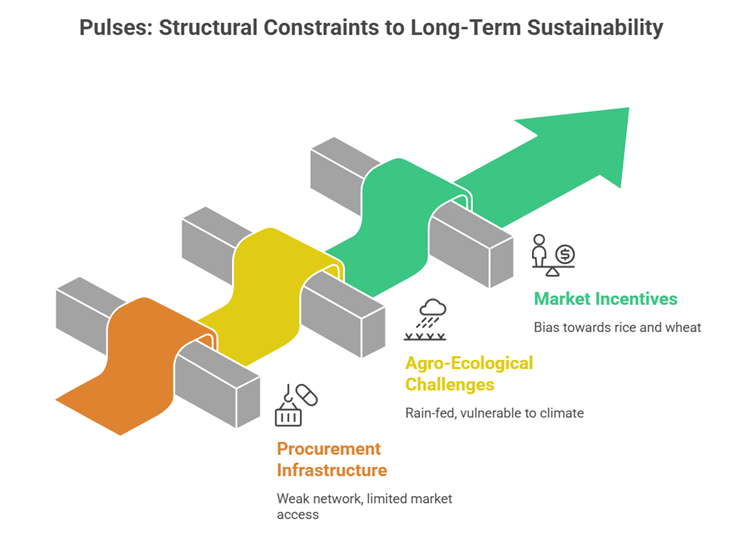
1. Weak Procurement Infrastructure and Institutional Gaps
- Unlike cereals, pulses lack a dense network of procurement centres; many rain-fed regions have limited market access, undermining the credibility of MSP announcements.
- Conditional procurement tied to market arrivals rather than universal purchase creates uncertainty, affecting cropping decisions.
- Example – Procurement disparity across States: States with stronger cooperative networks have higher procurement shares, while others see negligible government presence.
2. Agro-Ecological and Productivity Challenges
- Pulses are largely cultivated in rain-fed areas, making them vulnerable to climatic variability; yields remain lower than international competitors due to limited irrigation and research intensity.
- Investment in high-yielding and climate-resilient varieties under institutions such as the Indian Council of Agricultural Research (ICAR) has shown potential but requires scaling.
- Case Study – Adoption of improved tur varieties in Karnataka: Demonstrated yield gains when supported by extension and assured marketing channels.
3. Market Incentives and Crop Diversification Dynamics
- Farmers often shift acreage toward crops with assured procurement and lower risk, such as rice and wheat, creating a structural bias against pulses.
- Conditional MSP without enforceable guarantees leads to underinvestment, perpetuating a vicious cycle of low productivity and import dependence.
- The broader objective of crop diversification—essential for water conservation and soil health—requires explicit market rewards and stable price signals.
- Evaluation: Without strengthening procurement infrastructure, enhancing productivity, and creating stable market ecosystems, conditional MSP and price stabilisation remain reactive rather than transformative tools.
Conclusion:
- Conditional MSP procurement and price stabilisation measures have played a meaningful but limited role in moderating price volatility and providing episodic income support. They have prevented extreme consumer hardship and contributed to short-term food security.
- However, with domestic demand exceeding supply by several lakh tonnes annually and procurement covering only a modest share of production, these instruments alone are insufficient to ensure long-term nutritional and production sustainability.
- Achieving the targeted expansion to 350 lakh tonnes by 2030–31 will require structural reforms: strengthening procurement infrastructure in rain-fed regions, ensuring credible and transparent MSP operations, scaling climate-resilient technologies, and aligning trade policy with domestic production cycles.
- A balanced framework that simultaneously secures farmer incomes and consumer nutrition can gradually reduce import dependence, enhance protein availability, and reinforce India’s broader food security architecture in a sustainable manner.
- Conditional MSP procurement and price stabilisation measures have played a meaningful but limited role in moderating price volatility and providing episodic income support. They have prevented extreme consumer hardship and contributed to short-term food security.
- However, with domestic demand exceeding supply by several lakh tonnes annually and procurement covering only a modest share of production, these instruments alone are insufficient to ensure long-term nutritional and production sustainability.
- Achieving the targeted expansion to 350 lakh tonnes by 2030–31 will require structural reforms: strengthening procurement infrastructure in rain-fed regions, ensuring credible and transparent MSP operations, scaling climate-resilient technologies, and aligning trade policy with domestic production cycles.
- A balanced framework that simultaneously secures farmer incomes and consumer nutrition can gradually reduce import dependence, enhance protein availability, and reinforce India’s broader food security architecture in a sustainable manner.
Recap: