Colombo Security Conclave: India’s Strategic Challenge Amid Growing Chinese Presence in the Indian Ocean
Introduction
-
The Colombo Security Conclave (CSC) has emerged as a crucial sub-regional security framework in the Indian Ocean Region (IOR), focusing on maritime security, counter-terrorism, cybersecurity, and transnational crime. The strategic relevance of the CSC is amplified by the Indian Ocean’s centrality in global trade, with over 80 percent of global seaborne oil trade and close to 40 percent of India’s trade passing through these waters.
-
As geopolitical competition intensifies in the Indo-Pacific, China’s expanding military-logistical footprint in the IOR—through dual-use ports, strategic partnerships, and the PLA Navy’s increasing deployments—has become a significant concern for India.
-
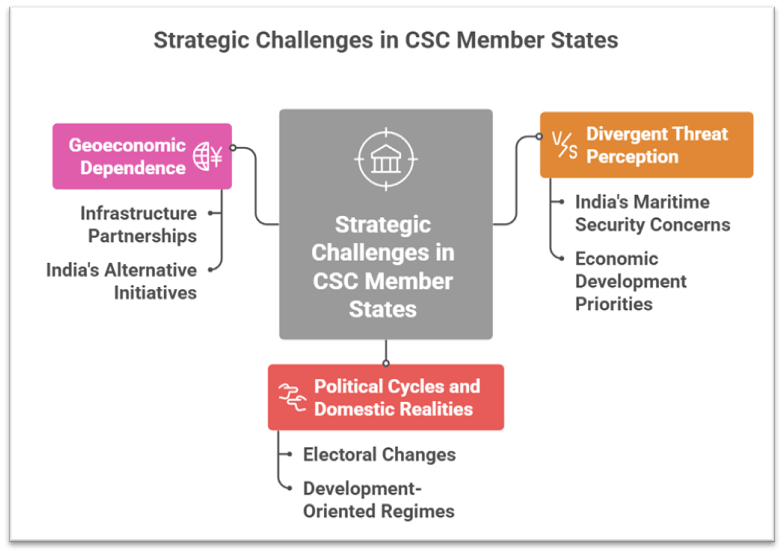
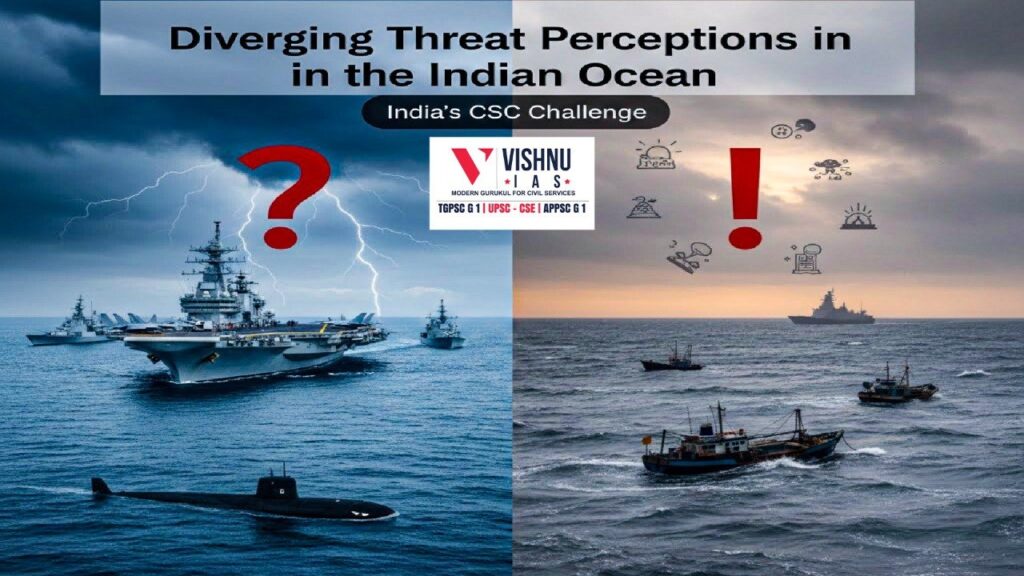
However, the CSC faces a key strategic challenge: divergent threat perceptions among member states regarding China, shaped by their developmental dependencies, domestic politics, and regional priorities. This divergence has direct implications for CSC’s cohesion and India’s strategic interests.
Body
Structural Nature of The Strategic Challenge
1. Divergent Threat Perception between India and Other CSC Members
-
India views China as a structural maritime-security challenge due to the expansion of PLA Navy’s bases and access points (for example, the Djibouti base and Hambantota port’s long-term lease). In contrast, countries like Sri Lanka, Maldives, and Mauritius often prioritise economic development over strategic risk, relying heavily on Chinese infrastructure investments.
-
Example: Sri Lanka’s Hambantota Port case demonstrates how economic reliance translates into strategic ambiguity. While India sees it as a dual-use asset for Chinese naval access, Sri Lanka frames it as an economic concession.
-
Government initiatives like SAGAR (Security and Growth for All in the Region) attempt to offer an alternative development-security framework, but the absorption capacity of smaller island economies remains limited.
2. Political Cycles and Domestic Realities of CSC States
-
Electoral changes in Sri Lanka and Maldives repeatedly shift foreign policy alignments. Frequent alternation between pro-India and pro-China leadership creates instability in long-term security alignment.
-
Example: Maldives’ oscillation between the ‘India First’ and ‘India Out’ campaigns has directly affected maritime cooperation, access to EEZ surveillance, and trilateral naval exercises.
-
Development-oriented regimes often see Chinese financing through BRI as essential for domestic legitimacy, decreasing inclination to confront China geopolitically.
3. Geoeconomic Dependence Dilutes Strategic Alignment
-
Many CSC members rely on China for large-scale infrastructure, FDI, debt-relief packages, and concessional loans, creating a structural imbalance in strategic autonomy.
-
Case study: Bangladesh’s infrastructure partnerships with China (Padma rail link, Karnaphuli tunnels) show that economic leverage shapes security posture.
-
India’s alternative initiatives like Lines of Credit, Coastal Surveillance Radar Systems (CSRS), and Neighbourhood First policy are expanding but still face resource constraints compared to China’s financial muscle.
Implications For the Functioning of the CSC
1. Limited Convergence on Maritime Security Priorities
-
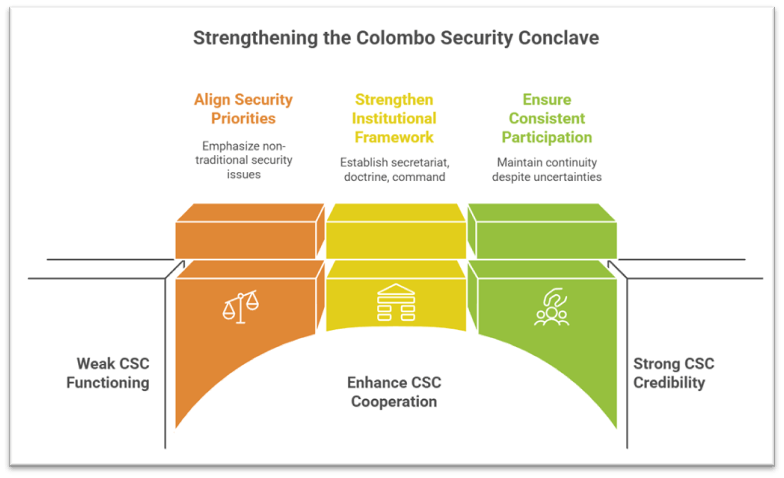
While India emphasises military-security risks, smaller states focus more on non-traditional security issues like illegal fishing, climate-induced coastal vulnerabilities, drug trafficking, and economic resilience.
-
Example: Mauritius’ emphasis on maritime ecological protection underlines how environmental and economic concerns often outweigh hard-security threat perception.
-
This mismatch makes it difficult to generate consensus on maritime domain awareness (MDA) or coordinated responses to PLA naval activities.
2. Fragmentation of Institutional Framework within CSC
-
The CSC operates at the NSA-level mechanism, lacking a permanent secretariat, unified doctrine, or joint operational command. Divergent threat assessments limit the evolution of deeper institutional formats like joint forces or binding protocols.
-
Case Study: The trilateral format (India–Sri Lanka–Maldives) stagnated for nearly a decade due to political turnover and lack of agreement on China’s role, delaying the formation of stable committees and rapid-response mechanisms.
-
India’s attempts to strengthen institutionalisation through regular MDA workshops, coastal security training, and cybersecurity cells have helped, but political reluctance of partners prevents deeper integration.
3. Inconsistent Participation Risks Reducing CSC’s Strategic Credibility
-
Domestic uncertainties (in Bangladesh or Maldives) can derail continuity, undermining India’s objective of using CSC as a core Indo-Pacific subregional security pillar.
-
Example: Bangladesh’s shifting attentiveness to security cooperation during internal political transitions directly influences the CSC’s momentum, affecting joint patrols or data-sharing agreements.
-
Without uniform participation, the CSC risks remaining a soft-cooperation platform, hindering India’s ability to counterbalance China’s strategic footprint.
India’s Strategic Challenge and Policy Responses
1. Balancing Developmental Needs of Partners with Security Imperatives
-
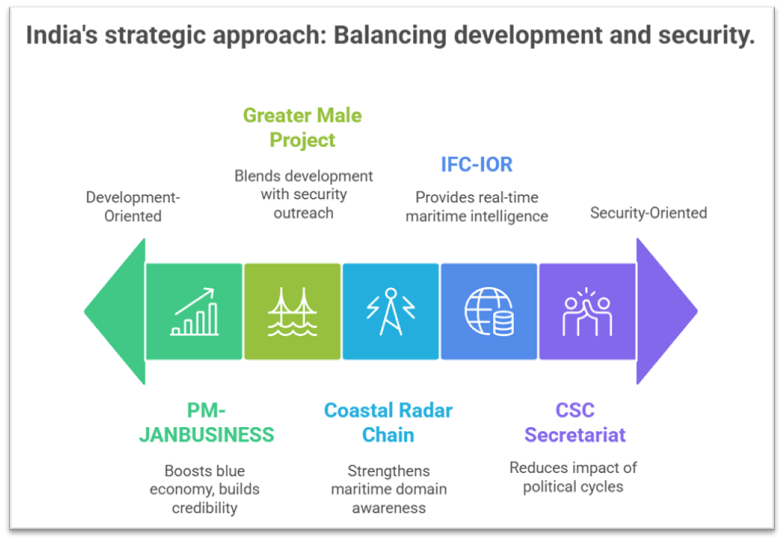
India must recognise that CSC states prioritise economic survival and infrastructure development, areas where China provides rapid financing. Therefore, India needs a dual-track strategy integrating economic assistance with security cooperation.
-
Example: India’s grant-based projects in Maldives (Greater Male Connectivity Project) and Sri Lanka’s emergency financial assistance demonstrate the importance of blending development with security outreach.
-
Expanding initiatives like PM-JANBUSINESS (Blue Economy push), Integrated Coastal Zone Management Projects, and capacity building under IORA can strengthen India’s developmental credibility.
2. Enhancing Maritime Capacity-Building and Technology Sharing
-
India has already supplied offshore patrol vessels, Dornier aircraft, CSRS networks, and training to many CSC members, but needs to scale up.
-
Case Study: The Coastal Surveillance Radar Chain installed across Mauritius, Seychelles, and Sri Lanka has strengthened maritime domain awareness but requires deeper integration and shared data.
-
Initiatives like Information Fusion Centre–Indian Ocean Region (IFC-IOR) provide real-time maritime intelligence, but member states must be encouraged to commit fully to data sharing despite political sensitivities.
3. Building Trust through Institutionalisation and Multilateral Diplomacy
-
Regularising ministerial-level meetings, creating a CSC Secretariat, and establishing issue-specific working groups will reduce the impact of political cycles.
-
India can promote multilateral naval exercises, joint statements on freedom of navigation, and coordinated responses to grey-zone tactics.
-
Example: The 2025 expansion of CSC to include Seychelles signals potential for broader regional alignment if institutional mechanisms are strengthened.
Conclusion
-
India’s primary strategic challenge within the CSC arises from the misalignment of threat perception regarding China, rooted in the developmental dependencies and domestic political realities of member states. While India sees China’s maritime expansion as a structural threat, most CSC members view it through an economic lens, creating a divergence that complicates deeper security cooperation. Yet, the CSC has demonstrated consistent evolution and expansion, indicating its value as a cooperative framework in a fragmented maritime region.
-
A constructive way forward lies in aligning developmental assistance with security cooperation, strengthening MDA networks, institutionalising the CSC structure, and enhancing trust-building measures. With over 40 percent of the world’s population dependent on the Indian Ocean economy, the need for a coherent and resilient maritime security architecture is pressing.
Structural Nature of The Strategic Challenge
1. Divergent Threat Perception between India and Other CSC Members
- India views China as a structural maritime-security challenge due to the expansion of PLA Navy’s bases and access points (for example, the Djibouti base and Hambantota port’s long-term lease). In contrast, countries like Sri Lanka, Maldives, and Mauritius often prioritise economic development over strategic risk, relying heavily on Chinese infrastructure investments.
- Example: Sri Lanka’s Hambantota Port case demonstrates how economic reliance translates into strategic ambiguity. While India sees it as a dual-use asset for Chinese naval access, Sri Lanka frames it as an economic concession.
- Government initiatives like SAGAR (Security and Growth for All in the Region) attempt to offer an alternative development-security framework, but the absorption capacity of smaller island economies remains limited.
2. Political Cycles and Domestic Realities of CSC States
- Electoral changes in Sri Lanka and Maldives repeatedly shift foreign policy alignments. Frequent alternation between pro-India and pro-China leadership creates instability in long-term security alignment.
- Example: Maldives’ oscillation between the ‘India First’ and ‘India Out’ campaigns has directly affected maritime cooperation, access to EEZ surveillance, and trilateral naval exercises.
- Development-oriented regimes often see Chinese financing through BRI as essential for domestic legitimacy, decreasing inclination to confront China geopolitically.
3. Geoeconomic Dependence Dilutes Strategic Alignment
- Many CSC members rely on China for large-scale infrastructure, FDI, debt-relief packages, and concessional loans, creating a structural imbalance in strategic autonomy.
- Case study: Bangladesh’s infrastructure partnerships with China (Padma rail link, Karnaphuli tunnels) show that economic leverage shapes security posture.
- India’s alternative initiatives like Lines of Credit, Coastal Surveillance Radar Systems (CSRS), and Neighbourhood First policy are expanding but still face resource constraints compared to China’s financial muscle.
Implications For the Functioning of the CSC
1. Limited Convergence on Maritime Security Priorities
- While India emphasises military-security risks, smaller states focus more on non-traditional security issues like illegal fishing, climate-induced coastal vulnerabilities, drug trafficking, and economic resilience.
- Example: Mauritius’ emphasis on maritime ecological protection underlines how environmental and economic concerns often outweigh hard-security threat perception.
- This mismatch makes it difficult to generate consensus on maritime domain awareness (MDA) or coordinated responses to PLA naval activities.
2. Fragmentation of Institutional Framework within CSC
- The CSC operates at the NSA-level mechanism, lacking a permanent secretariat, unified doctrine, or joint operational command. Divergent threat assessments limit the evolution of deeper institutional formats like joint forces or binding protocols.
- Case Study: The trilateral format (India–Sri Lanka–Maldives) stagnated for nearly a decade due to political turnover and lack of agreement on China’s role, delaying the formation of stable committees and rapid-response mechanisms.
- India’s attempts to strengthen institutionalisation through regular MDA workshops, coastal security training, and cybersecurity cells have helped, but political reluctance of partners prevents deeper integration.
3. Inconsistent Participation Risks Reducing CSC’s Strategic Credibility
- Domestic uncertainties (in Bangladesh or Maldives) can derail continuity, undermining India’s objective of using CSC as a core Indo-Pacific subregional security pillar.
- Example: Bangladesh’s shifting attentiveness to security cooperation during internal political transitions directly influences the CSC’s momentum, affecting joint patrols or data-sharing agreements.
- Without uniform participation, the CSC risks remaining a soft-cooperation platform, hindering India’s ability to counterbalance China’s strategic footprint.
India’s Strategic Challenge and Policy Responses
1. Balancing Developmental Needs of Partners with Security Imperatives
- India must recognise that CSC states prioritise economic survival and infrastructure development, areas where China provides rapid financing. Therefore, India needs a dual-track strategy integrating economic assistance with security cooperation.
- Example: India’s grant-based projects in Maldives (Greater Male Connectivity Project) and Sri Lanka’s emergency financial assistance demonstrate the importance of blending development with security outreach.
- Expanding initiatives like PM-JANBUSINESS (Blue Economy push), Integrated Coastal Zone Management Projects, and capacity building under IORA can strengthen India’s developmental credibility.
2. Enhancing Maritime Capacity-Building and Technology Sharing
- India has already supplied offshore patrol vessels, Dornier aircraft, CSRS networks, and training to many CSC members, but needs to scale up.
- Case Study: The Coastal Surveillance Radar Chain installed across Mauritius, Seychelles, and Sri Lanka has strengthened maritime domain awareness but requires deeper integration and shared data.
- Initiatives like Information Fusion Centre–Indian Ocean Region (IFC-IOR) provide real-time maritime intelligence, but member states must be encouraged to commit fully to data sharing despite political sensitivities.
3. Building Trust through Institutionalisation and Multilateral Diplomacy
- Regularising ministerial-level meetings, creating a CSC Secretariat, and establishing issue-specific working groups will reduce the impact of political cycles.
- India can promote multilateral naval exercises, joint statements on freedom of navigation, and coordinated responses to grey-zone tactics.
- Example: The 2025 expansion of CSC to include Seychelles signals potential for broader regional alignment if institutional mechanisms are strengthened.
Conclusion
- India’s primary strategic challenge within the CSC arises from the misalignment of threat perception regarding China, rooted in the developmental dependencies and domestic political realities of member states. While India sees China’s maritime expansion as a structural threat, most CSC members view it through an economic lens, creating a divergence that complicates deeper security cooperation. Yet, the CSC has demonstrated consistent evolution and expansion, indicating its value as a cooperative framework in a fragmented maritime region.
- A constructive way forward lies in aligning developmental assistance with security cooperation, strengthening MDA networks, institutionalising the CSC structure, and enhancing trust-building measures. With over 40 percent of the world’s population dependent on the Indian Ocean economy, the need for a coherent and resilient maritime security architecture is pressing.
Recap: