Blogs

Find the best resources and blogs written by our fine content writers. You can find this useful to crack UPSC. We had fabricated our blog part in a way which is comprehensive and elaborate.

Explore India’s urban flood management strategies, their adequacy against evolving rainfall patterns, and climate change impacts. Learn how cities can strengthen resilience, update drainage systems, and adopt climate-resilient urban planning to reduce flood risks.

Urban Flood Management in India: Evaluating Strategies Amid Climate Change

Urban Flood Management India: Evaluating Strategies Amid Climate Change Introduction: Urban Flood Management in India faces increasing challenges due to evolving rainfall patterns and climate change. Urban floods occur when intense or prolonged rainfall overwhelms drainage capacity, leading to waterlogging, disruption of essential services, and loss of lives and property. Floods have been the most […]

Urban Flood Management in India: Evaluating Strategies Amid Climate Change Read More »
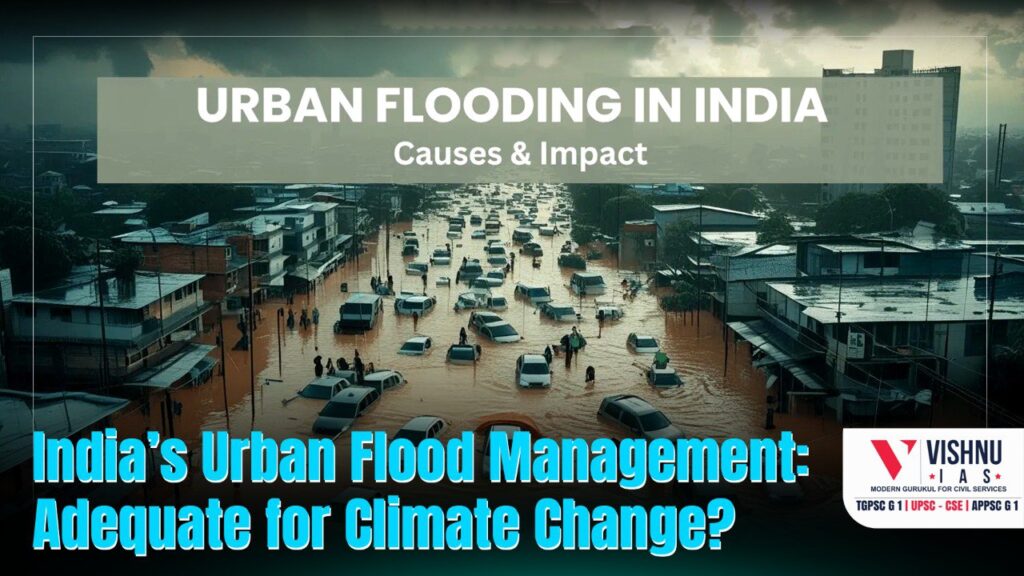
Explore the adequacy of urban flood management in India in the face of evolving rainfall patterns and climate change. Learn about current strategies, challenges, and future solutions.

Urban Flood Management in India: Are Current Strategies Enough for Climate Change?

Introduction Urban floods occur when intense or prolonged rainfall overwhelms drainage capacity, leading to waterlogging, disruption of essential services, and loss of lives and property. Floods have been the most damaging natural disaster in India in the past two decades, accounting for maximum economic losses and casualties among disasters. A single flood event today can

Urban Flood Management in India: Are Current Strategies Enough for Climate Change? Read More »

The latest GST reforms 2025 simplify tax slabs, resolve the inverted duty structure, reduce litigation, and ease compliance. Discover how these changes strengthen India’s manufacturing and export competitiveness.

GST Reforms 2025: Addressing Inverted Duty Structure & Boosting Manufacturing Competitiveness

Introduction The recent GST reforms approved by the 56th GST Council on 3 September 2025 mark a watershed moment in India’s indirect tax architecture. At its core is the principle of simplifying and rationalising rates and reducing compliance burdens while correcting structural distortions. Under the new regime, the erstwhile four-rate structure (5 %, 12 %,

GST Reforms 2025: Addressing Inverted Duty Structure & Boosting Manufacturing Competitiveness Read More »

Explore the role of Primary Healthcare Centres in rural India and how caregiver burnout affects healthcare outcomes. Learn about challenges, reforms, and strategies for strengthening rural health systems.

Primary Healthcare Centres in Rural India: Addressing Caregiver Burnout for Better Outcomes

Primary Healthcare Centres in Rural India & the Impact of Caregiver Burnout on Healthcare Outcomes Introduction Primary Healthcare Centres (PHCs) in rural India form the first formal point of contact between rural populations and the public health system. Established under the Bhore Committee vision (1946), PHCs are designed to provide comprehensive, preventive, promotive, and curative

Primary Healthcare Centres in Rural India: Addressing Caregiver Burnout for Better Outcomes Read More »

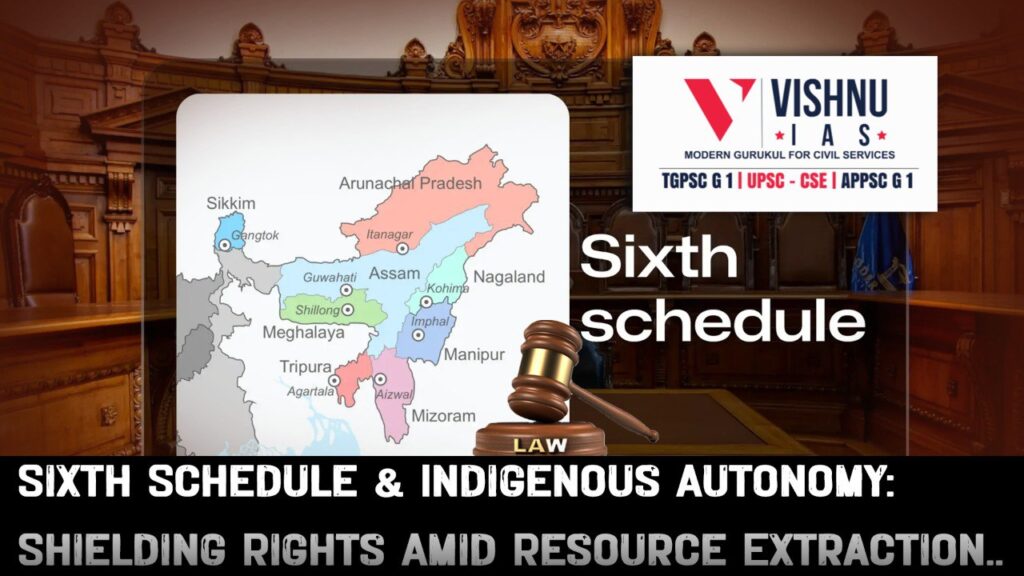
Discover how the Sixth Schedule protects indigenous autonomy and tribal rights in Northeast India while facing challenges from centrally-driven resource extraction projects like mining and energy exploration.

Sixth Schedule and Indigenous Autonomy: Safeguarding Tribal Rights from Resource Extraction Projects

Sixth Schedule and Indigenous Autonomy: Safeguarding Tribal Rights from Resource Extraction Projects The Sixth Schedule of the Indian Constitution plays a crucial role in safeguarding indigenous autonomy and tribal rights in Northeast India. Designed to empower Autonomous District Councils (ADCs), it provides legislative, judicial, and financial powers over land, forests, and local customs. However, in

Sixth Schedule and Indigenous Autonomy: Safeguarding Tribal Rights from Resource Extraction Projects Read More »

Evaluate the effectiveness of India’s food subsidy regime and learn how restructuring the PDS with a diversified food basket can address hidden hunger, improve nutrition, and ensure inclusive food security.

India’s Food Subsidy Regime: Effectiveness and the Need for PDS Restructuring

Evaluating India’s Food Subsidy Regime: Restructuring PDS for Nutrition & Inclusive Food Security Introduction India’s food subsidy regime is one of the largest social welfare interventions in the world, primarily delivered through the Public Distribution System (PDS) and backed by schemes such as the National Food Security Act (NFSA), 2013. Currently, about 800 million beneficiaries

India’s Food Subsidy Regime: Effectiveness and the Need for PDS Restructuring Read More »

Explore the role and powers of the Governor under Article 200 of the Indian Constitution, the challenges of legislative deadlock, and whether judicial intervention is a valid solution to ensure federal balance.

Role and Powers of Governor under Article 200 | Judicial Intervention in Legislative Deadlock

Elucidate the Role and Powers of the Governor under Article 200 of the Constitution and Discuss Whether Judicial Intervention is a Valid Recourse to Address Legislative Deadlock Introduction The Governor of a State is the constitutional head under Article 153, whose powers and functions are defined by the Constitution. One of the most debated provisions

Role and Powers of Governor under Article 200 | Judicial Intervention in Legislative Deadlock Read More »

Procurement Reforms in India are shifting the public sector from a compliance-driven model to an innovation-driven ecosystem. Explore GFR 2025, GeM reforms, global lessons, and future directions for procurement-led innovation.

Procurement Reforms in India: Transforming the Public Sector from Compliance to Innovation

Procurement Reforms in India: Transforming the Public Sector from Compliance to Innovation Procurement Reforms in India are reshaping how the government acquires goods, works, and services—moving the public sector from a rigid compliance-driven framework to an innovation-driven ecosystem. With procurement accounting for nearly 20–22% of India’s GDP, these reforms under GFR 2025 hold the potential

Procurement Reforms in India: Transforming the Public Sector from Compliance to Innovation Read More »

Discover the relevance of India’s Non-Alignment legacy in shaping its contemporary global engagements. Explore how non-alignment influences India’s strategic autonomy, South-South cooperation, and foreign policy in today’s multipolar world.

India’s Non-Alignment Legacy: Relevance in Contemporary Global Engagements

India’s Non-Alignment Legacy and Its Relevance in Contemporary Global Engagements Introduction India’s Non-Alignment legacy emerged as an independent foreign policy doctrine in the early years of independence, seeking to maintain strategic autonomy amidst Cold War bipolarity. India, under Jawaharlal Nehru and later leaders, helped found the Non-Aligned Movement (NAM) in 1961, which gave newly decolonized

India’s Non-Alignment Legacy: Relevance in Contemporary Global Engagements Read More »

Scroll to Top