Blogs

Find the best resources and blogs written by our fine content writers. You can find this useful to crack UPSC. We had fabricated our blog part in a way which is comprehensive and elaborate.

Explore how India can balance voter privacy and electoral transparency amid rising use of booth-level data and video recordings. Learn about legal safeguards, technology, and reforms ensuring free and fair elections.

Balancing Voter Privacy and Electoral Transparency | Challenges of Booth-Level Data & Video Recordings

Balancing Voter Privacy and Electoral Transparency: Challenges of Booth-Level Data & Video Recordings <stron/p> Introduction Free and fair elections form the foundation of any democracy, ensuring legitimacy and public trust in governance. In India, where over 96 crore citizens are registered voters, the integrity and transparency of electoral processes are vital for maintaining democratic confidence. […]
Balancing Voter Privacy and Electoral Transparency | Challenges of Booth-Level Data & Video Recordings Read More »

Special Intensive Revision (SIR) is both a test case and a necessary reform in India’s electoral management — assessing ECI capacity while modernising electoral rolls.

Special Intensive Revision: A Test Case and Necessary Reform in India’s Electoral Management

Special Intensive Revision: A Test Case and Necessary Reform in India’s Electoral Management Introduction: The Special Intensive Revision (SIR) of Electoral Rolls is a time-bound, house-to-house verification and rationalisation of the electoral register initiated by the Election Commission of India (ECI) under its constitutional authority (Article 324) and statutory mandate (Section 21 of the Representation

Special Intensive Revision: A Test Case and Necessary Reform in India’s Electoral Management Read More »

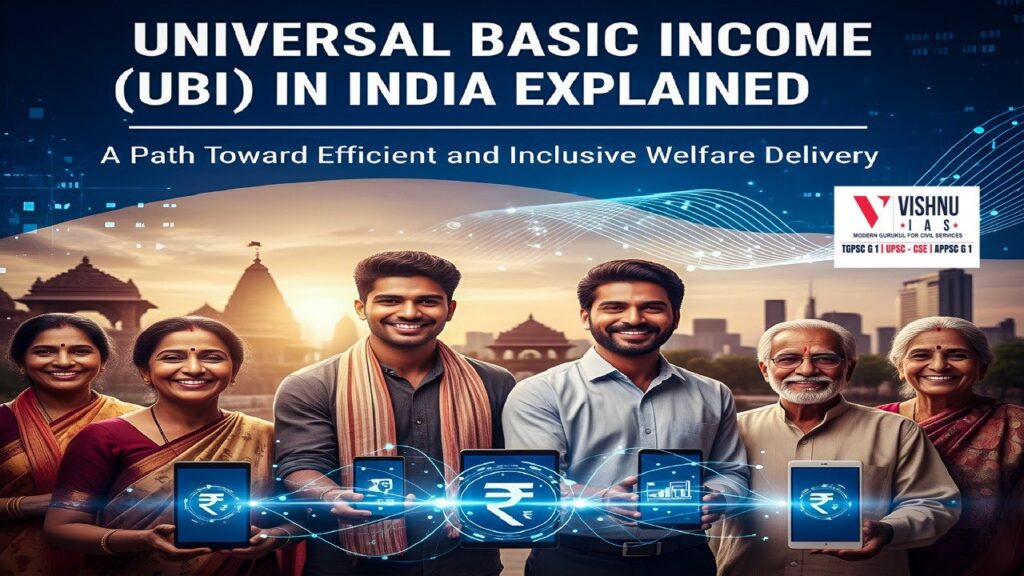
Explore how Universal Basic Income (UBI) can transform India’s fragmented welfare system into an inclusive, transparent, and efficient model for growth. Learn its benefits, challenges, and potential for social equity.

Universal Basic Income (UBI) in India: Streamlining Welfare Delivery and Ensuring Inclusive Growth

Universal Basic Income (UBI) in India: Streamlining Welfare Delivery and Ensuring Inclusive Growth <strong   Universal Basic Income (UBI) in India is gaining traction as a potential game-changer in social welfare and inclusive growth. A Universal Basic Income (UBI) is a policy model whereby every citizen receives a periodic, unconditional cash transfer, irrespective of employment

Universal Basic Income (UBI) in India: Streamlining Welfare Delivery and Ensuring Inclusive Growth Read More »

Analyse the transnational nature of cyber scams involving Southeast Asian scam compounds and evaluate India's strategic options for a coordinated regional response.

Transnational Cyber Scams in Southeast Asia: India’s Strategic Regional Response

Transnational Cyber Scams in Southeast Asia: India’s Strategic Regional Response Introduction Transnational cyber scams involving Southeast Asian “scam compounds” have emerged as a critical security and human-rights concern for India and the broader Asia-Pacific region. Defined broadly, these digital fraud schemes involve victims trafficked or coerced into engaging in online fraud such as romance-investment scams,

Transnational Cyber Scams in Southeast Asia: India’s Strategic Regional Response Read More »

Energy efficiency in India is crucial for integrating variable renewable energy (VRE) sources like solar and wind. Learn how efficiency, demand-side flexibility, and smart policies can reduce peak load reliance on coal and accelerate India’s clean energy transition.

Energy Efficiency in India: The Key to Integrating Solar & Wind Power into a Smarter Grid

<!doctype html> Energy efficiency in India: The Indispensable Prerequisite for Integrating Solar & Wind (VRE)   Introduction Energy efficiency in India • Energy efficiency refers to the reduction in the amount of energy required to produce the same service (e.g., cooling, lighting, industrial output) through more efficient technologies, processes, or behavioural changes. At the same

Energy Efficiency in India: The Key to Integrating Solar & Wind Power into a Smarter Grid Read More »

Explore how UN Security Council reforms can address structural limitations like veto paralysis and narrow representation. Learn how functional reforms could strengthen its capacity to sustain peace and enhance global governance effectiveness.

UN Security Council Reforms: Overcoming Structural Limitations to Sustain Global Peace

<!doctype html> UN Security Council Reforms: Addressing Structural Limits to Sustaining Peace UN Security Council reforms are increasingly seen as essential for bridging the gap between crisis response and long-term peace. This analysis examines the Council’s structural limitations in sustaining peace and evaluates how functional (non-Charter-changing) reforms could improve its effectiveness in modern conflict and

UN Security Council Reforms: Overcoming Structural Limitations to Sustain Global Peace Read More »

Explore how India’s tiger conservation strategy has evolved from a fortress conservation model to a community-centered approach. Learn how this shift impacts forest-dwelling communities and tiger habitats through inclusive and rights-based conservation policies.

Shift from Fortress Conservation to Community-Centered Approach in India’s Tiger Conservation

Shift from Fortress Conservation to Community-Centered Approach in India’s Tiger Conservation <stro Introduction Tiger conservation in India has gradually evolved from a “fortress conservation model”—which prioritised creating inviolate spaces by excluding human presence—to a community-centered approach that recognises the rights and participation of forest-dwelling communities in protecting biodiversity. With India hosting over 70% of the

Shift from Fortress Conservation to Community-Centered Approach in India’s Tiger Conservation Read More »

Presumption of Innocence and the 130th Amendment Bill 2025: A Test of Due Process and Accountability in Indian Politics

Presumption of Innocence and the 130th Amendment Bill 2025: Balancing Accountability and Due Process Introduction The principle of presumption of innocence—that an accused person is deemed innocent until proven guilty—forms a foundational pillar of criminal jurisprudence. It safeguards individual liberty and rights, ensuring that the mere accusation or detention does not equate to guilt. However,

Presumption of Innocence and the 130th Amendment Bill 2025: A Test of Due Process and Accountability in Indian Politics Read More »

Explore how exclusionary immigration frameworks in modern democracies reflect racial and cultural biases. Learn how historical legacies, policy design, and algorithmic systems perpetuate inequality — and what reforms are needed for inclusive governance.

Exclusionary Immigration Frameworks and Racial Bias: How Modern Democracies Reflect Hidden Inequalities

Exclusionary Immigration Frameworks: Unmasking Racial and Cultural Bias in Modern Democracies Introduction: Exclusionary immigration frameworks refer to legal, administrative or policy mechanisms adopted by states to restrict, regulate or deny the entry, residence or rights of non-citizens (migrants, refugees, asylum seekers) on the basis of prescribed criteria. These frameworks often manifest through visa restrictions, deportation

Exclusionary Immigration Frameworks and Racial Bias: How Modern Democracies Reflect Hidden Inequalities Read More »

Scroll to Top