

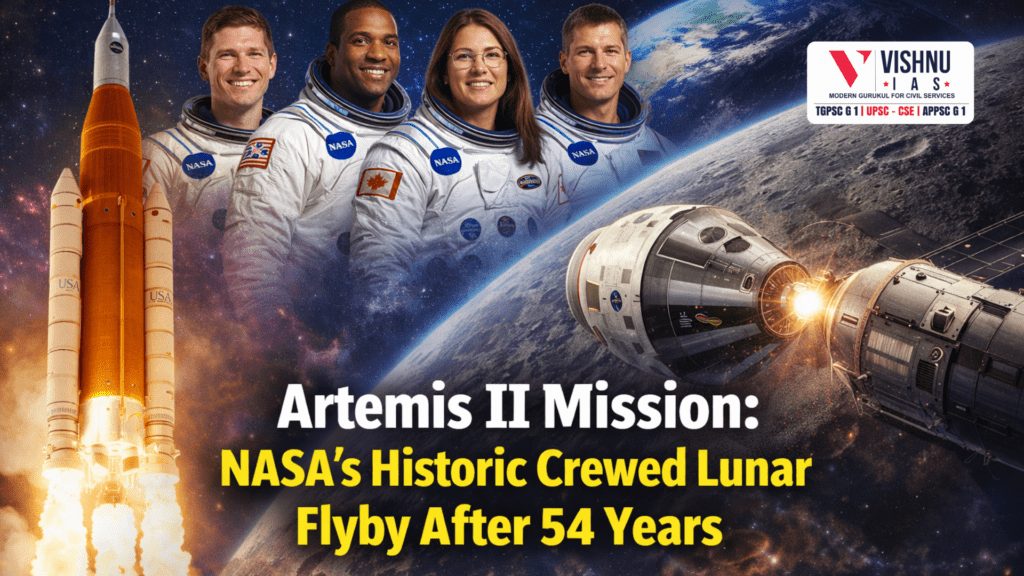
Artemis II Mission: NASA’s Historic Crewed Lunar Flyby After 54 Years
Artemis II Mission marks a historic milestone in space exploration as NASA resumes human missions to deep space after more than five decades since the Apollo era.
NASA Artemis II Mission: Current Context
- Historic Launch: NASA launched the Artemis II mission on April 1, 2026, from the Kennedy Space Center, Florida.
- Milestone: It marks the first crewed lunar mission in 54 years (since Apollo 17 in 1972) to venture beyond Low Earth Orbit (LEO) into deep space.
Mission Overview & Objectives
- Nature of Mission: It is an approximate 10-day lunar flyby mission. The crew will loop around the far side of the Moon and return to Earth. They will not land on the lunar surface.
- Core Objective: To serve as a critical flight test to validate the life-support, deep-space navigation, and radiation shielding systems.
- Stepping Stone: Artemis II acts as the essential precursor to future missions (Artemis III and IV), which aim to land humans on the Moon and build long-term lunar infrastructure.
Spacecraft & Launch Vehicle
- Launch Vehicle: Space Launch System (SLS), NASA's next-generation super heavy-lift rocket.
- Crew Module: The Orion Spacecraft, designed specifically to sustain human life during deep-space exploration and withstand high-velocity atmospheric re-entry.
The Crew & Historic Firsts
The four-person multinational crew represents a major milestone in spaceflight diversity:
- Reid Wiseman: Commander.
- Victor Glover: Pilot (First person of color on a lunar mission).
- Christina Koch: Mission Specialist (First woman on a lunar mission; holds the record for the longest single spaceflight by a woman).
- Jeremy Hansen: Mission Specialist representing the Canadian Space Agency (First non-American on a lunar mission).
Significance of Artemis II Mission
- Sustained Exploration: Shift from short-term “flags & footprints” to a continuous human presence on the Moon as a stepping stone to Mars.
- Global & Commercial Collaboration: Multi-nation and private-sector partnerships under the Artemis Accords (signed by India in 2023).
- Deep Space Capability: Tests human endurance to radiation and strengthens deep-space communication systems.