
Challenges and Solutions for Agriculture-Based Carbon Credit Projects in India
Agriculture-Based Carbon Credit Projects in India are gaining attention as key tools to align economic development with climate goals. These projects can empower farmers, promote sustainable agriculture, and contribute to India's net-zero commitments. However, they face several structural, institutional, and governance-related challenges that must be addressed to enhance inclusivity and effectiveness.
Introduction
Carbon credit projects are increasingly being recognised as an essential mechanism for aligning economic growth with climate goals. A carbon credit represents a certified reduction or removal of greenhouse gases equivalent to one tonne of CO₂.
Globally, nearly 175–180 million credits are retired annually, with a significant portion arising from renewable energy and nature-based solutions. In the context of developing economies like India, agriculture holds immense potential—both as a mitigation sector and as a livelihood base for over 43% of the workforce.
However, despite this potential, agriculture-based carbon credit projects face structural, institutional, and equity challenges. Strengthening these projects is crucial to achieving net-zero ambitions under the commitments of the Paris Agreement and ensuring just climate transitions.
1. Structural and Institutional Barriers
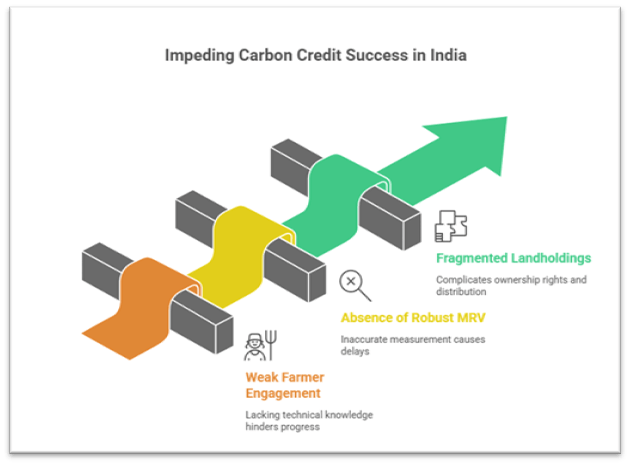
a) Weak Farmer Engagement and Capacity Constraints
- Over 85% of Indian farmers are smallholders, lacking technical knowledge about carbon crediting, verification requirements, and revenue models.
- Many projects fail due to poor follow-up and inadequate extension services, especially among marginalised communities.
- Example: Under agriculture projects listed with Verra, only a fraction have successfully registered and none have issued credits, reflecting limited community capacity.
b) Absence of Robust Monitoring, Reporting and Verification (MRV) Systems
- Accurate soil carbon measurement remains technically and financially challenging at scale.
- Lack of harmonised MRV standards results in delays and credibility issues.
- Example: The suspension of Northern Rangelands Trust credits in Kenya due to flawed soil carbon accounting highlights global MRV challenges.
c) Fragmented Landholdings and Unclear Land Tenure
- India’s average landholding size (less than 1.1 ha) complicates aggregation and verification of emission reductions.
- Customary and common land use further complicates ownership and benefit distribution.
- Example: NABARD’s climate initiatives show the importance of land consolidation for viable credit projects.
2. Equity, Rights, and Governance Issues
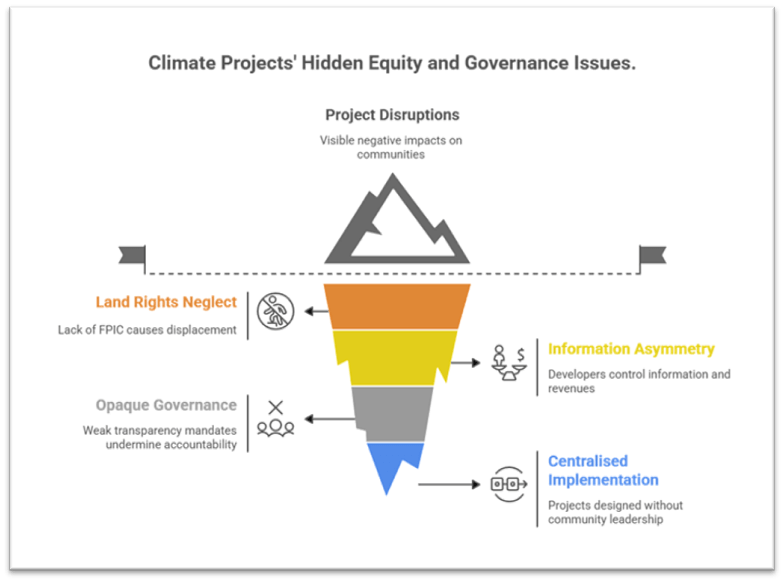
a) Inadequate Recognition of Land and Community Rights
- Projects often extend to village commons and forest fringes without formalising Free, Prior and Informed Consent (FPIC).
- This creates risks of displacement and restricted access to resources like grazing lands and fuelwood.
- Example: The Lake Turkana Wind Power case in Kenya illustrates how neglecting land rights can disrupt livelihoods.
b) Power Asymmetries and Opaque Benefit-Sharing
- Developers and intermediaries often control information and revenues, while farmers receive minimal or delayed benefits.
- Lack of transparency under India’s Carbon Credit Trading Scheme weakens accountability.
- Marginalised caste farmers are often bypassed in agricultural carbon projects.
c) Centralised Top-Down Implementation
- Many projects are designed without community leadership, leading to poor local ownership.
- Contrast: Kenya’s decentralised conservancies show potential but also reveal risks when governance is opaque.
- India must embed FPIC and governance safeguards to prevent similar pitfalls.
3. Measures to Enhance Inclusivity and Effectiveness
1. Institutional and Technical Strengthening
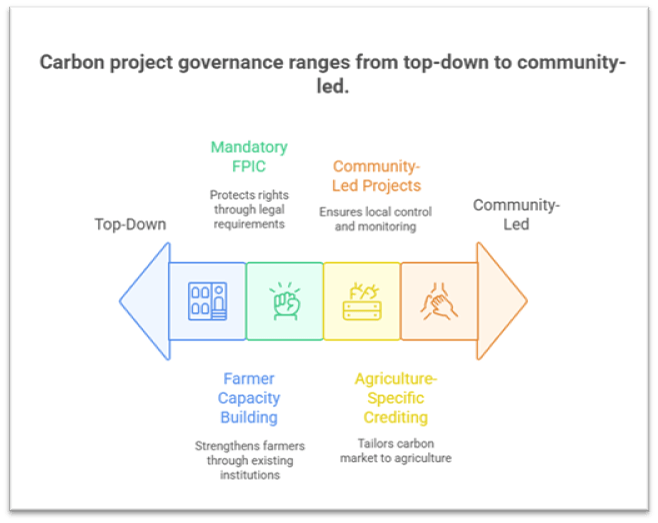
- Farmer Capacity Building: Launch targeted extension services via Krishi Vigyan Kendras and integrate carbon literacy into the National Mission on Sustainable Agriculture. Empower FPOs to aggregate smallholders.
- Develop India-Specific MRV Protocols: Use remote sensing and ISRO’s satellite-based soil carbon mapping to create low-cost monitoring systems.
- Tenure Clarity and Land Aggregation: Use the Digital India Land Records Modernization Programme to formalise rights and promote group certification models.
2. Governance Reforms and Social Safeguards
- Mandatory FPIC and Land Rights Protection: Align carbon projects with Forest Rights Act, 2006 and PESA Act to secure consent and tenure.
- Transparent and Equitable Benefit-Sharing: Mandate disclosure of revenue agreements and minimum community benefit thresholds.
- Decentralised and Participatory Governance: Ensure local monitoring, elected representation, and grievance redressal systems through Panchayati Raj Institutions.
3. Market Development and Policy Integration
- Strengthen Domestic Carbon Market: Introduce agriculture-specific crediting methodologies under CCTS, including biochar and agroforestry.
- Ensure Price Stability and Financial Access: Set floor prices and offer upfront cost support via NABARD’s green finance facilities.
- Integrate with National Climate Strategies: Align crediting with India’s Low Emissions Development Strategy and major rural schemes like PMKSY and MGNREGA.
Conclusion:
Agriculture-based carbon credit projects offer a transformative pathway for India to meet its climate goals while supporting rural livelihoods. However, without addressing structural, governance, and market-level challenges, these projects risk reinforcing inequities and failing to deliver tangible benefits.
A balanced regulatory approach—lightweight yet rights-protective—is required. Ensuring transparency, FPIC, fair benefit-sharing, and strong MRV frameworks can empower smallholders and make these projects inclusive. Embedding carbon crediting into national agricultural programs and incentivising farmer-led cooperatives can turn India’s agricultural landscape into a cornerstone of climate justice and sustainable development.
Recap: