
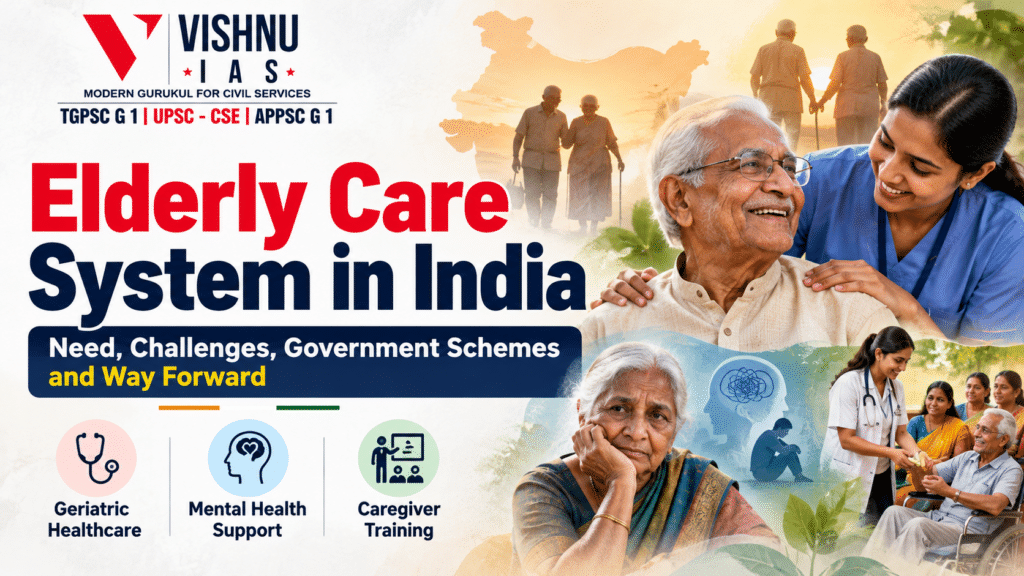
Elderly Care System in India: Need, Challenges, Government Schemes and Way Forward
Introduction
India is undergoing a demographic transition characterised by increasing life expectancy and a declining fertility rate. According to NITI Aayog's 2024 report, Senior Care Reforms in India, the elderly population is projected to reach 19.5% of the total population by 2050. The need for an Elderly Care System in India is therefore becoming increasingly important, particularly in geriatric healthcare, mental health support and caregiver training.
I. Need for an Elderly Care System
1. Rising Burden of Age-Related Diseases
According to the Longitudinal Ageing Study of India (LASI), 75% of elderly persons have one or more chronic diseases. Conditions such as diabetes, hypertension, cardiovascular diseases and arthritis require regular monitoring, medication management and continuous medical care.
2. Limitations of Existing Healthcare Infrastructure
India's healthcare system remains largely oriented towards general healthcare rather than specialised geriatric care. Shortages of trained geriatric professionals, limited access to affordable treatment and inadequate home-based healthcare affect the quality of care available to older persons, particularly in rural areas.
3. Growing Mental Health Concerns
Ageing can be accompanied by loneliness, social isolation, depression, dementia and other cognitive disorders. The loss of a spouse, declining independence and reduced social interaction can aggravate these problems. According to the NITI Aayog report, one in three elderly persons reported depressive symptoms.
4. Changing Family Structures
The transition from joint families to nuclear households, coupled with migration and changing work patterns, has weakened traditional family-based support systems. Elderly persons living alone or without adequate family support are particularly vulnerable to neglect and delayed medical attention.
5. Burden on Informal Caregivers
Family members often learn caregiving through trial and error, including managing medicines, monitoring blood pressure and blood glucose, assisting with mobility and responding to emergencies. Inadequate training can lead to preventable complications, while prolonged caregiving increases physical and psychological stress.
6. Gender Inequality in Unpaid Care
Women disproportionately undertake unpaid domestic and caregiving responsibilities, often alongside household work and employment. Recognising and training informal caregivers can improve care quality, distribute responsibilities more equitably and create employment opportunities for women.
7. Financial Insecurity and Vulnerability
Limited pension coverage, inadequate health insurance and high out-of-pocket expenditure can push elderly households into financial distress. The NITI Aayog report, Senior Care Reforms in India, noted that 78% were living without pension coverage.
II. Existing Schemes and Initiatives
1. National Programme for Health Care of the Elderly (NPHCE)
The NPHCE seeks to provide specialised and dedicated healthcare facilities for senior citizens through different levels of the public healthcare system, including district hospitals, community health centres and primary healthcare facilities.
2. Ayushman Bharat – Ayushman Arogya Mandirs
Ayushman Arogya Mandirs provide comprehensive primary healthcare, creating a platform for preventive healthcare, screening, health education and follow-up services for older persons. They can also support the early identification of age-related health problems.
3. Ayushman Bharat PM-JAY
Ayushman Bharat PM-JAY provides hospitalisation coverage to eligible beneficiaries. The expansion announced in 2024 extended coverage to all senior citizens aged 70 years and above, irrespective of income, subject to the scheme's applicable provisions.
4. Atal Vayo Abhyuday Yojana (AVYAY)
Implemented by the Ministry of Social Justice and Empowerment, AVYAY seeks to promote the welfare and social inclusion of senior citizens through support for senior citizen homes, community-based services and other welfare interventions.
5. Rashtriya Vayoshri Yojana
Rashtriya Vayoshri Yojana provides eligible senior citizens suffering from age-related disabilities or infirmities with assisted-living devices, such as walking sticks, hearing aids and wheelchairs, to improve mobility and functional independence.
6. Maintenance and Welfare of Parents and Senior Citizens Act, 2007
The Act provides a legal framework for maintenance of parents and senior citizens by children or specified relatives, and addresses related welfare concerns. It reinforces the responsibility to protect older persons from neglect.
7. National Action Plan for the Welfare of Senior Citizens (NAPSrC)
NAPSrC provides a framework for promoting financial security, healthcare, nutrition, shelter and the welfare of senior citizens.
8. Kudumbashree's K4 Care Initiative
Kudumbashree's K4 Care initiative has introduced training for geriatric, patient and disability care, demonstrating how community-based organisations and Self-Help Groups can contribute to developing a trained caregiving workforce.
9. Elderly-Care Training for ASHA Workers
The National Health Systems Resource Centre has developed an elderly-care training manual for ASHA workers.
Gaps in Existing Initiatives
Despite these initiatives, gaps remain in specialised geriatric services, mental healthcare, home-based care and trained personnel.
III. Way Forward
- Strengthen specialised geriatric healthcare: Expand geriatric departments, outpatient services, rehabilitation facilities and home-based healthcare.
- Integrate mental health screening: Incorporate routine screening for depression, dementia and other cognitive disorders into primary healthcare.
- Standardise caregiver training: Develop certified training programmes covering medicine management, mobility assistance, hygiene, nutrition, emergency response, chronic disease monitoring and basic mental health support. Training should be accessible to family caregivers as well as professional care workers.
- Support unpaid family caregivers: Provide skill certification, counselling, respite care and access to healthcare guidance.
- Harness technology: Expand teleconsultation, digital health records, emergency alert systems and remote monitoring where appropriate.
Conclusion
India must move beyond a predominantly family-dependent model towards an integrated, affordable and professionally supported elderly care system. By combining geriatric healthcare, mental health services, caregiver training and social protection, India can transform population ageing from a welfare challenge into an opportunity to promote dignity, inclusion and employment in the care economy.