
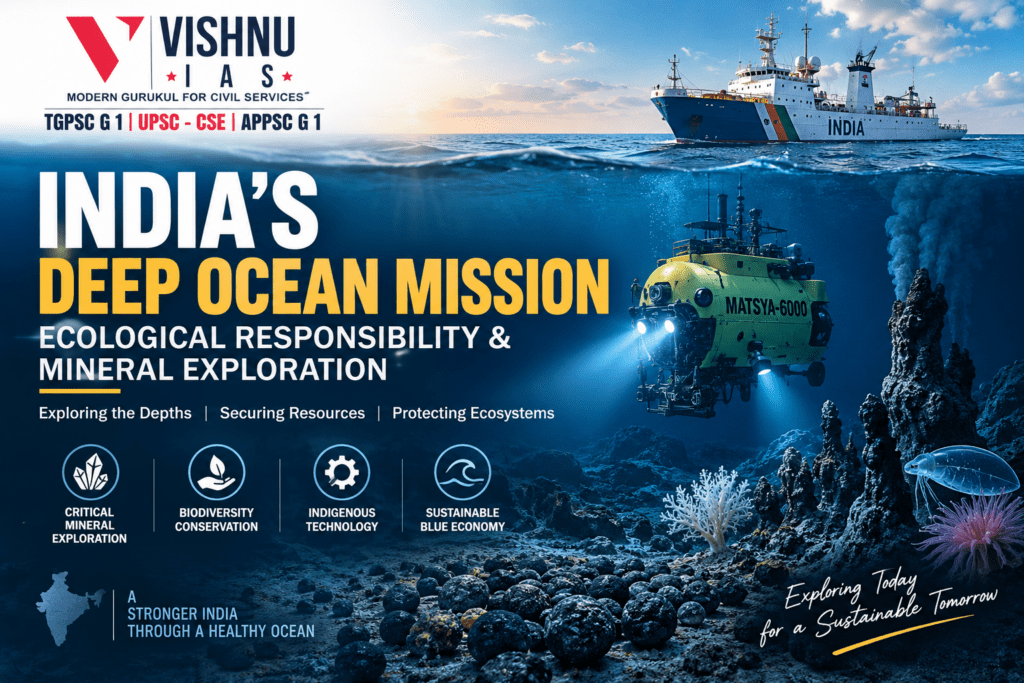
India’s Deep Ocean Mission: Ecological Responsibility & Mineral Exploration
The deep ocean is simultaneously a frontier of scientific discovery, critical-mineral exploration and ecological uncertainty. India’s Deep Ocean Mission (DOM), launched in 2021, seeks to develop capabilities in deep-sea mining, human submersibles, underwater robotics, biodiversity conservation, ocean observation, energy and marine biology. However, the discovery of previously unrecorded species and fragile deep-sea ecosystems creates an equally important obligation to ensure that technological capability does not automatically translate into ecological exploitation.
1. Deep Ocean Mission
The Mission has six major verticals:
- Technologies for deep-sea mining, human submersibles and underwater robotics.
- Ocean climate-change advisory services.
- Exploration and conservation of deep-sea biodiversity.
- Deep-ocean survey and exploration.
- Energy and freshwater from the ocean.
- An Advanced Marine Station for Ocean Biology.
Deep-sea technology
- The design and system engineering of MATSYA-6000, a human submersible capable of reaching 6,000 metres with three aquanauts, has been completed. NIOT has also developed a self-propelled deep-sea nodule collector, with a demonstration involving collection of over 100 kg of polymetallic nodules at 1,173 metres in the Andaman Sea.
Resource exploration
- India has identified hydrothermal vent fields and inactive vents in the Indian Ocean, which are potential mineralised zones.
Ocean observation
- DOM has supported glider missions, wave-spectrum drifters and Argo floats, strengthening India's capacity to monitor ocean processes and climate-related risks.
2. Ecological responsibility
Deep-sea ecosystems remain poorly understood
- The mission demonstrated how much remains to be discovered. Nearly 2,038 deep-sea microbes have been isolated from Indian EEZ samples, while surveys of 31 seamounts documented 201 deep-sea species, including 43 potentially new to science. Such discoveries indicate that the deep ocean contains biological resources whose ecological functions are not yet fully understood.
Physical disturbance of the seabed
- Commercial extraction of polymetallic nodules or sulphide deposits involves physical intervention in deep-sea habitats. Disturbance of sediment and associated organisms could produce ecological effects that are difficult to predict or reverse.
Scientific uncertainty
- Where baseline ecological knowledge is incomplete, conventional assumptions about environmental recovery become uncertain. Hence, the precautionary principle becomes particularly relevant.
Biodiversity value beyond mineral wealth
- Hydrothermal vents, seamounts and deep-sea microbial ecosystems may have scientific, genetic and ecological value. Therefore, the economic value of minerals should not automatically be treated as greater than the ecological value of the ecosystem.
3. The strategic case for deep-sea resources
- The ecological argument should not obscure India's legitimate resource-security concerns. Polymetallic nodules contain nickel, copper, cobalt and manganese, while polymetallic sulphides contain minerals such as copper, zinc, lead, iron and other valuable metals. These resources have relevance for India's ambitions in renewable energy, electric mobility, advanced manufacturing and technological industries.
- Deep-ocean capabilities also provide broader benefits through indigenous underwater engineering, scientific research, ocean observation, climate-risk assessment, biodiversity research, marine biotechnology and development of a Blue Economy.
4. Ecological safeguards required
- Potentially irreversible ecological damage should be prevented where scientific evidence remains inadequate.
- Long-term biodiversity and ecosystem data should precede commercial extraction so that changes can be scientifically measured.
- Mining proposals should undergo rigorous EIAs covering direct, indirect and cumulative ecological effects.
- Continuous monitoring should accompany any future activity, with clearly defined thresholds for modifying or suspending operations.
- Management strategies should change in response to new scientific evidence rather than assuming that existing assessments are permanently adequate.
- The draft ISA Mining Code incorporates these principles through precaution, baseline studies, EIAs, environmental management and monitoring programmes, and adaptive management. India participates in the consultative process developing these safeguards.
5. Reduce the pressure to extract
- Ecological responsibility also requires questioning whether every identified mineral deposit must eventually be exploited.
- India's mineral requirements can be addressed partly through recycling, resource efficiency, substitution and circular economy which are in line with Mission LiFE, which places emphasis on responsible consumption and reducing unnecessary pressure on natural resources.
Conclusion
India's Deep Ocean Mission demonstrates that scientific exploration and ecological conservation need not be contradictory objectives. Indeed, the more India discovers about the deep ocean, the stronger becomes the responsibility to protect it. The appropriate measure of technological progress is therefore not merely how much of the seabed India can access, but how responsibly it can determine what should be explored, what may eventually be used and what should remain undisturbed.
Thus, the Deep Ocean Mission can become a model of responsible Blue Economy, where mineral security is pursued alongside biodiversity conservation and precaution.