Introduction
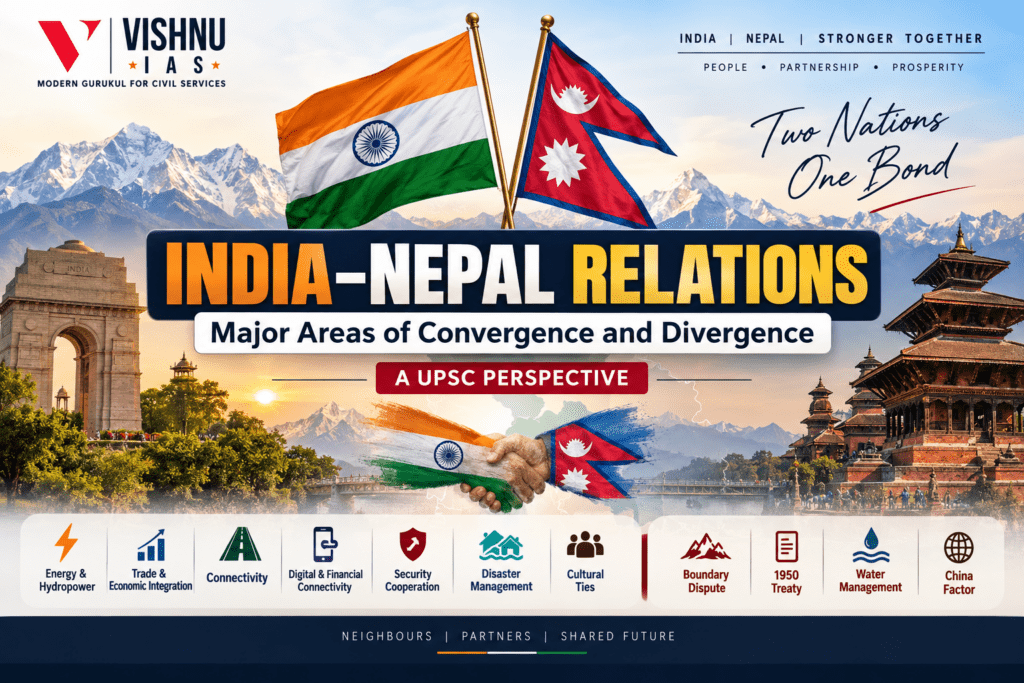
India–Nepal relations are shaped by geographical proximity, civilisational linkages, an open border and extensive people-to-people ties. The relationship has expanded from traditional cultural and security linkages to cooperation in energy, connectivity, digital payments, disaster management and regional integration. However, boundary disputes, treaty-related concerns and differing geopolitical orientations continue to create friction.
1. Major Areas of Convergence
Energy and Hydropower
- Energy and hydropower:
- Nepal possesses substantial hydropower potential, while India has a growing requirement for clean electricity. The agreement enabling Nepal to export 10,000 MW of electricity to India over ten years provides a framework for deeper energy interdependence. Projects such as Arun-III and Lower Arun illustrate this potential.
- India supplied expedite electricity post August 2026 to Nepal as their hydropower plants were damaged in flash floods.
Trade and Economic Integration
- Trade and economic integration:
- India is Nepal's largest trading partner and a major source of investment. Nepal's access to Indian markets and transit facilities is particularly important because of its landlocked geography. At the same time, India benefits from deeper economic integration with its Himalayan neighbour.
- For instance, Nepal uses Indian ports such as Kolkata/Haldia for access to international markets.
Connectivity
- Connectivity:
- Cross-border roads, railways and Integrated Check Posts are strengthening economic links. The Jayanagar–Kurtha railway and ICPs at Raxaul–Birgunj and Jogbani–Biratnagar have improved the movement of people and goods.
Digital and Financial Connectivity
- Digital and financial connectivity:
- The UPI–NPI linkage has created a mechanism for faster and lower-cost cross-border digital payments, particularly relevant for remittances and everyday economic transactions.
Security Cooperation
- Security cooperation:
- The open border creates shared concerns relating to human trafficking, smuggling, terrorism and other transnational crimes. Mechanisms such as the Bilateral Consultative Group on Security Issues and the Surya Kiran military exercise facilitate cooperation.
Disaster Management
- Disaster management:
- India and Nepal face common vulnerabilities from floods, landslides and earthquakes. India's response to the 2015 Nepal earthquake through Operation Maitri, followed by HADR assistance during the August 2026 flash floods, demonstrates India's role as a regional first responder. Such cooperation strengthens humanitarian trust and supports the Neighbourhood First approach.
Cultural Ties
- Cultural ties:
- Shared Hindu and Buddhist heritage provides a strong societal foundation. Places such as Ayodhya–Janakpur and Lumbini–Bodh Gaya reinforce tourism and people-to-people relations.
2. Major Areas of Divergence
Boundary Dispute
- Boundary dispute:
- The Kalapani–Limpiyadhura–Lipulekh issue remains a major source of disagreement. Different interpretations regarding the course of the Kali River and the legacy of the 1816 Treaty of Sugauli contribute to the dispute.
- The dispute intensified in 2020 when Nepal issued a revised political map incorporating Kalapani, Limpiyadhura and Lipulekh, which India rejected.
Perceptions of Interference
- Perceptions of interference:
- Sections of Nepalese political opinion have periodically expressed concerns regarding perceived Indian influence in Nepal's domestic political affairs. Such perceptions have contributed to a trust deficit.
China Factor
- China factor:
- Nepal seeks to maintain relations with both India and China and has expanded its engagement with China, including through the Belt and Road Initiative. India, meanwhile, remains attentive to Chinese-funded infrastructure and connectivity projects that may have strategic implications.
- The Pokhara International Airport, constructed with Chinese assistance, illustrates Nepal's diversification of infrastructure partnerships beyond India.
Trade and Transit Concerns
- Trade and transit concerns:
- Although India is Nepal's principal trading partner, Nepal has raised concerns regarding market access, logistics and non-tariff barriers. It has also sought greater diversification of transit routes.
1950 Treaty
- 1950 Treaty:
- 1950 India–Nepal Treaty of Peace and Friendship, particularly provisions relating to security and reciprocal rights has to reviewed and reframed as contemporary bilateral realities needs to be addressed.
Water and Flood Management
- Water and flood management:
- Shared rivers create opportunities for hydropower and irrigation cooperation but also generate disagreements over flood control, river management and projects.
- The Pancheshwar Multipurpose Project, envisaged under the 1996 Mahakali Treaty, has faced prolonged delays, illustrating the difficulty of translating water-sharing agreements into completed projects.
3. Way Forward
- Boundary and water-related differences shall be addressed through regular political and technical-level mechanisms rather than public rhetoric.
- India and Nepal can move beyond conventional trade towards cross-border value chains, energy trade and industrial cooperation, enabling Nepal to benefit more from its hydropower and labour resources.
- Greater integration of road, rail, energy grids, digital payments and border infrastructure can reduce transaction costs while strengthening Nepal's access to regional markets.
- The 1950 Treaty shall be discussed through a mutually agreed review process so that legitimate contemporary concerns are addressed while preserving beneficial aspects of bilateral cooperation.
- Joint planning for floods, earthquakes and Himalayan ecological risks can convert shared vulnerabilities into an area of partnership.
Conclusion
India–Nepal relations possess an unusually strong foundation of geography, culture and societal interdependence. The emerging emphasis on hydropower, connectivity, digital integration and disaster resilience provides an opportunity to complement these traditional ties with a modern partnership based on mutual respect, economic interdependence and institutionalised dialogue.