

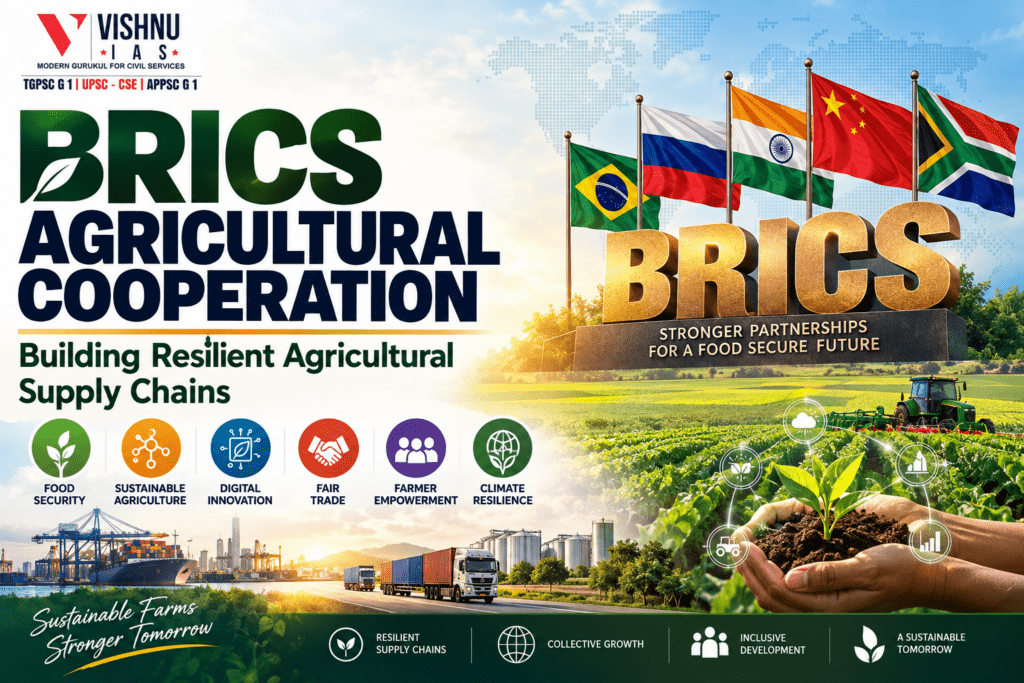
BRICS Agricultural Cooperation: Building Resilient Agricultural Supply Chains
BRICS agricultural cooperation has significant potential to strengthen resilient agricultural supply chains in the face of climate-induced production losses, extreme weather events, fertiliser shortages, geopolitical disruptions and food-price volatility.
Introduction
Agricultural supply chains are increasingly vulnerable to climate-induced production losses, extreme weather events, fertiliser shortages, geopolitical disruptions and food-price volatility.
The 16th BRICS Agriculture Ministers’ Meeting, 2026 held at Indore identified four priorities: food security, nutrition and livelihoods; agricultural trade and cooperation; regenerative, climate-resilient and sustainable agriculture; and innovation and investment for a future-ready agricultural and food system. The meeting adopted the BRICS Agriculture Ministers’ Joint Declaration with emphasis on farmer-centric approaches, smallholders, sustainable agriculture and resilient food systems.
1. Diversifying Agricultural Supply Chains
- BRICS has identified resilient and non-discriminatory agricultural supply chains as an important area of cooperation.
- The 2025 BRICS Agriculture Ministers’ Declaration records that BRICS countries are major producers and consumers of grains and supports further discussions on facilitating transactions between grain producers, exporters and importers.
- The 2026 Agriculture Ministers’ Meeting also provided opportunities for bilateral engagements on market access and agricultural cooperation, strengthening the practical trade dimension of BRICS agricultural cooperation.
2. BRICS Grain Exchange
- A major initiative is the proposed BRICS Grain Exchange.
- The 2025 Agriculture Ministers’ Declaration records continuing discussions on a grain trading platform within BRICS, with the possibility of subsequent expansion to other agricultural products and commodities. It also refers to transactions between grain producers, exporters and importers through transparent and secure payments.
- In 2026, India hosted a Special Dialogue on the BRICS Grain Exchange, which provided momentum to discussions and helped develop a shared understanding of its operational aspects.
3. Climate-Resilient and Regenerative Agriculture
- Climate change directly affects agricultural productivity through droughts, floods, heat stress, changing rainfall patterns and ecosystem degradation.
- Thus, BRICS expanded agricultural cooperation beyond food production towards climate resilience and regenerative practices in its 2026 meet.
- It agreed to establish a BRICS Network of Centres of Excellence on Agroecology and Regenerative Agriculture, initially coordinated by ICAR–Indian Institute of Farming System Research (IIFSR), Modipuram. ICAR-IIFSR will serve as India's Centre of Excellence on Natural Farming and facilitate collaborative research, capacity building and exchange of best practices.
4. Digital Agriculture and Agricultural Information Systems
- Digital technologies provide mechanisms for improving agricultural decision-making, monitoring production and responding to emerging supply disruptions.
- BRICS aims to establish a Network on Digital Agriculture among BRICS countries. The network will promote cooperation in artificial intelligence, geospatial technologies, digital public infrastructure and data-driven agricultural solutions, with initial coordination by IIT Delhi.
- This complements existing cooperation through the Basic Agricultural Information System (BAIES), which facilitates exchange of information relating to agricultural policies, trade, investment, scientific achievements and legislation.
5. Agricultural Research and Technology
- BRICS has established institutional mechanisms for agricultural research cooperation.
- The BRICS Agricultural Research Platform (BARP) is being strengthened and, under the 2026 Agriculture Ministers’ Joint Declaration, is to be transformed into a dynamic “Knowledge-to-Action Hub”. The objective is to ensure that agricultural research outputs are translated into practical and scalable solutions for farmers.
- The Agriculture Working Group also identifies digital technologies, precision farming, biotechnology, sustainable agricultural practices and climate-resilient production systems as areas of cooperation.
6. Farmers' Rights, Seeds and Genetic Resources
- The Agriculture Ministers’ Meeting launched a Global Forum on Farmers’ Rights in Seed Systems, aimed at protecting and promoting farmers' rights while recognising traditional knowledge, seed heritage and farmers' contributions. India, through the Protection of Plant Varieties and Farmers’ Rights Authority (PPV&FRA), will initially coordinate the initiative.
- This is complemented by the establishment of the BRICS AGRIN (Agro-Inputs, Genetic Resources and Information Network) Framework.
- AGRIN seeks to strengthen cooperation on seeds, agricultural inputs and genetic resources through information exchange, technical cooperation, capacity building and partnerships among BRICS countries.
7. Smallholders, Women and Youth
- BRICS adopted a farmer-centric approach and specifically highlighted the importance of smallholder farmers in global food security.
- A dedicated Ministerial Dialogue titled “Small Farmers, Women and Youth: Shaping the Future of Food Security” highlighted the role of these groups in building inclusive, resilient and sustainable food systems.
8. Fertiliser and Agricultural-Input Security
- Agricultural resilience depends not only on food output but also on reliable access to critical inputs.
- The 2026 BRICS agenda identifies agricultural inputs as an important area of cooperation, while the AGRIN Framework specifically covers seeds, agricultural inputs and genetic resources.
9. Sustainable and Predictable Agricultural Trade
- BRICS supports agricultural trade that is fair, transparent, open, non-discriminatory, inclusive and long-term, while encouraging the removal of trade barriers inconsistent with WTO rules.
- The Grain Exchange dialogue further sought to develop greater clarity on mechanisms for agricultural trade.
10. Food-Loss Reduction, Livestock and Aquaculture
- Agricultural supply-chain resilience extends beyond crop production.
- The 2026 Agriculture Ministers’ Meeting reached understandings to integrate technical dialogue on food-loss reduction, livestock technologies and aquaculture into future BRICS programmes. These areas are linked with improving efficiency, nutrition security and farmer incomes.
11. Integration with Wider BRICS Cooperation
- Agricultural resilience is increasingly connected with wider economic and technological cooperation.
- BRICS initiatives concerning digitalisation, digital public infrastructure, trade facilitation, cross-border payments, local-currency settlements and resilient global value chains create a broader institutional environment for agricultural trade.
Challenges to Realising the Potential
- Diverse agricultural systems: BRICS members have substantially different agro-climatic conditions, agricultural structures, production patterns and domestic food-security priorities.
- Trade restrictions during crises: Food-exporting countries may prioritise domestic availability during periods of shortage.
- Uneven technological capacities: The ability to adopt AI, precision agriculture, biotechnology, geospatial technologies and digital infrastructure differs considerably among members.
- Infrastructure gaps: Storage, cold chains, transport, irrigation and rural infrastructure remain critical determinants of whether increased production translates into resilient supply chains.
- Technology-to-farm gap: Establishing networks and research platforms does not automatically ensure adoption by small and marginal farmers. Capacity building, affordability and last-mile delivery remain important.
- Institutional coordination: Multiple initiatives involving BARP, AGRIN, digital agriculture networks, Centres of Excellence and the Grain Exchange require sustained coordination to avoid fragmented cooperation.
- Implementation deficit: Several initiatives remain at the stage of establishment, dialogue or further development. The Grain Exchange, for instance, received renewed momentum through the 2026 Special Dialogue, but its operationalisation remains a continuing process.
Conclusion
BRICS agricultural cooperation has evolved beyond conventional food-security coordination towards a broader framework of resilient, sustainable, inclusive and technology-enabled food systems.
The central challenge is to move from institutional commitments and proposed mechanisms to operational implementation. Effective coordination of agricultural trade, climate-resilient production, digital technologies, research, agricultural inputs, infrastructure and finance would determine the extent to which BRICS cooperation translates into more resilient agricultural supply chains and contributes to global food security.