India and Japan Defence Cooperation in the Indo-Pacific | Strategic Convergence to Operational Cooperation
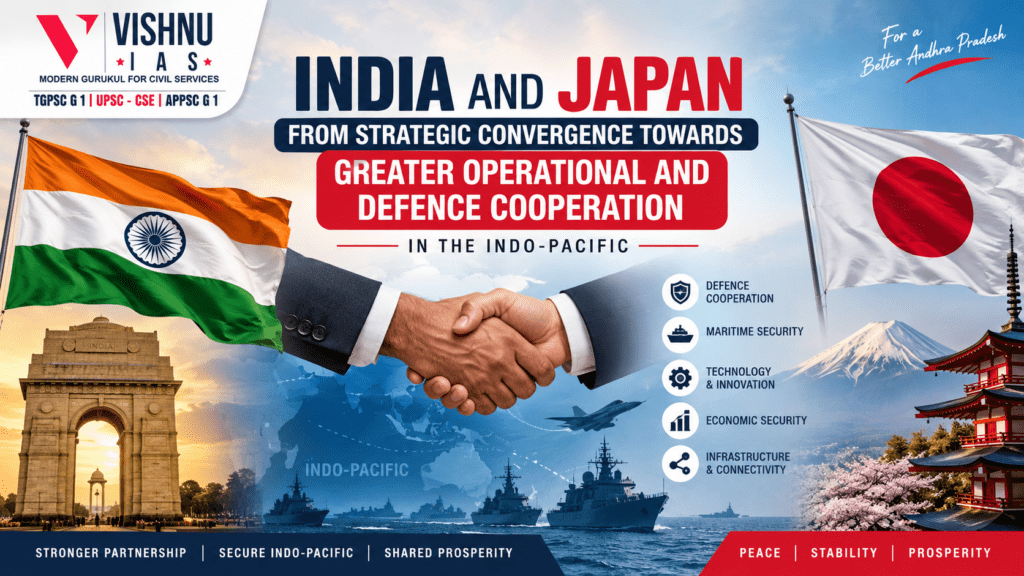
India and Japan have developed a Special Strategic and Global Partnership that extends beyond traditional economic cooperation to defence, maritime security, technology, infrastructure and economic security. The relationship has acquired considerable institutional depth through mechanisms such as the 2+2 Foreign and Defence Ministers’ Dialogue, Annual Defence Ministerial Dialogue, security dialogues and the Act East Forum.
1. Growing Defence and Maritime Cooperation
- India and Japan share an interest in a free, open and rules-based Indo-Pacific and have steadily expanded security cooperation.
- The 2+2 Ministerial Dialogue, established at the leadership level in 2018, provides a platform for discussing regional security and defence cooperation.
- The Acquisition and Cross-Servicing Agreement (ACSA), signed in 2020 and effective from 2021, provides a framework for reciprocal provision of supplies and services between the Indian Armed Forces and Japan’s Self-Defense Forces. It facilitates greater logistical cooperation and operational engagement.
- Regular exercises such as JIMEX, Dharma Guardian and Veer Guardian, along with participation in Malabar, have increased interoperability among the armed forces.
- The Veer Guardian 2026 exercise in Jodhpur in September, involves the Indian Air Force and Japan Air Self-Defense Force, is another step towards greater operational familiarity.
2. Maritime Security and Maritime Domain Awareness
- The maritime dimension is particularly important because India and Japan occupy strategically significant positions in the Indian Ocean and Western Pacific respectively.
- The two countries are strengthening cooperation in maritime security, information sharing and Maritime Domain Awareness (MDA). Their Coast Guards also maintain institutional cooperation. The objective is to improve their ability to monitor maritime spaces, protect sea lanes and respond collectively to emerging challenges.
3. Defence Industrial Cooperation
- India and Japan are now exploring joint development and design in naval shipbuilding, combining Japan’s technological expertise with India’s manufacturing capabilities.
- The two sides are also discussing greater use of Indian production facilities by Japanese companies and reciprocal arrangements for ship repair, which can strengthen maritime logistics and defence-industrial cooperation.
- The UNICORN integrated communications antenna system is a concrete example of defence-technology cooperation. An MoU involving Bharat Electronics Limited (BHEL) was signed in November 2024 for cooperation on UNICORN, and the focus in 2026 is on early implementation of the project.
- India’s DRDO and Japan’s Acquisition, Technology and Logistics Agency (ATLA) are also seeking to deepen cooperation in defence technology and equipment, providing a framework for future technological collaboration.
4. Economic Security and Supply-Chain Resilience
- India-Japan relations are increasingly moving beyond conventional trade towards economic security.
- The 2026 Annual Summit placed emphasis on areas such as AI, semiconductors, critical minerals, clean energy and resilient supply chains. India and Japan have complementary strengths. Japan possesses advanced technological and manufacturing capabilities, while India offers a large market, skilled human resources and expanding manufacturing capacity.
- The two countries can therefore contribute to diversification of global supply chains and reduce excessive dependence on concentrated sources of critical technologies and materials.
5. Infrastructure and Connectivity
- Japan has been one of India's important infrastructure partners. The Mumbai-Ahmedabad High-Speed Rail project, based on Japanese Shinkansen technology, is a flagship example of bilateral infrastructure cooperation. Japan has also supported metro and urban infrastructure projects in India.
- The Act East Forum, established in 2017, provides a platform for cooperation particularly in India's North-East, including connectivity and development.
6. Technology and Innovation
- The partnership is expanding into artificial intelligence, semiconductors, digital technology, clean energy and space cooperation.
- The LUPEX mission, involving ISRO and JAXA, represents cooperation in lunar exploration.
7. Institutional Foundation timeline
- Strategic Global Partnership → 2006
- Special Strategic and Global Partnership → 2014
- 2+2 Ministerial Dialogue → 2019 first meeting
- ACSA → signed 2020; entered into force 2021
- CEPA → signed 2011
- The India-Japan CEPA provides the framework for liberalisation and facilitation of trade and investment between the two countries.
Way forward
- India and Japan shall focus on “declarations to delivery” by attaching clear timelines and implementation milestones to defence and infrastructure agreements.
- They shall deepen joint development and co-production rather than limiting cooperation to buyer-seller transactions. Japanese technology and Indian manufacturing capabilities can be combined under Make in India.
- Greater maritime information sharing, logistics and reciprocal maintenance facilities can improve Indo-Pacific operational readiness.
- The two countries shall accelerate CEPA review to reduce non-tariff barriers, strengthen semiconductor and critical-mineral supply chains, and expand cooperation in AI, clean energy and advanced manufacturing.
Conclusion
India-Japan relations have evolved from an economic and development partnership into a multidimensional strategic partnership. The recent emphasis on maritime coordination, exercises, defence technology and industrial cooperation indicates a shift from strategic convergence towards operational capability. The partnership in maritime security, technology, resilient supply chains, infrastructure and regional connectivity can contribute to a stable, inclusive and rules-based Indo-Pacific.