Left Wing Extremism in India: Government Measures to Eliminate Naxalism
Primary Keyword: Left Wing Extremism in India
Secondary Keywords: Naxalism in India, LWE in India, Left Wing Extremism measures, Naxal-free India, Government measures against Naxalism, LWE elimination, National Policy and Action Plan 2015
Introduction
Left Wing Extremism in India, commonly referred to as Naxalism, has been one of India's major internal security challenges, particularly in remote and tribal-dominated regions. It combined armed violence with extortion, attacks on security forces and infrastructure, and attempts to establish parallel systems of authority.
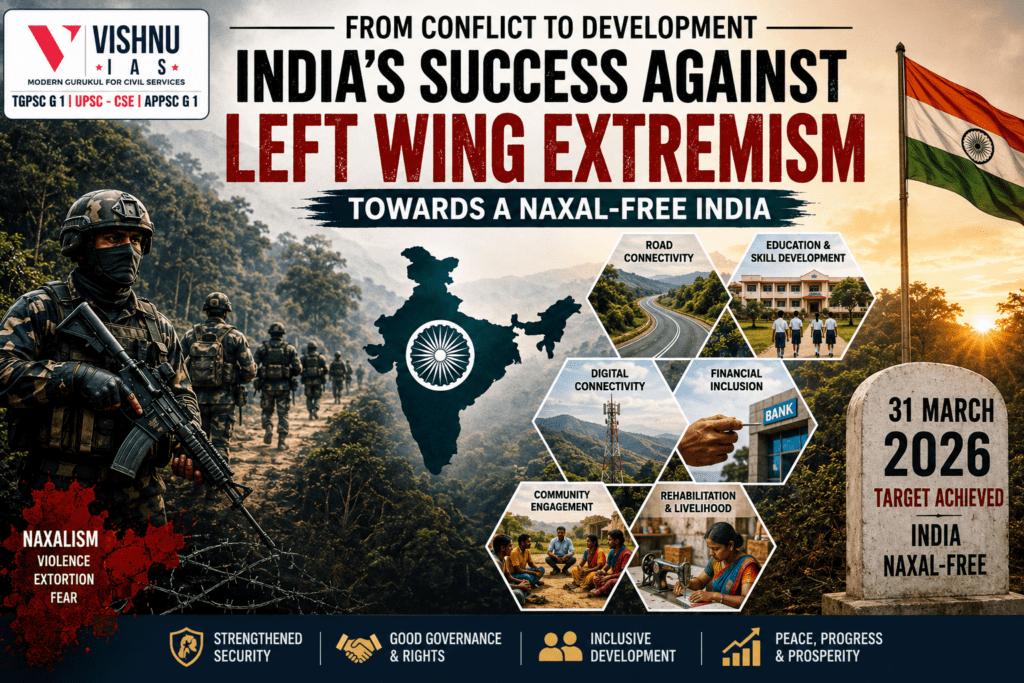
The Government has adopted a multi-pronged approach was institutionalised through the National Policy and Action Plan to address LWE, approved in 2015. The sustained implementation of this strategy, along with State-level efforts, has significantly reduced both the geographical spread and intensity of LWE. The Government subsequently set 31 March 2026 as the target for eliminating LWE.
Measures Taken to Eliminate LWE
1. National Policy and Action Plan: An Integrated Approach
- The National Policy and Action Plan, 2015 moved beyond a purely security-centric response. It adopted an integrated strategy covering security measures, development interventions; protection of rights and entitlements of local communities; improvement of governance, public perception and community engagement.
2. Strengthening Security Architecture
- The Centre strengthened the capacity of LWE-affected States through deployment of Central Armed Police Forces (CAPFs); raising of India Reserve Battalions; strengthening of security camps; construction of Fortified Police Stations; training of State police forces; modernisation of State police forces and intelligence apparatus; provision of equipment and arms; helicopter support for operations; and intelligence sharing and inter-State coordination.
- The CRPF and its specialised CoBRA units have played a particularly important role in operations in difficult forested terrain.
- The Security Related Expenditure (SRE) Scheme also supports security operations, training, rehabilitation of surrendered cadres, compensation and community-oriented measures.
3. Intelligence-led and Coordinated Operations
- The counter-LWE strategy increasingly relied on intelligence-based operations and coordination among Central and State agencies rather than isolated operations.
- Greater coordination between CAPFs, State police and intelligence agencies helped identify Maoist cadres, camps, leadership structures and support networks. Inter-State coordination was particularly important as LWE networks historically operated across State boundaries.
- The Government has also strengthened investigative action against LWE-linked offences through agencies such as the National Investigation Agency (NIA).
4. Disruption of Maoist Financing
- An insurgency requires sustained financial resources for recruitment, weapons, logistics and operations. Therefore, the Government targeted the financial networks supporting LWE.
- Investigative and enforcement agencies have acted against sources and channels of Maoist financing, including extortion-linked networks and assets associated with the insurgency. This weakened the ability of extremist organisations to finance operations and replenish their organisational strength.
5. Surrender and Rehabilitation of Cadres
- Security pressure was complemented by a surrender-cum-rehabilitation strategy.
- Former cadres who surrender are provided assistance aimed at enabling their return to civilian life, including financial assistance; stipends during rehabilitation; skill development and livelihood support; incentives linked to surrender; and assistance relating to deposited weapons.
- The Government reported that 2,337 Naxalites surrendered in 2025, while 3,927 cadres surrendered between 2024 and March 2026.
6. Expansion of Road Connectivity
- LWE historically benefited from the geographical isolation of forested and tribal regions.
- Road construction improves access of security forces; access to markets; movement of agricultural and forest produce; access to hospitals and schools; delivery of government schemes; and integration of remote settlements with the wider economy.
- The Government has implemented dedicated road programmes for LWE-affected areas alongside broader infrastructure programmes.
7. Telecommunications and Digital Connectivity
- The Government has expanded telecommunication connectivity in LWE-affected regions. Mobile and digital connectivity reduces geographical isolation; facilitate access to government services; improve communication during emergencies; support digital education and financial services; and integrate remote communities with wider economic and social networks. Thus, connectivity becomes an instrument of both development and State capacity.
8. Financial Inclusion
- The expansion of banking facilities, ATMs, post offices and other financial infrastructure has helped integrate remote populations into the formal economy.
- Financial inclusion reduces dependence on informal and exploitative financial arrangements and facilitates access to welfare transfers; savings; credit; pensions; insurance; and other government benefits.
9. Education and Skill Development
- The Government has expanded educational and skill-development infrastructure in former LWE-affected regions, including Eklavya Model Residential Schools (EMRSs); Industrial Training Institutes; skill-development centres; and other educational infrastructure.
- Education and skills are particularly important for tribal youth because they expand legitimate employment opportunities and reduce the socio-economic conditions that can facilitate recruitment into extremist organisations.
10. Special Central Assistance for Development Gaps
- The Special Central Assistance (SCA) Scheme provides resources for filling critical gaps in public infrastructure in erstwhile LWE-affected districts.
- As of July 2026, the Government reported that approximately ₹4,282.96 crore had been released to States under the scheme since its inception in 2017.
11. Civic Action and Community Engagement
- Security cannot be sustained without local trust. The Government has therefore supported community policing and civic-action initiatives. Such measures improved interaction between security forces and local communities.
12. Improving Governance and Delivery of Rights and Entitlements
- The Government's approach explicitly recognises rights, entitlements and governance as components of the LWE response.
- The objective is to ensure that people in remote and tribal regions experience the State through functioning schools and health facilities; welfare delivery; roads and communications; financial institutions; livelihood opportunities; responsive administration; and effective implementation of constitutional and statutory protections.
Impact
According to the Ministry of Home Affairs, LWE-affected districts declined from 126 in 2018 to 90 in April 2018, 70 in July 2021, 38 in April 2024, 18 in April 2025 and 11 in October 2025. LWE-related violent incidents declined from 1,936 in 2010 to 222 in 2025, while deaths of civilians and security personnel declined from 1,005 in 2010 to 95 in 2025. The Government subsequently reached its stated March 2026 target of eliminating LWE.
Way Forward
The post-LWE strategy should therefore focus on converting the former Red Corridor into a development corridor through the following measures.
- Sustained State presence as security infrastructure should be complemented by functioning civil administration.
- Rights-based tribal development to ensure effective implementation of forest, land and community rights.
- Youth employment by expanding skilling, entrepreneurship and local livelihood opportunities.
- Connectivity with economic outcomes as roads and telecom infrastructure should translate into market access, healthcare and education.
- Participatory governance to strengthen Gram Sabhas and local institutions in tribal areas.
- Continued rehabilitation to monitor and support surrendered cadres until their reintegration is stable.
- Community trust-building to maintain civic-action and community-policing initiatives.
- Preventive intelligence by retaining adequate intelligence and security capabilities to prevent resurgence without perpetuating a permanent conflict environment.
Conclusion
India's progress against Left Wing Extremism demonstrates that a complex internal security challenge cannot be resolved only through force. The National Policy and Action Plan, 2015 provided an integrated framework in which security operations were combined with development, rights and entitlements, governance and community engagement. The achievement of the March 2026 target should therefore be viewed not as the end of the policy challenge but as the beginning of a post-conflict consolidation phase.