
Recurring Floods in India: Why Disaster Resilience is the Need of the Hour
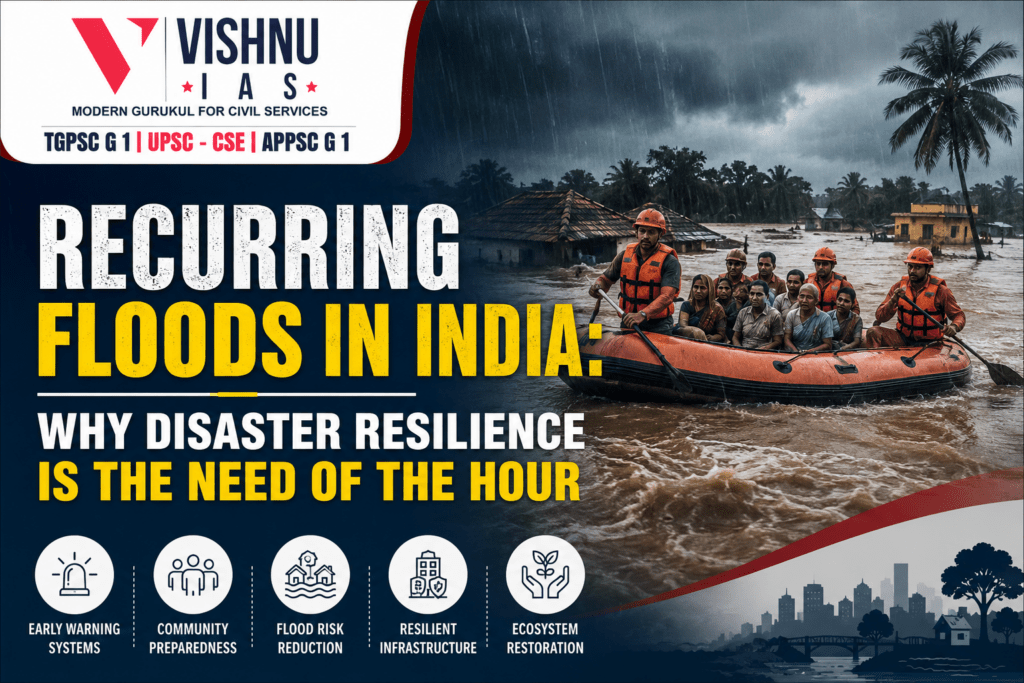
Recurring Floods in India have become one of the biggest disaster management challenges due to climate change, rapid urbanisation, deforestation, floodplain encroachments, and inadequate drainage systems. The increasing frequency and intensity of floods demand a shift from a relief-centric approach to a resilience-based disaster management strategy that prioritises prevention, preparedness, mitigation, and adaptive recovery.
Introduction
- Floods are the most frequent natural disaster in India, affecting millions annually through riverine flooding, flash floods, urban flooding, glacial lake outburst floods (GLOFs), and coastal inundation. Nearly 40 million hectares (about 12% of India's geographical area) are flood-prone.
- Climate change, rapid urbanisation, encroachment of floodplains, deforestation, and inadequate drainage have increased the frequency and intensity of floods. Consequently, India must move beyond a relief-centric disaster response towards a resilience-based approach that focuses on prevention, preparedness, mitigation, and adaptive recovery.
Need for Shift Towards Disaster Resilience
1. Climate Change Has Intensified Flood Frequency and Severity
- Rising temperatures have increased the occurrence of extreme rainfall events, cloudbursts, and glacial melt, making floods more frequent and unpredictable. Traditional relief measures are inadequate against increasingly complex climate-induced disasters.
- Example: Recent floods in Assam, Himachal Pradesh, Kerala, and the 2023 Sikkim GLOF highlighted the growing impact of climate change on flood disasters.
2. High Human and Economic Losses Require Preventive Action
- Recurring floods cause loss of lives, displacement, destruction of crops, livestock, housing, and public infrastructure, imposing heavy fiscal burdens on governments. Investing in resilience reduces long-term recovery costs compared to repeated expenditure on relief and rehabilitation.
- Example: The recurring floods in Bihar and Assam require annual relief expenditure, underscoring the need for permanent mitigation measures.
3. Protecting Critical Infrastructure and Economic Activity
- Floods disrupt transportation networks, power supply, telecommunications, industries, and essential public services. Building resilient infrastructure ensures continuity of economic activity and faster post-disaster recovery.
- Government Initiative: Coalition for Disaster Resilient Infrastructure (CDRI), launched by India, promotes resilient infrastructure against climate and disaster risks.
4. Enhancing Community Preparedness and Reducing Vulnerability
- Communities equipped with early warning systems, evacuation plans, and disaster awareness experience significantly lower casualties. Community participation strengthens local resilience and enables quicker response during disasters.
- Example: Odisha's disaster preparedness model has demonstrated the effectiveness of community-based evacuation and early warning systems in reducing disaster-related deaths.
5. Ensuring Sustainable Urban Development
- Rapid urbanisation, concretisation, and encroachment of wetlands and natural drainage channels have increased urban flooding. Resilient urban planning can minimise waterlogging and protect cities from extreme rainfall events.
- Example: Chennai (2015, 2023) and Bengaluru (2022) floods exposed the consequences of poor urban planning and wetland encroachments.
6. Safeguarding Agriculture and Food Security
- Floods destroy standing crops, damage irrigation infrastructure, and reduce farmers' incomes, threatening food security. Climate-resilient agriculture and flood-resilient infrastructure reduce agricultural vulnerability.
- Government Initiative: Pradhan Mantri Fasal Bima Yojana (PMFBY) provides insurance coverage against crop losses due to floods and other natural disasters.
7. Protecting Vulnerable Sections of Society
- Women, children, elderly persons, persons with disabilities, and economically weaker sections suffer disproportionately during floods. Disaster resilience integrates inclusive planning, social protection, and livelihood security.
- International Framework: The Sendai Framework for Disaster Risk Reduction (2015–2030) advocates shifting from disaster management to disaster risk reduction through prevention, preparedness, and resilience. It also advocates for a people-centred approach.
Measures Required to Build Disaster Resilience
1. Strengthen Early Warning Systems and Forecasting
- Improve real-time flood forecasting through Doppler weather radars, satellite monitoring, AI-based forecasting, and integrated river basin monitoring.
- Enhance dissemination of timely warnings through digital platforms and local governance institutions.
- Initiatives: IMD's Impact-Based Forecasting and CWC's Flood Forecasting System.
2. Adopt Integrated River Basin Management
- Flood management should shift from fragmented state-level interventions to basin-wide planning involving upstream and downstream coordination.
- Scientific reservoir operations and catchment area treatment reduce flood risks.
- Example: Integrated management of the Ganga and Brahmaputra river basins.
3. Restore Natural Ecosystems as Flood Buffers
- Wetlands, mangroves, forests, and floodplains naturally absorb excess water and reduce flood intensity.
- Prevent encroachments and promote ecosystem-based disaster risk reduction.
- Examples: National Plan for Conservation of Aquatic Ecosystems (NPCA) and MISHTI (Mangrove Initiative for Shoreline Habitats & Tangible Incomes).
4. Promote Climate-Resilient Urban Planning
- Implement flood-sensitive land-use planning, improve stormwater drainage, enforce zoning regulations, and preserve urban water bodies.
- Integrate flood resilience into Smart Cities and AMRUT projects.
- Example: Sponge City concepts adopted internationally provide useful lessons for Indian cities.
5. Build Disaster-Resilient Infrastructure
- Design roads, bridges, embankments, schools, hospitals, and public utilities to withstand flood risks.
- Incorporate climate risk assessments into infrastructure planning.
- India launched the Coalition for Disaster Resilient Infrastructure (CDRI) to help countries upgrade infrastructure, share knowledge, and align with Sustainable Development Goals (SDGs).
6. Strengthen Local Governance and Community Participation
- Equip Panchayats and Urban Local Bodies with disaster management plans, financial resources, and technical capacity.
- Conduct regular mock drills, awareness campaigns, and community-based disaster preparedness programmes.
- The 73rd and 74th Constitutional Amendments empower local bodies in disaster preparedness and local planning.
7. Improve Risk Financing and Insurance Mechanisms
- Expand flood insurance, disaster risk financing, and resilient recovery funds to support households and businesses.
- Encourage public-private partnerships for disaster risk reduction investments.
- Examples: Pradhan Mantri Fasal Bima Yojana (PMFBY) and State Disaster Response Funds (SDRF).
8. Strengthen Institutional Coordination
- Improve coordination among NDMA, SDMAs, CWC, IMD, NDRF, State agencies, and local governments through integrated disaster governance.
- Mainstream disaster risk reduction into development planning.
Conclusion
Recurring floods demonstrate that relief-centric disaster management is no longer sufficient in an era of climate uncertainty and rapid urbanisation.
India must institutionalise risk-informed planning, resilient infrastructure, ecosystem restoration, community participation, and integrated governance to build long-term disaster resilience. A proactive resilience-based approach will not only minimise disaster losses but also strengthen sustainable development, climate adaptation, and the vision of Viksit Bharat 2047.