

Introduction:
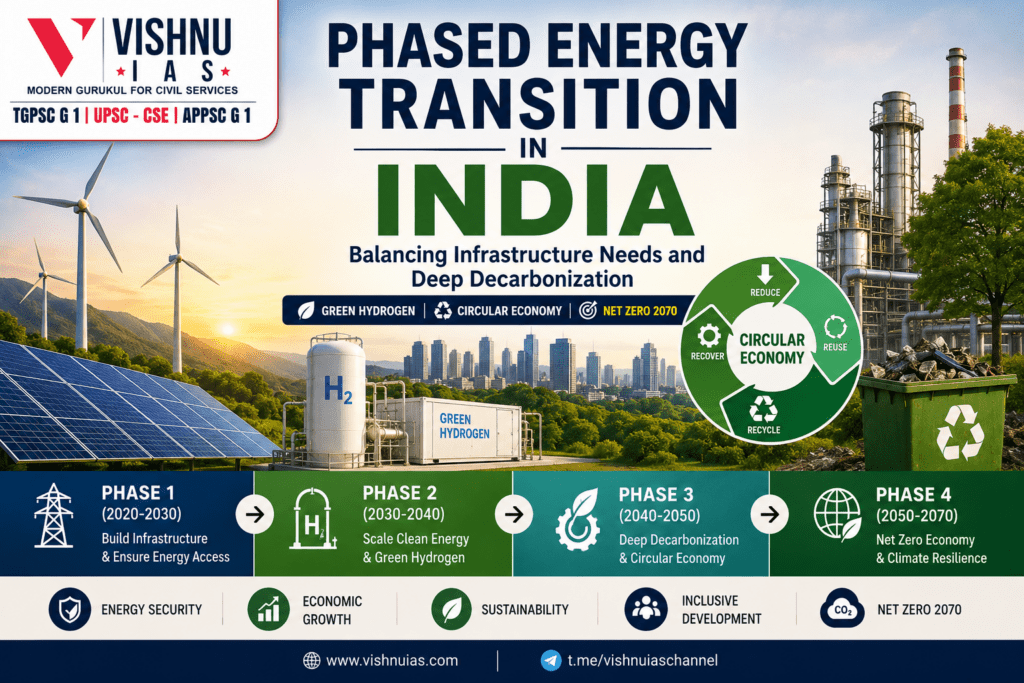
- A phased energy transition refers to a sequenced and adaptive transformation of the energy system, wherein immediate investments in energy access, infrastructure, reliability and affordability progressively evolve into a low-carbon, resource-efficient and climate-resilient economy.
- As one of the world’s fastest-growing energy markets, India has expanded its renewable energy capacity from about 40 GW in 2015 to nearly 260 GW by 2025, while achieving near-universal household electrification and significantly improving access to clean cooking fuels.
- Against the backdrop of energy self-reliance by 2047 and net-zero emissions by 2070, a phased transition provides a pragmatic pathway to reconcile developmental imperatives with long-term decarbonization.
Body:
I. Significance of a Phased Transition in Meeting Immediate Infrastructure Requirements
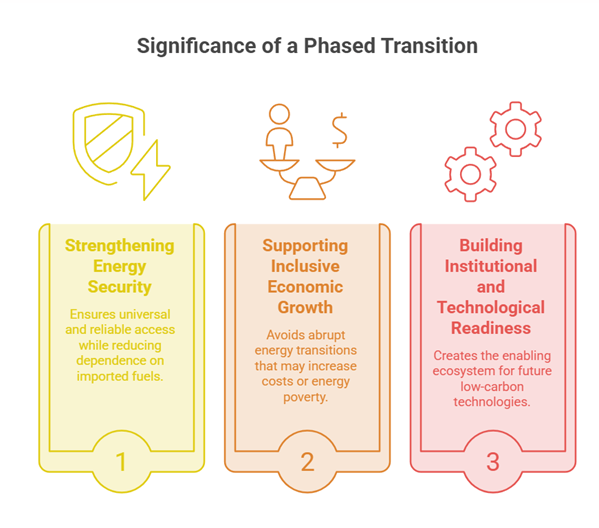
1. Strengthening energy security while ensuring universal and reliable access
- A phased approach enables simultaneous expansion of generation, transmission, storage and distribution infrastructure, thereby maintaining reliability amid rapidly growing electricity demand driven by industrialisation and urbanisation.
- It reduces excessive dependence on imported crude oil and natural gas through gradual diversification into renewables, domestic bio-resources and cleaner conventional fuels, strengthening long-term energy security.
- Example: The nationwide expansion of household electrification under Saubhagya and clean cooking access through Pradhan Mantri Ujjwala Yojana demonstrates how foundational infrastructure can become the base for future clean-energy adoption.
2. Supporting inclusive economic growth without disrupting development
- Phased implementation avoids abrupt energy transitions that may increase production costs, inflationary pressures or energy poverty, thereby ensuring affordability alongside sustainability.
- It facilitates continued industrial growth by allowing existing sectors to gradually adopt cleaner technologies while maintaining competitiveness.
- Case Study: India’s rapid renewable energy expansion alongside sustained economic growth illustrates that capacity addition and development objectives can progress simultaneously through calibrated policy interventions.
3. Building institutional and technological readiness
- Initial investments in smart grids, battery storage, digital energy management systems and transmission corridors create the enabling ecosystem for future low-carbon technologies.
- Coordinated planning across generation, transmission, storage, distribution and emerging technologies minimizes fragmentation and enhances system resilience.
- Government Initiative: The National Smart Grid Mission, Green Energy Corridor Projects and transmission expansion support greater renewable integration while preparing the grid for future flexibility requirements.
II. Enabling Long-Term Deep Decarbonization through Sequential Transformation
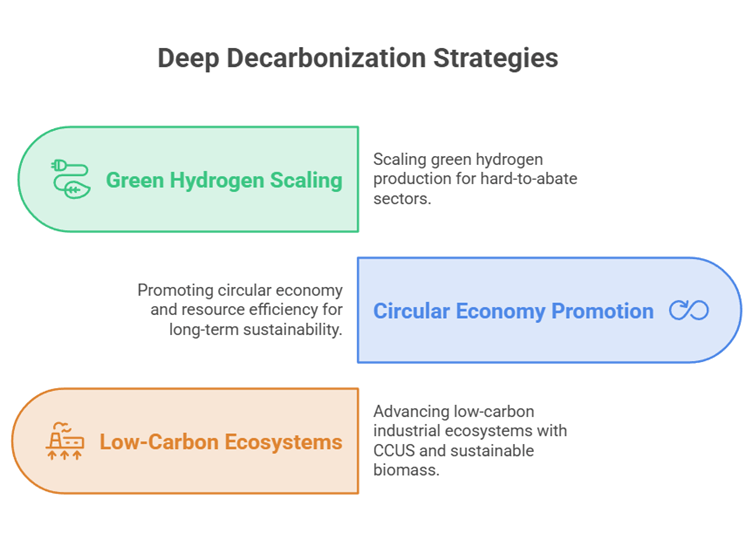
1. Scaling green hydrogen and hard-to-abate sector decarbonization
- Once reliable renewable capacity and transmission networks are established, surplus renewable electricity can support large-scale Green Hydrogen production for steel, fertilizers, refineries and heavy transport.
- Phased deployment reduces production costs through technological learning, economies of scale and infrastructure maturity.
- Government Initiative: The National Green Hydrogen Mission seeks to position India as a global hub for production, utilization and export of green hydrogen and its derivatives.
2. Promoting circular economy and resource efficiency
- Long-term sustainability requires shifting from a linear “take-make-dispose” model towards a Circular Economy, where waste becomes a productive resource.
- Resource recovery, recycling, industrial symbiosis and extended producer responsibility reduce raw material dependence while lowering emissions.
- Example: Increasing recycling of metals, batteries, construction waste and electronic waste reduces extraction pressure and supports cleaner industrial growth.
3. Advancing low-carbon industrial ecosystems
- Deep decarbonization extends beyond electricity to include Carbon Capture, Utilisation and Storage (CCUS), sustainable biomass, waste-to-energy systems and low-carbon manufacturing.
- These technologies particularly benefit sectors where direct electrification remains technically challenging.
- Case Study: Pilot CCUS initiatives in cement and thermal power sectors indicate the potential to reduce industrial emissions while preserving industrial productivity during the transition.
III. Challenges, Strategic Priorities and the Way Forward
1. Addressing financial, technological and governance constraints
- Large-scale investments are required for renewable integration, storage technologies, hydrogen infrastructure and circular economy value chains.
- Regulatory coordination across multiple institutions remains essential to avoid fragmented planning and implementation delays.
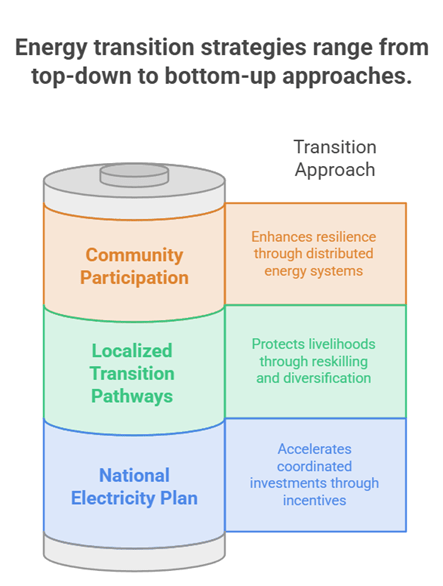
- Government Initiative: The National Electricity Plan, production-linked incentive schemes and green finance initiatives seek to accelerate coordinated investments.
2. Ensuring a just and region-specific transition
- Energy transition policies must protect livelihoods dependent on fossil-fuel industries through reskilling, social protection and economic diversification.
- Regional differences in resource availability require localized transition pathways rather than uniform policy prescriptions.
- Case Study: Renewable energy parks in Rajasthan and Gujarat demonstrate how region-specific resource advantages can generate employment while supporting clean energy expansion.
3. Integrating innovation, resilience and community participation
- Future energy systems require greater deployment of distributed renewable energy, digital technologies, energy storage and climate-resilient infrastructure.
- Public-private partnerships, research institutions and local communities must jointly drive innovation and implementation.
- Example: Expansion of rooftop solar, decentralized biomass projects and community-based renewable systems enhances resilience while improving last-mile energy delivery.
Conclusion:
- A phased transition recognizes that energy security, affordability, inclusiveness and sustainability are complementary rather than competing objectives. By first strengthening infrastructure and institutional capacity before advancing transformative technologies such as Green Hydrogen, CCUS and Circular Economy practices, India can achieve a resilient and economically viable low-carbon transition.
- With renewable energy accounting for an increasingly significant share of installed power capacity and long-term national commitments guiding policy, a calibrated and integrated approach offers the most credible pathway toward energy self-reliance, sustainable industrialization and net-zero emissions by 2070.