

Introduction:
- Artificial Intelligence (AI) has evolved from a transformative digital technology into a strategic geopolitical asset, with frontier AI models—requiring approximately 10²⁵ floating-point operations (FLOPs) for training—now increasingly treated as instruments of national power, economic competitiveness, and technological sovereignty.
- As AI-driven sectors are projected to contribute over $15 trillion to the global economy by 2030, while India’s digital economy is expected to account for nearly one-fifth of national GDP by the end of this decade, the growing trend of AI nationalism, export controls, and strategic technology restrictions presents both unprecedented opportunities and structural vulnerabilities for India’s globally integrated digital economy.
Body:
1. Geopolitical Weaponization of Frontier AI and Challenges to India’s Digital Economy
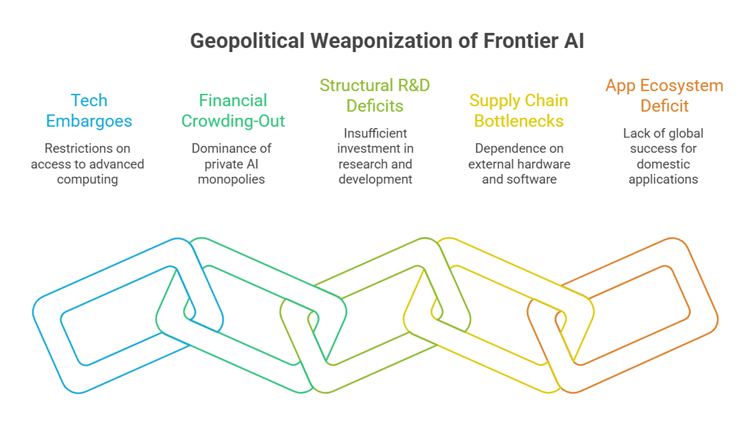
Tech Embargoes and Asymmetric Access Control
- Arbitrary Access Restrictions: Advanced economies have begun placing strict national security restrictions on foreign nationals accessing cutting-edge computing architectures. When access to foundational models is suspended on geopolitical grounds, domestic developers, startups, and enterprises face a sudden loss of critical building blocks, creating an existential risk for consumer software applications.
- Pre-Clearance and Early-Access Asymmetry: Presidential and federal executive mandates in tech-surplus nations have created frameworks that allow domestic state agencies to access advanced models up to 30 days before they are shared with trusted global partners. This institutionalized lag ensures that foreign markets remain perpetual second-tier adopters, handicapping their real-time competitiveness in high-frequency trading, automated cybersecurity defenses, and advanced logistics.
- Example: The United States government’s directive restricting access to Anthropic’s advanced Fable 5 and Mythos 5 models for foreign nationals serves as a clear template for how proprietary technology can be instantly weaponized on national security grounds.
Financial Crowding-Out and Structural R&D Deficits
- Capital Scale Mismatch: The global private AI monopolies possess financial outlays that dwarf the total innovation budgets of medium-sized economies. When a single multinational corporation outspends an entire nation’s combined public and private research expenditures multiple times over, local innovators are crowded out of the frontier market, cementing a subordinate position in the global tech hierarchy.
- Stagnant Innovation Metrics: The domestic gross expenditure on research and development sits at approximately 0.64% of Gross Domestic Product (GDP), with the private sector contributing only a third of this total. This financial shortfall limits the capability to build capital-intensive foundational infrastructure from scratch, restricting local enterprises to superficial wrapper-application development.
- Case Study: OpenAI’s projected compute spending of approximately $50 billion within a single fiscal year demonstrates an scale gap that is over six times the total annual private research and development spending of India.
Structural Supply Chain Bottlenecks and Vulnerabilities
- The Component Dependency Trap: Emphasizing software deployment without securing hardware linkages or chemical active bases leaves industrial ecosystems highly brittle. Much like strategic sectors that remain dependent on external imports for core raw materials despite local incentive policies, a digital economy that relies on external graphic processing units (GPUs) and foundational models can be crippled by unilateral export controls.
- The App Ecosystem Deficit: Despite massive domestic mobile internet penetration, local application developers have failed to secure a meaningful global footprint. No indigenous consumer application ranks within the global top ten in terms of active monthly users or in-app purchase revenues, revealing a deep deficit in high-value software product creation.
2. Navigating the Dilemma: Balancing Rapid Diffusion and Strategic Autonomy
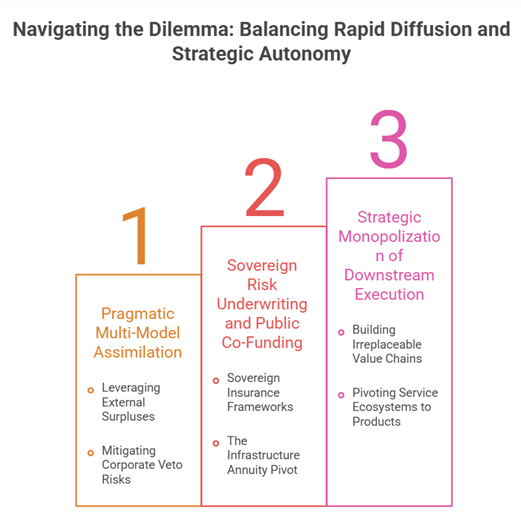
Pragmatic Multi-Model Assimilation
- Leveraging External Surpluses: To accumulate the necessary capital and technical expertise to build autonomous infrastructure tomorrow, domestic firms must use the absolute best frontier technology available today. Preventing local industries from accessing foreign proprietary architectures in the name of protectionism would depress service sector productivity and cripple global competitiveness.
- Mitigating Corporate Veto Risks: While businesses must remain open to global digital ecosystems, public policy must actively insulate them from geopolitical shocks. This involves setting up data architectures that ensure corporate workflows can pivot seamlessly across competing global cloud environments if one provider enforces a sudden geopolitical embargo.
Sovereign Risk Underwriting and Public Co-Funding
- Sovereign Insurance Frameworks: Individual private enterprises cannot insure themselves against geopolitical friction or concentrated technology blockades. Public policy must introduce sovereign risk-mitigation toolkits, mimicking export credit frameworks, to insulate domestic technology startups from systemic supply chain shocks.
- The Infrastructure Annuity Pivot: To construct high-gestation capital infrastructure like advanced compute farms, the state must implement co-investment models. By utilizing public-private partnerships where the sovereign funds a significant portion of initial capital expenditure and guarantees long-term fixed payments, private venture capital can be drawn into building local sovereign compute.
Strategic Monopolization of Downstream Execution
- Building Irreplaceable Value Chains: Rather than engaging in a direct, unviable spending war on core foundational architectures, policy must focus on dominating the downstream application layer. By creating world-class, localized specialized datasets in agriculture, healthcare, and digital governance, the nation can establish counter-leverage against global model creators.
- Pivoting Service Ecosystems to Products: The traditional IT service landscape must evolve beyond labour arbitrage and visa dependency management. It must leverage its vast engineering pool to transform into a provider of enterprise software-as-a-service (SaaS) products that embed sovereign AI directly into global corporate workflows.
3. Policy Structural Interventions for a Sovereign Strategic Future
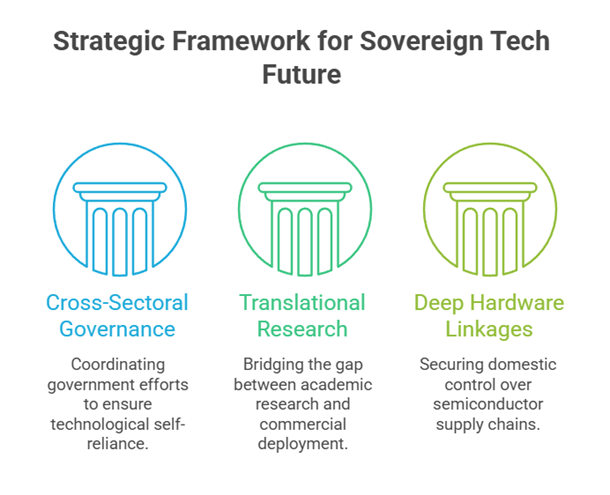
Deploying Cross-Sectoral Whole-of-Government Governance
- Inter-Ministerial Strategic Synthesis: Technological self-reliance cannot be managed solely by a single digital ministry. Securing access to global tech supply networks requires a coordinated, whole-of-government mandate that combines trade diplomacy, intelligence, energy planning, and communication protocols.
- Compute as a Core Public Utility: High-performance computing power must be reclassified as a strategic national asset, on par with nuclear energy and aerospace infrastructure. This status unlocks long-term sovereign protections and guarantees that data centers receive priority grid access and long-term economic exemptions.
Institutionalizing Translational Research Ecosystems
- Bridging the Prototyping Valley of Death: Domestic scientific institutions excel at early-stage academic research but struggle with commercial deployment. State funding must be redirected away from pure theoretical papers toward setting up specialized centers designed to convert lab-scale prototypes into market-ready industrial solutions.
- Catalyzing Private Innovation Capital: Recognizing the low private sector contribution to domestic research, public funds must be used as a force multiplier. Long-term, concessional sovereign loans must be extended to specialized fund managers to incentivize private venture capital investments in core deep-tech domains.
Cultivating Deep Hardware and Infrastructure Linkages
- Securing the Silicon Substrate: A truly sovereign AI strategy cannot exist without domestic control over the underlying semiconductor supply chain. Fabricating chipsets locally ensures that advanced computing nodes cannot be remotely deactivated or restricted by foreign export regimes.
- Long-Horizon Fiscal Environments: Building capital-intensive server clusters requires decades of regulatory certainty. The state must provide long-term fiscal safe harbours and tax immunities to incentivize global and domestic infrastructure giants to place their physical compute footprints within domestic borders.
Conclusion:
- The emerging era of AI geopolitics signifies that competitive advantage will increasingly depend not merely on possessing advanced algorithms but on controlling compute infrastructure, data ecosystems, semiconductor supply chains, and global digital standards.
- For India, the optimal strategy lies neither in technological protectionism nor unrestricted dependence, but in pursuing strategic technological autonomy—leveraging global frontier AI for immediate economic gains while steadily building indigenous capabilities through research, innovation, resilient supply chains, and international partnerships.
- As global estimates suggest AI could add over $15 trillion to the world economy by 2030, India’s ability to combine rapid AI diffusion with long-term technological self-reliance will determine its emergence as a leading digital power in the evolving knowledge economy.