
Introduction:
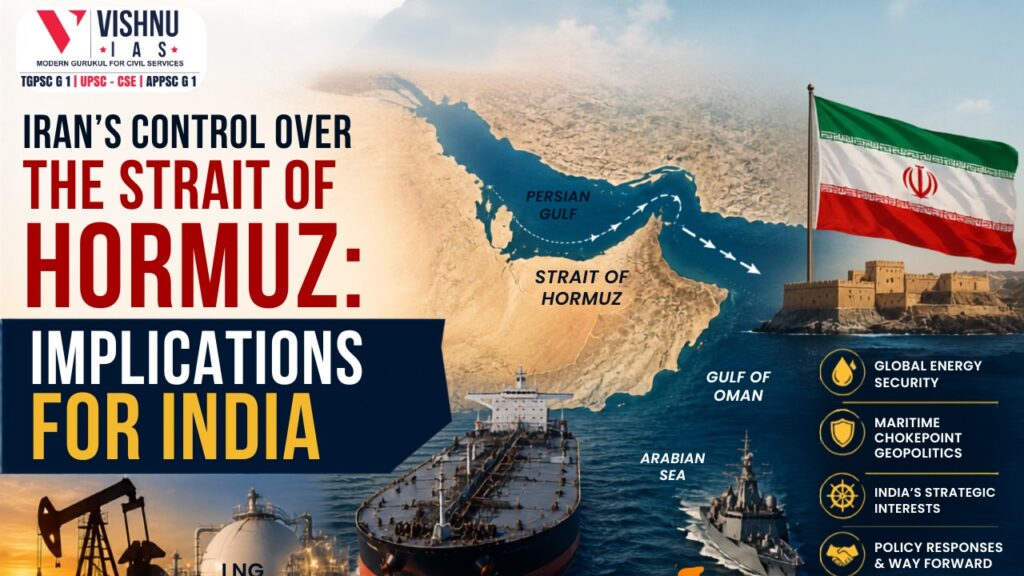
- The Strait of Hormuz is one of the world’s most critical maritime chokepoints, connecting the Persian Gulf with the Gulf of Oman and the Arabian Sea. Nearly one-fifth of global petroleum consumption and a significant share of the world’s Liquefied Natural Gas (LNG) trade pass through this narrow waterway, making it central to global energy security and maritime commerce.
- Iran’s increasing assertion of authority over maritime transit in the Strait reflects the growing use of geoeconomic leverage, where control over strategic sea lanes can influence global trade flows, energy markets, and geopolitical outcomes. This development has profound implications for the evolving maritime order and for countries such as India that remain heavily dependent on Gulf energy supplies.
Body:
I. Impact of Iran’s Assertion on the Global Maritime Framework
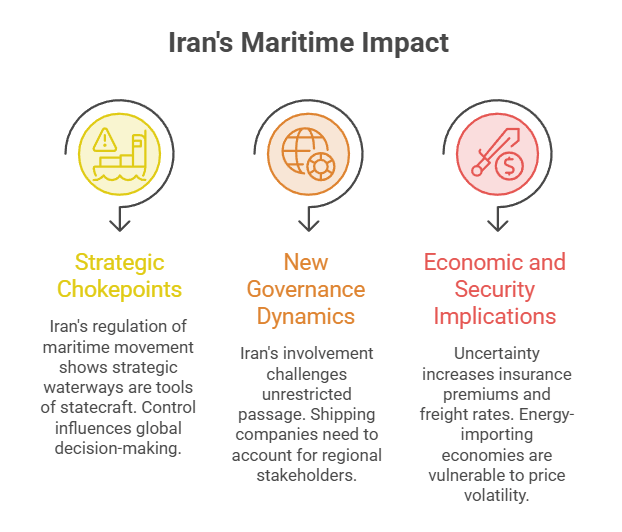
1. Transformation of Strategic Chokepoints into Instruments of Geopolitical Influence
- Iran’s growing role in regulating maritime movement demonstrates how strategic waterways have become tools of statecraft, complementing traditional military and economic instruments.
- Control over critical sea lanes now influences global decision-making as much as conventional economic sanctions, reshaping the balance between maritime powers and regional actors.
- Example – Russia–Ukraine Conflict: Disruptions in the Black Sea grain corridor highlighted how control over maritime routes can affect global food security and diplomatic negotiations.
2. Emergence of New Maritime Governance Dynamics
- Increased involvement of Iran in transit management challenges the traditional principle of relatively unrestricted passage through international chokepoints.
- Shipping companies may increasingly need to account for multiple regional stakeholders, creating a more complex framework of maritime administration.
- The development signals a shift from a predominantly globalized maritime system toward a more regionalized governance architecture, where coastal states seek greater influence over adjacent sea lanes.
- Case Study – South China Sea: China’s assertion of maritime claims through the “Nine-Dash Line” demonstrates how coastal powers are increasingly attempting to shape maritime governance in strategically important waters.
3. Economic and Security Implications for Global Shipping
- Greater uncertainty in transit routes increases insurance premiums, freight rates, and compliance costs, affecting global supply chains.
- Energy-importing economies become vulnerable to price volatility whenever geopolitical tensions escalate in strategic waterways.
- Increased naval deployments by external powers may lead to further militarization of sea lanes, raising the risks of maritime incidents.
- Example – Red Sea Crisis (2023–25): Attacks on commercial shipping led several companies to reroute vessels around the Cape of Good Hope, increasing transit time and transportation costs substantially.
II. Strategic Implications for India
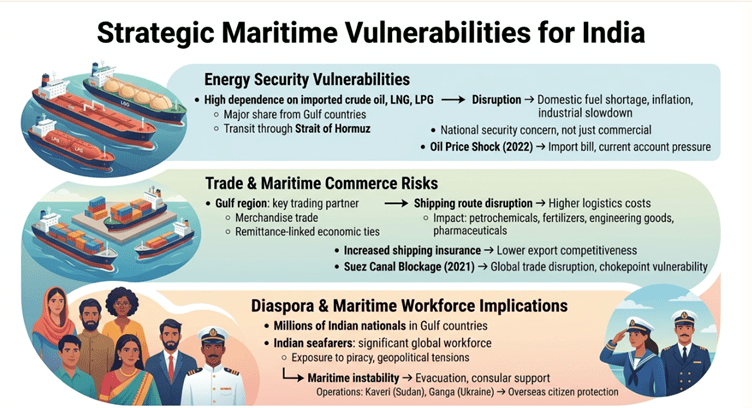
1. Energy Security Vulnerabilities
- India imports a significant share of its crude oil, LNG, and LPG requirements, with a substantial portion originating from Gulf countries and transiting through the Strait of Hormuz.
- Any disruption can directly affect domestic fuel availability, inflation, industrial production, and economic growth.
- India’s dependence on imported energy makes maritime disruptions a critical national security concern rather than merely a commercial issue.
- Example – Oil Price Shock of 2022: Rising global energy prices widened India’s import bill and current account pressures, demonstrating the economy’s sensitivity to external energy disruptions.
2. Risks to Trade and Maritime Commerce
- The Gulf region remains one of India’s largest trading partners, accounting for substantial merchandise trade and remittance-linked economic ties.
- Disruptions in shipping routes can increase logistics costs for exports and imports, affecting sectors such as petrochemicals, fertilizers, engineering goods, and pharmaceuticals.
- Higher shipping insurance costs can reduce competitiveness of Indian exports in global markets.
- Case Study – Suez Canal Blockage (2021): The blockage by the vessel Ever Given disrupted global trade and highlighted how dependence on a few maritime chokepoints creates systemic vulnerabilities.
3. Implications for Diaspora and Maritime Workforce
- Millions of Indian nationals reside in Gulf countries, making regional stability a major concern for India.
- Indian seafarers constitute a significant segment of the global maritime workforce and often operate in high-risk waters exposed to piracy and geopolitical tensions.
- Maritime instability may require large-scale evacuation and consular support operations.
- Example – Operation Kaveri (Sudan) and Operation Ganga (Ukraine): These operations demonstrate India’s growing capacity to protect overseas citizens during geopolitical crises.
III. Policy Responses and Strategic Options for India
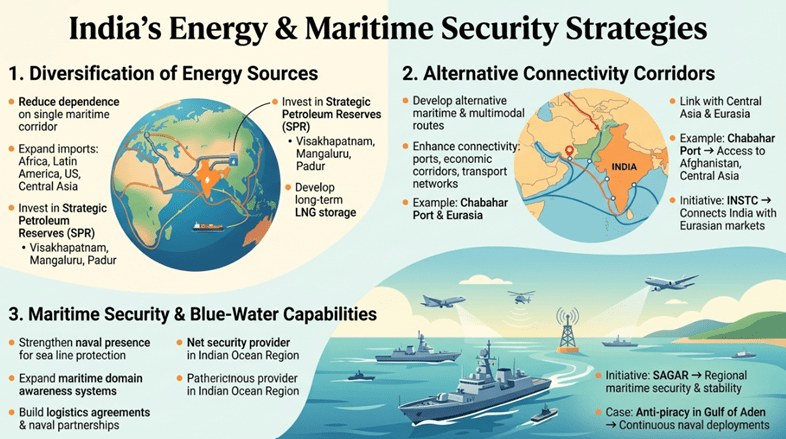
1. Diversification of Energy Sources and Supply Chains
- India must reduce excessive dependence on any single maritime corridor through diversification of suppliers and routes.
- Expanding imports from regions such as Africa, Latin America, the United States, and Central Asia can strengthen resilience against regional disruptions.
- Greater investment in Strategic Petroleum Reserves (SPR) and long-term LNG storage infrastructure can provide buffers during crises.
- Government Initiative – Strategic Petroleum Reserve Programme: Underground reserves at locations such as Visakhapatnam, Mangaluru, and Padur strengthen emergency preparedness.
2. Strengthening Alternative Connectivity Corridors
- Developing alternative maritime and multimodal routes can reduce dependence on the Strait of Hormuz.
- Enhanced connectivity through ports, economic corridors, and international transport networks can diversify trade pathways.
- Projects linking India with Central Asia and Eurasia can improve strategic flexibility.
- Example – Chabahar Port: Provides access to Afghanistan and Central Asia while reducing reliance on traditional transit routes through Pakistan.
- Government Initiative – International North-South Transport Corridor (INSTC): Seeks to connect India with Eurasian markets through multimodal trade networks.
3. Enhancing Maritime Security and Blue-Water Capabilities
- A stronger naval presence is essential to protect sea lines of communication and ensure uninterrupted commerce.
- Expansion of maritime domain awareness systems, logistics agreements, and naval partnerships can improve crisis response capabilities.
- India must continue developing itself as a net security provider in the Indian Ocean Region.
- Government Initiative – SAGAR (Security and Growth for All in the Region): Promotes cooperative maritime security and regional stability.
- Case Study – Anti-Piracy Operations in the Gulf of Aden: Continuous naval deployments have protected merchant vessels and reinforced India’s maritime credibility.
Conclusion:
- Iran’s assertion of influence over the Strait of Hormuz underscores the growing importance of maritime geopolitics in shaping global economic outcomes. The episode demonstrates that strategic chokepoints can become powerful instruments of geoeconomic leverage capable of influencing energy markets, trade flows, and diplomatic behaviour.
- For India, whose economic growth remains closely linked to secure maritime commerce and imported energy, the lesson is clear: resilience must be built through energy diversification, strategic reserves, alternative connectivity corridors, and stronger maritime capabilities.
- As global trade continues to depend on the oceans with over 80% of world merchandise trade by volume moving through sea routes India’s long-term security and prosperity will increasingly depend on its ability to anticipate and adapt to an evolving maritime order.