

Introduction:
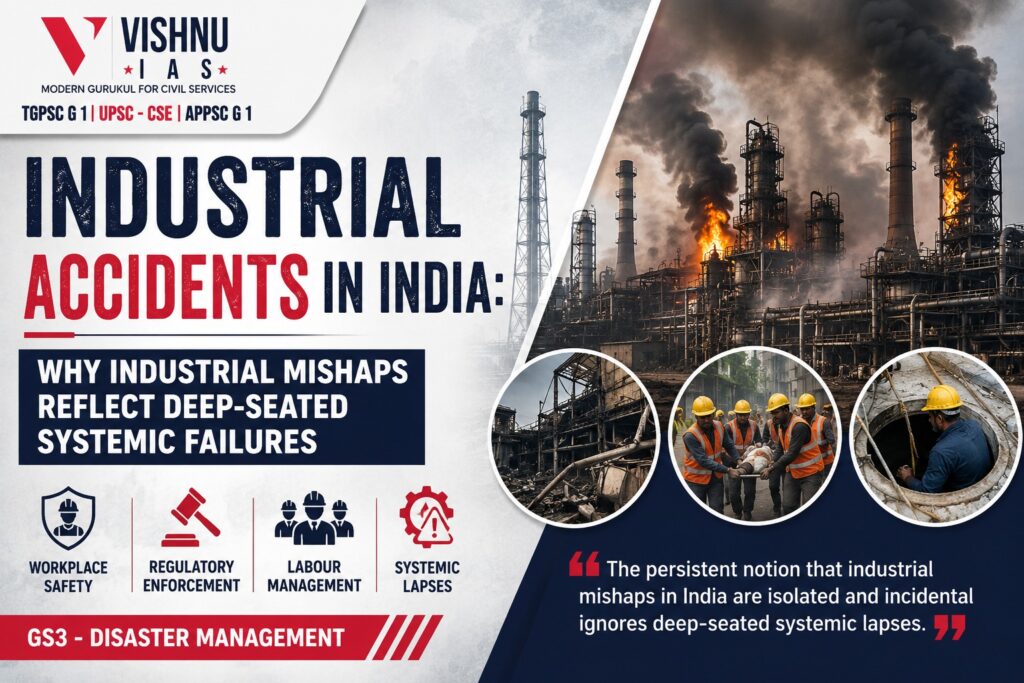
- Industrial accidents refer to unplanned events in industrial establishments that result in loss of life, injury, environmental damage, or disruption of production processes. While such incidents are often portrayed as isolated mishaps, repeated occurrences across sectors indicate the presence of systemic deficiencies in occupational safety, regulatory oversight, workplace culture, and organizational management.
- India continues to face significant occupational safety challenges despite rapid industrialization. Fatal incidents in manufacturing units, mines, construction sites, chemical industries, sanitation work, and heavy engineering plants reveal that many accidents are not random events but manifestations of accumulated vulnerabilities. The recurring nature of such tragedies suggests that industrial disasters are often the outcome of preventable failures rather than unforeseeable events.
Body:
I. Why industrial mishaps in India often reflect deep-seated systemic lapses
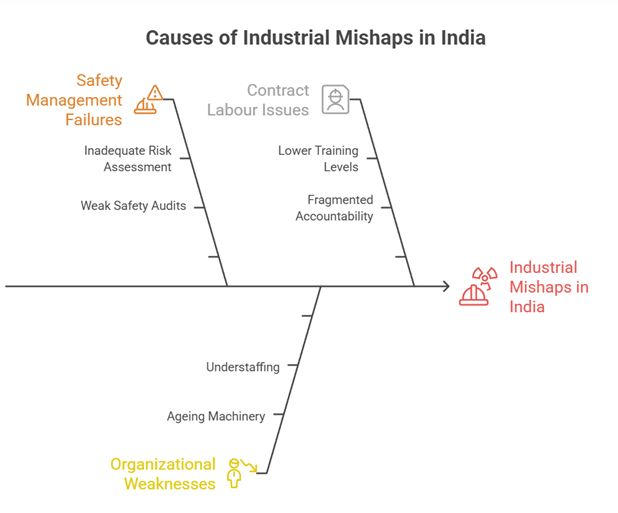
1. Persistent failures in occupational safety management
- Many industrial establishments continue to treat safety compliance as a procedural requirement rather than an operational priority, resulting in inadequate risk assessment, weak safety audits, and poor emergency preparedness.
- Fatalities in confined spaces, septic tanks, and sewage systems frequently occur because workers enter hazardous environments without protective gear, gas detectors, ventilation systems, or rescue mechanisms despite long-established safety protocols.
- Example: Repeated septic tank and sewer deaths across several states demonstrate continuing violations of the prohibition on hazardous cleaning and manual scavenging despite statutory safeguards.
2. Organizational weaknesses and deferred maintenance
- Major industrial accidents often emerge from a gradual accumulation of risks such as ageing machinery, delayed repairs, inadequate inspections, understaffing, and excessive workload pressures.
- Financially stressed units may prioritize production targets and cost reduction over preventive maintenance, thereby increasing the probability of catastrophic failures.
- Case Study: The explosion at a major steel plant in Visakhapatnam highlighted concerns regarding equipment reliability, maintenance practices, staffing patterns, and operational oversight in high-risk industrial environments.
3. Structural vulnerabilities associated with contract labour
- Contract workers frequently perform hazardous tasks while receiving comparatively lower levels of training, supervision, and social protection than permanent employees.
- Fragmented accountability between principal employers and contractors often weakens responsibility for workplace safety.
- Occupational safety research consistently shows higher accident rates among temporary and outsourced workers because of insecure employment conditions and inadequate skill development.
- Example: Numerous industrial incidents in construction, mining, ports, and manufacturing sectors have involved contract workers undertaking high-risk operations without adequate safeguards.
II. Factors reinforcing the systemic nature of industrial accidents
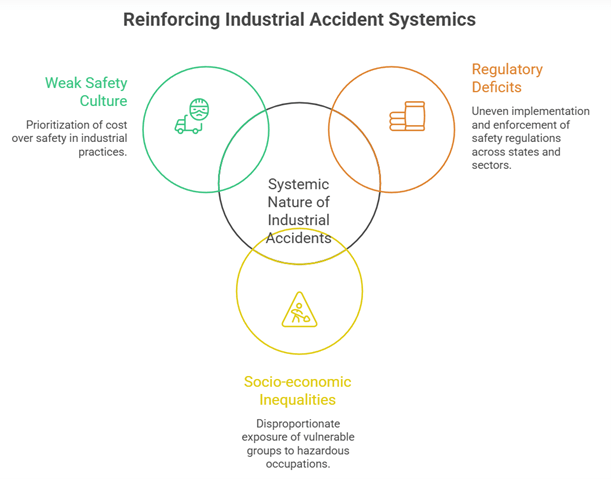
1. Regulatory and enforcement deficits
- India possesses an extensive legal framework, including the Occupational Safety, Health and Working Conditions Code, 2020, yet implementation remains uneven across states and sectors.
- Labour inspections are often constrained by manpower shortages, limited technical expertise, and difficulties in monitoring small and medium enterprises.
- Compliance frequently becomes documentation-driven rather than outcome-oriented, reducing the effectiveness of safety regulations.
- Government Initiative: Digital inspection systems and risk-based compliance mechanisms are being promoted to improve transparency and enforcement effectiveness.
2. Socio-economic inequalities and hazardous labour exposure
- Dangerous occupations continue to be disproportionately performed by economically vulnerable groups, migrant workers, informal labourers, and socially marginalized communities.
- Such workers often lack bargaining power, safety awareness, insurance coverage, and access to grievance redressal mechanisms.
- The persistence of hazardous sanitation work illustrates how occupational risk is intertwined with broader issues of social exclusion and labour precarity.
- Example: Fatal sewer and septic tank incidents frequently involve workers employed informally without adequate protective equipment or emergency support.
3. Weak safety culture and the “cost-over-safety” mindset
- In several industries, safety expenditure is perceived as a cost rather than an investment in productivity and sustainability.
- Production deadlines, competitive pressures, and financial constraints can encourage shortcuts in maintenance, training, and compliance.
- International studies have demonstrated that organizations with strong safety cultures experience significantly lower accident frequencies and operational disruptions.
- Case Study: The 2020 gas leak at the chemical facility in Visakhapatnam highlighted how process safety lapses and inadequate preparedness can transform localized failures into large-scale disasters.
III. Why industrial mishaps cannot be viewed solely as systemic failures: the need for a balanced perspective
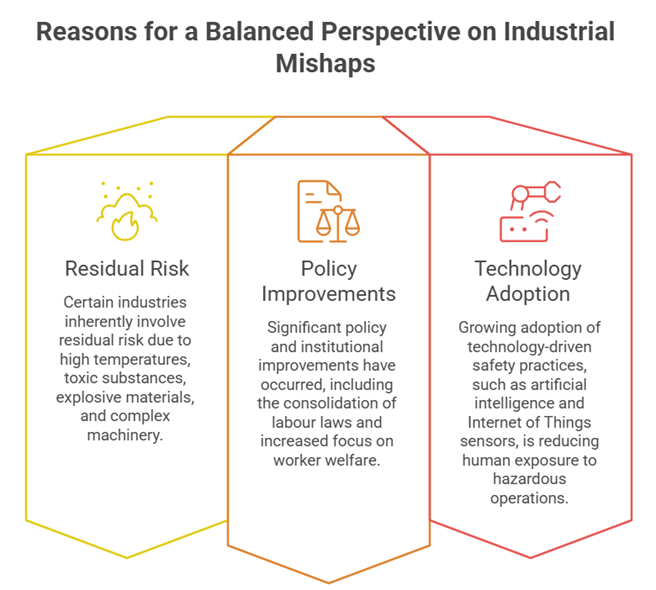
1. Certain industries inherently involve residual risk
- Sectors such as steelmaking, petrochemicals, mining, offshore drilling, and nuclear energy handle high temperatures, toxic substances, explosive materials, and complex machinery where risk can never be completely eliminated.
- Even advanced economies with robust safety systems experience industrial accidents due to technological complexity and unforeseen interactions between processes.
- Example: Major industrial disasters in developed countries demonstrate that residual operational risks persist despite stringent regulations.
2. Significant policy and institutional improvements have occurred
- The consolidation of labour laws into the Occupational Safety, Health and Working Conditions Code, expansion of digital compliance systems, and increased focus on worker welfare indicate gradual progress.
- Industrial clusters increasingly employ automated monitoring systems, predictive maintenance technologies, and real-time hazard detection mechanisms.
- Government Initiative: National programmes promoting industrial modernization, skill development, and technological upgrading are helping improve workplace safety standards.
3. Growing adoption of technology-driven safety practices
- Artificial intelligence, Internet of Things sensors, predictive analytics, remote monitoring, robotics, and automated shutdown systems are increasingly reducing human exposure to hazardous operations.
- Large public and private sector enterprises are investing in behavioural safety programmes, emergency response infrastructure, and internationally recognized safety standards.
- Case Study: Several refineries, ports, and heavy engineering complexes have reported improvements in safety performance through digitized monitoring and predictive maintenance systems.
Conclusion:
- The view that industrial mishaps in India are merely isolated and incidental is only partially valid. While certain residual risks are inherent in industrial activity, the recurring pattern of fatalities in factories, mines, chemical plants, construction sites, and sanitation work points toward systemic shortcomings in safety governance, maintenance practices, labour management, regulatory enforcement, and workplace culture. The concentration of accidents among vulnerable workers further underscores the structural nature of the problem.
- Moving forward, India’s aspiration to become a global manufacturing hub requires a transition from compliance-based safety to culture-based safety, supported by stronger enforcement, universal worker training, technological modernization, accountability in contract labour systems, and preventive risk management. Evidence from industries that have successfully integrated safety into core operations shows that improved occupational safety not only saves lives but also enhances productivity, competitiveness, and long-term industrial sustainability.