
Introduction:
- Critical minerals are mineral resources that are economically indispensable for modern industries, clean-energy technologies, advanced manufacturing, semiconductors, telecommunications and defence systems, while simultaneously facing risks of supply disruption.
- As the world accelerates toward energy transition, demand for minerals such as lithium, cobalt, graphite, nickel, vanadium and rare earth elements (REEs) has risen sharply. India has identified 30 critical minerals and launched the National Critical Mineral Mission (NCMM) to strengthen domestic exploration, mining, processing and supply-chain resilience, with over 1,200 exploration projects targeted by 2030-31.
- Against this backdrop, the Northeast region has emerged as a strategically significant frontier due to its geological potential, geopolitical location and role in India’s long-term resource security.
Body:
I. Why the Northeast Has Acquired Strategic Importance in India’s Critical Mineral Strategy
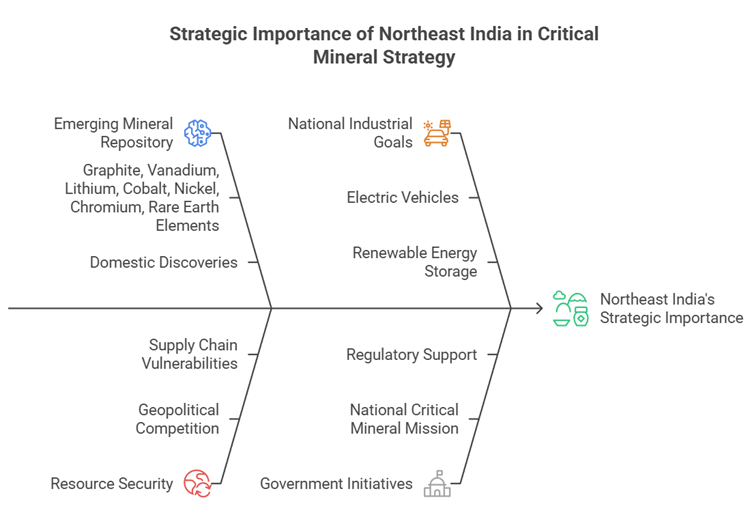
1. Emerging Repository of Critical and Strategic Minerals
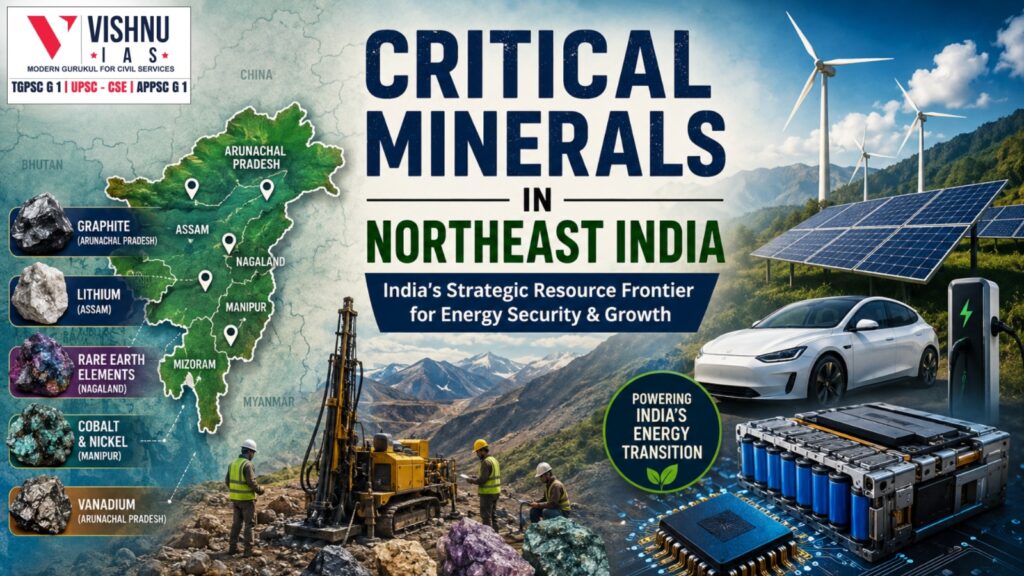
- Geological investigations indicate the presence of graphite, vanadium, lithium, cobalt, nickel, chromium and rare earth elements across several northeastern states, making the region an important component of India’s mineral-security architecture.
- Dependence on imports for battery minerals and rare earths exposes India to external shocks; therefore, domestic discoveries in the Northeast acquire strategic significance beyond their commercial value.
- The region complements India’s broader objective of creating indigenous value chains for electric vehicles, renewable energy storage, electronics and defence manufacturing.
- Example: Arunachal Pradesh hosts significant graphite and vanadium resources, while nickel-cobalt prospects have been identified in parts of Manipur and Nagaland.
2. Resource Security in an Era of Geopolitical Competition
- Global supply chains for critical minerals are heavily concentrated, particularly in mineral processing and refining, creating vulnerabilities during geopolitical tensions.
- Major powers increasingly view critical minerals as instruments of economic security, technological leadership and strategic autonomy.
- India’s efforts to diversify mineral sources align with the broader trend of nations building resilient supply chains and reducing excessive dependence on single-country suppliers.
- Case Study: The global race for lithium and rare earth resources has intensified following disruptions in strategic supply chains during recent geopolitical conflicts and trade restrictions, prompting many countries to expand domestic exploration programmes.
3. Alignment with National Industrial and Energy Transition Goals
- India’s ambition to expand renewable energy capacity, battery manufacturing and semiconductor ecosystems requires secure access to critical minerals.
- The NCMM seeks to integrate exploration, extraction, processing, recycling and strategic stockpiling into a unified framework.
- The Northeast can serve as a domestic source base supporting initiatives related to clean energy, advanced manufacturing and technological self-reliance.
- Government Initiative: The National Critical Mineral Mission aims to strengthen the entire critical mineral value chain and reduce import dependence through accelerated exploration and regulatory support.
II. How the Northeast Fits into the Larger Geopolitical Context
1. From Borderland to Strategic Resource Geography
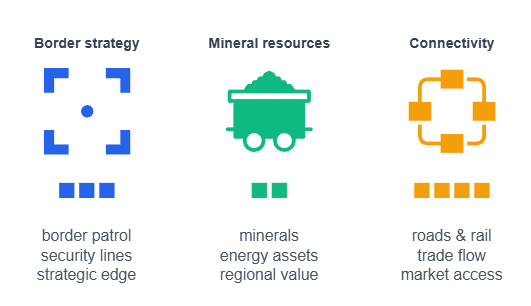
- Historically, the Northeast was viewed primarily through the lens of border management, connectivity and security because of its proximity to multiple international boundaries.
- The rise of critical minerals has expanded this strategic perspective, transforming the region into a resource-rich zone linked to national industrial competitiveness.
- Resource security and territorial security are increasingly converging, making the region important in both economic and geopolitical calculations.
- Example: The Northeast shares borders with China, Myanmar, Bangladesh and Bhutan, placing mineral-rich territories within a broader strategic landscape.
2. Gateway to Indo-Pacific and Regional Supply Chains
- The region’s location enables connectivity with Southeast Asian markets through initiatives such as the Act East Policy.
- Mineral development can complement cross-border infrastructure, logistics corridors and industrial networks connecting India with the wider Indo-Pacific region.
- Access to processing hubs and export routes can strengthen India’s position within emerging critical-mineral supply chains.
- Government Initiative: Projects such as the Kaladan Multi-Modal Transit Transport Project and the India-Myanmar-Thailand Trilateral Highway seek to enhance regional connectivity and economic integration.
3. Strategic Diversification and Economic Resilience
- The development of domestic mineral resources reduces vulnerability arising from concentrated global production networks.
- Resource diversification strengthens India’s bargaining capacity in international economic and technological partnerships.
- Mineral-rich northeastern states can contribute to the creation of a more geographically diversified and resilient national resource base.
- Case Study: Several countries, including the United States, Australia, Japan and members of the European Union, have adopted critical mineral strategies aimed at reducing strategic supply vulnerabilities, reflecting a global trend toward resource security.
III. Challenges and Conditions for Sustainable Resource Development in the Northeast
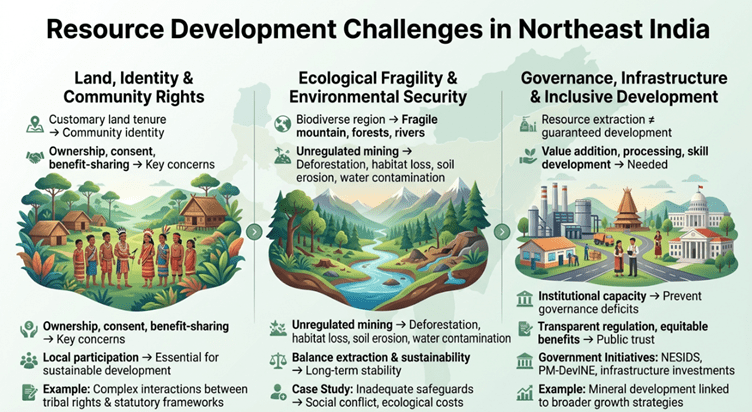
1. Land, Identity and Community Rights
- Large parts of the region operate under customary land tenure systems, where land ownership is closely linked with community identity and traditional governance structures.
- Mineral extraction projects may generate concerns regarding ownership, consent, benefit-sharing and representation.
- Sustainable development requires meaningful participation of local communities in decision-making processes.
- Example: Land-related issues in several northeastern states often involve complex interactions between customary institutions, tribal rights and statutory frameworks.
2. Ecological Fragility and Environmental Security
- The Northeast is one of the world’s most biodiverse regions, characterized by fragile mountain ecosystems, forests and river systems.
- Unregulated mining could intensify risks of deforestation, habitat fragmentation, soil erosion and water contamination.
- Balancing mineral extraction with ecological sustainability is essential for long-term regional stability.
- Case Study: Experiences from mining regions worldwide demonstrate that inadequate environmental safeguards often generate social conflict and long-term ecological costs.
3. Governance, Infrastructure and Inclusive Development
- Resource extraction alone does not guarantee development; value addition, processing industries, skill development and local employment generation are equally important.
- Institutional capacity must keep pace with exploration activities to prevent governance deficits and social tensions.
- Transparent regulatory mechanisms and equitable distribution of benefits are critical for ensuring public trust.
- Government Initiative: The North East Special Infrastructure Development Scheme (NESIDS), PM-DevINE, and investments in transport, digital connectivity and industrial infrastructure seek to improve the developmental ecosystem of the region.
- Example: Recent investments and exploration initiatives in the Northeast increasingly link mineral development with broader infrastructure and industrial growth strategies.
Conclusion:
- The Northeast occupies a unique position at the intersection of resource security, geopolitical strategy, energy transition and regional development. As India seeks to secure critical minerals essential for clean technologies, advanced manufacturing and strategic industries, the region’s mineral potential assumes national significance.
- However, successful integration of the Northeast into India’s critical mineral strategy will depend not merely on extraction, but on inclusive governance, ecological sustainability, community participation and value-chain development.
- If managed responsibly, the region can evolve from a peripheral frontier into a vital pillar of India’s resilient and secure critical-mineral future, supporting both economic growth and strategic autonomy in an increasingly competitive global order.