
Lorem ipsum dolor sit amet, consectetur adipiscing elit. Ut elit tellus, luctus nec ullamcorper mattis, pulvinar dapibus leo.
Introduction:
- A Comprehensive Economic Partnership Agreement (CEPA) is a broad-based trade and economic cooperation framework that goes beyond tariff liberalisation to include goods, services, investment, technology transfer, professional mobility, regulatory cooperation, and strategic economic integration.
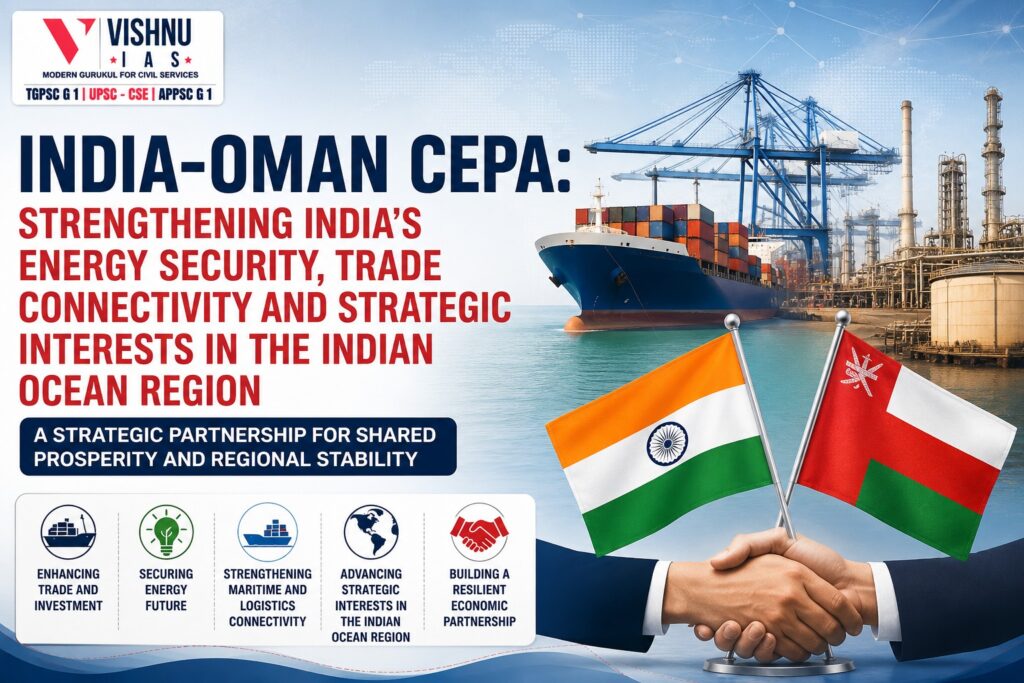
- The operationalisation of the India-Oman CEPA (2026) marks a significant step in India’s engagement with the Gulf region. At a time when the Gulf accounts for a substantial share of India’s energy imports, remittance inflows, maritime trade, and diaspora presence, the agreement assumes importance not merely as a trade pact but as a strategic instrument for advancing India’s long-term interests in the Indian Ocean Region (IOR).
- With bilateral trade crossing $11 billion and Oman providing duty-free access to over 98% of tariff lines, the partnership reflects the growing convergence of economic and geopolitical priorities.
Body:
I. CEPA as a Catalyst for Deepening Economic and Trade Integration
1. Expanding market access and export competitiveness
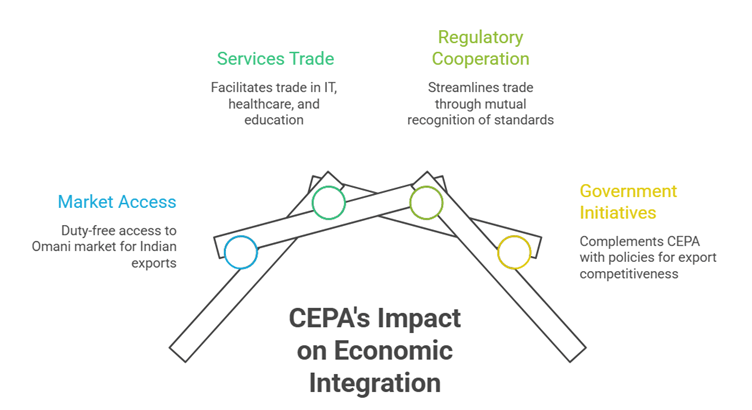
- The agreement provides duty-free access to nearly the entire basket of Indian exports, significantly improving the competitiveness of sectors such as textiles, engineering goods, chemicals, pharmaceuticals, gems and jewellery, seafood and processed food products.
- Reduced trade barriers enable Indian manufacturers to integrate more effectively into regional and global value chains, supporting the objective of becoming a major manufacturing hub.
- Example: Textile clusters of Tamil Nadu, engineering industries in Maharashtra and Punjab, and pharmaceutical producers in Telangana stand to gain from preferential access to the Omani market.
2. Facilitating services trade and mobility of professionals
- The agreement includes commitments in sectors such as information technology, healthcare, education, engineering, accounting and consulting, where India enjoys a comparative advantage.
- Enhanced provisions for intra-corporate transferees and skilled professionals improve labour mobility and create opportunities for Indian service providers in the Gulf region.
- Case Study: The success of Indian IT professionals in the United Arab Emirates demonstrates how mobility provisions under economic agreements can generate employment, technology collaboration and higher service exports.
3. Improving ease of trade through regulatory cooperation
- Recognition of Indian certification systems such as organic and halal standards, along with acceptance of inspection certifications, reduces compliance costs and delays.
- Dedicated provisions on Sanitary and Phytosanitary (SPS) measures and Technical Barriers to Trade (TBT) enhance transparency and predictability in trade.
- Government Initiative: The broader objectives complement initiatives such as PM Gati Shakti, National Logistics Policy, and Trade Infrastructure for Export Scheme (TIES) aimed at improving export competitiveness.
II. Significance of CEPA for India’s Energy and Logistics Security
1. Strengthening energy security through strategic partnerships
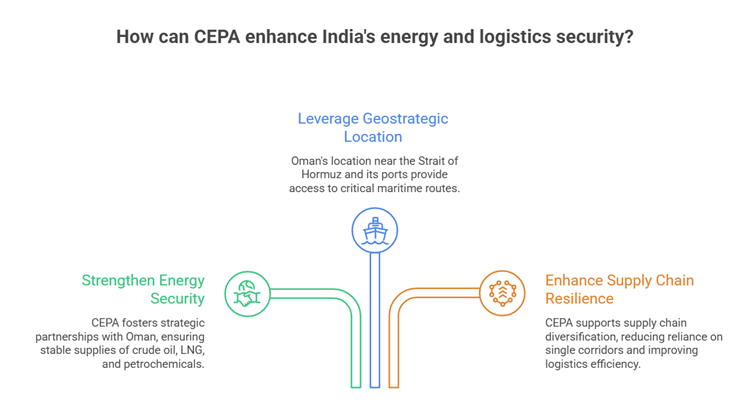
- Oman remains an important partner in the Gulf, a region supplying a major share of India’s crude oil, LNG and petrochemical requirements.
- Closer economic integration enhances the resilience of energy supply chains through long-term cooperation in hydrocarbons, petrochemicals, renewable energy and green hydrogen.
- Example: India’s strategic petroleum reserve cooperation and energy engagements with Gulf countries illustrate the importance of stable economic relationships in ensuring uninterrupted energy supplies.
2. Leveraging Oman’s geostrategic location for maritime connectivity
- Oman occupies a critical position near the Strait of Hormuz, through which a significant proportion of global energy trade passes.
- Ports such as Duqm, Sohar and Salalah provide India with access to important maritime routes linking the Gulf, East Africa and the wider Indian Ocean.
- Case Study: India’s involvement in the Duqm Port project has facilitated logistical support, commercial engagement and strategic maritime access, strengthening India’s presence in the western Indian Ocean.
3. Enhancing supply chain resilience and logistics integration
- The CEPA supports diversification of supply chains at a time when global trade faces disruptions due to geopolitical conflicts, protectionism and maritime insecurity.
- Improved customs procedures and faster clearance mechanisms reduce transaction costs and increase reliability for exporters.
- Example: The disruptions witnessed in global shipping during the COVID-19 pandemic and recent tensions in the Red Sea region underscored the importance of diversified logistics corridors and trusted economic partners.
III. Strategic and Geopolitical Dimensions Beyond Trade Statistics
1. Advancing India’s vision in the Indian Ocean Region
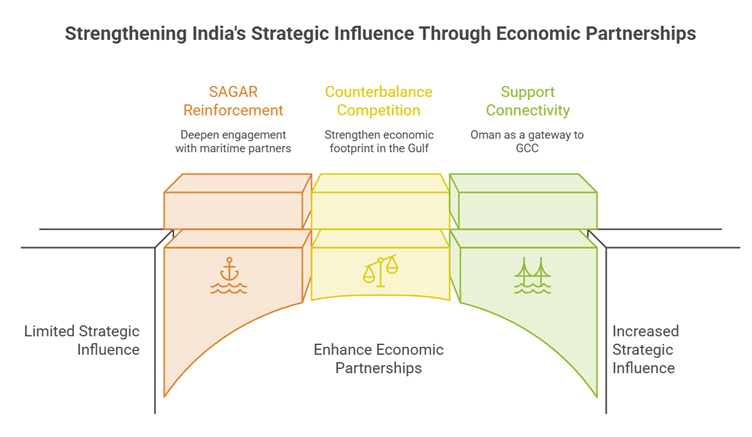
- Economic partnerships increasingly serve as instruments of strategic influence, complementing traditional diplomacy and security cooperation.
- Stronger economic integration with Oman supports India’s broader objective of promoting a free, open, inclusive and rules-based maritime order in the Indian Ocean.
- Government Initiative: The principles underlying SAGAR (Security and Growth for All in the Region) are reinforced through deeper economic engagement with key maritime partners.
2. Counterbalancing geopolitical competition in the Gulf
- The Gulf region has emerged as an arena of increasing strategic competition involving major powers such as China, the United States and European actors.
- CEPA strengthens India’s economic footprint and helps maintain its relevance in a region central to its energy, trade and diaspora interests.
- Example: China’s expanding presence through the Belt and Road Initiative (BRI) has increased the strategic importance of India building durable economic partnerships with Gulf countries.
3. Supporting regional connectivity and South-South cooperation
- Oman can function as a gateway connecting India with Gulf Cooperation Council (GCC) markets, East Africa and emerging maritime trade networks.
- Enhanced connectivity can stimulate investments in logistics, warehousing, manufacturing and value-added exports.
- Case Study: The growing role of India-Middle East-Europe Economic Corridor (IMEC) highlights how economic partnerships are increasingly linked to connectivity, infrastructure and strategic cooperation.