

Introduction:
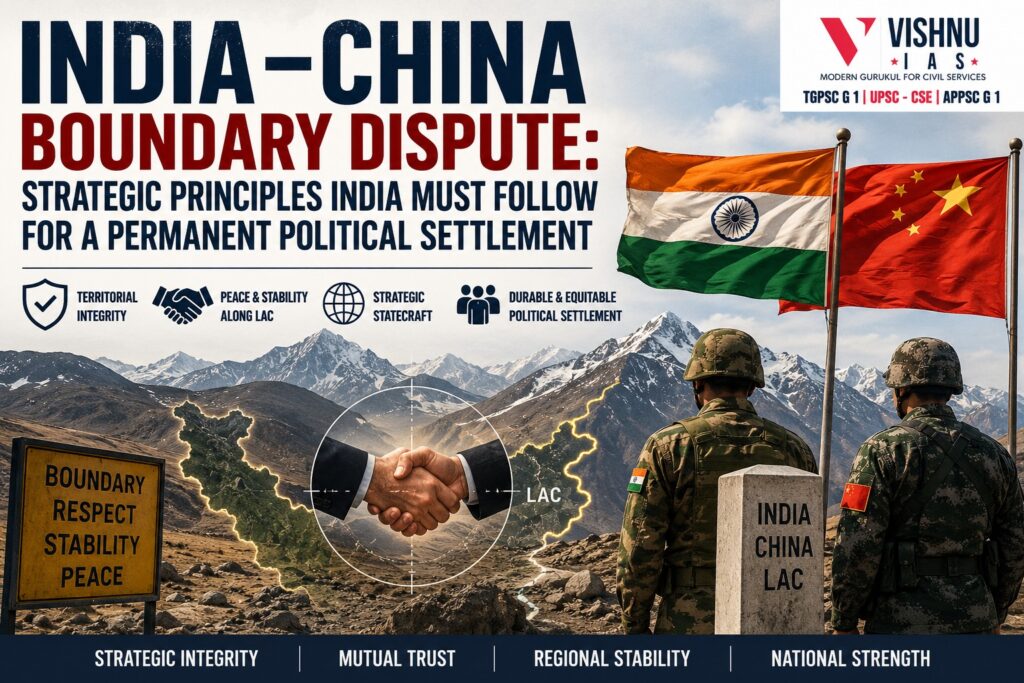
- The India–China boundary dispute, spanning nearly 3,488 km according to India’s official perception of the boundary, remains one of the most complex unresolved territorial disputes in the world. The challenge is not merely cartographic but deeply intertwined with national security, territorial sovereignty, geopolitical competition, border infrastructure, and regional stability. Following the events in Eastern Ladakh since 2020, the emphasis on maintaining peace and tranquillity along the Line of Actual Control (LAC) has become central to bilateral relations. In this context, proposals for sector-specific or “early harvest” settlements raise important questions regarding whether tactical diplomatic adjustments could inadvertently compromise India’s long-term strategic interests. Therefore, any permanent political settlement must be guided by principles that preserve India’s negotiating space while ensuring a stable and equitable resolution.
Body:
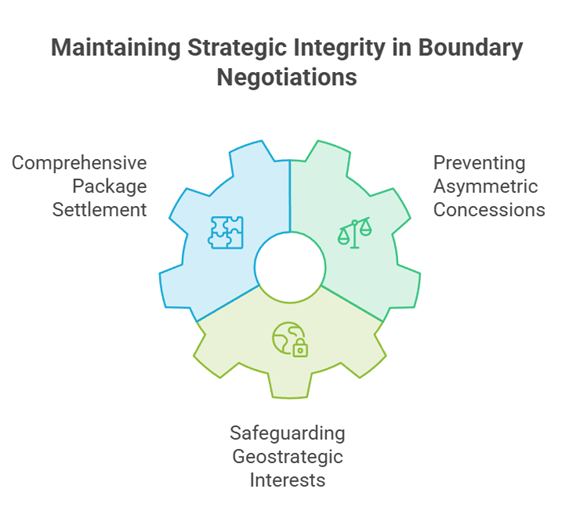
1. Preserving the Strategic Integrity of Boundary Negotiations
(a) Upholding the Principle of a Comprehensive Package Settlement
- The 2005 Agreement on Political Parameters and Guiding Principles envisages a package settlement covering all sectors of the boundary dispute, recognizing the interdependence of western, middle, eastern and Sikkim sectors.
- A sector-wise settlement risks enabling incremental gains by one side, thereby weakening India’s bargaining leverage in unresolved sectors.
- Example: The differing complexities of Eastern Ladakh, Arunachal Pradesh, and Sikkim demonstrate why cross-sector trade-offs are necessary for a balanced settlement.
(b) Preventing Asymmetric Concessions in Negotiations
- Boundary negotiations between unequal powers often involve attempts to secure advantages through selective issue prioritization.
- India must ensure that temporary diplomatic gains or symbolic breakthroughs do not translate into permanent strategic disadvantages.
- Case Study – Doklam Standoff (2017): India’s intervention highlighted concerns regarding changes in the strategic balance around the Siliguri Corridor, demonstrating the significance of evaluating territorial issues through a broader security lens.
(c) Safeguarding Critical Geostrategic Interests
- Any settlement must account for the security implications of terrain, connectivity corridors and military positioning.
- Areas adjoining the Chumbi Valley, Doklam Plateau, and approaches to the Siliguri Corridor possess significance extending beyond local boundary management.
- Example: The Siliguri Corridor, often termed India’s “Chicken’s Neck”, connects the northeastern region with the mainland and remains a critical national security consideration.
2. Ensuring Stability and Trust as Preconditions for Political Settlement
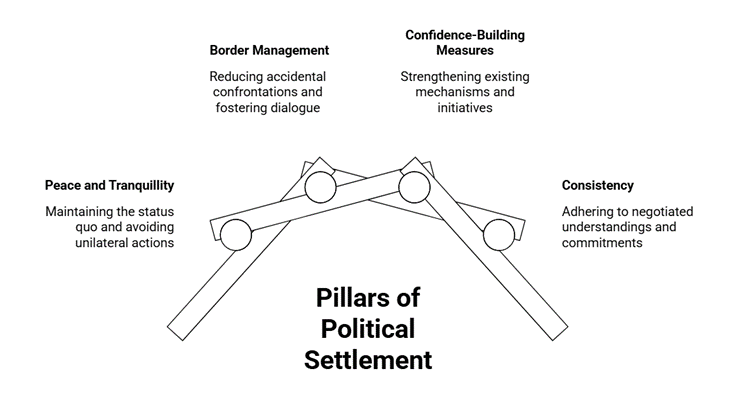
(a) Peace and Tranquillity Along the LAC as a Non-Negotiable Foundation
- Sustainable political settlements require restoration of mutual confidence through maintenance of the status quo and avoidance of unilateral actions.
- Continued military tensions undermine the credibility of diplomatic negotiations and increase risks of escalation.
- Case Study – Galwan Valley Clash (2020): The incident demonstrated how instability on the ground can severely impact broader bilateral relations despite ongoing diplomatic mechanisms.
(b) Strengthening Border Management and Confidence-Building Measures
- Effective border management reduces accidental confrontations and creates an environment conducive to political dialogue.
- Existing mechanisms such as the Working Mechanism for Consultation and Coordination (WMCC) and military commander-level talks should be strengthened.
- Government Initiative: Accelerated development under the Vibrant Villages Programme seeks to improve border habitations, enhance surveillance and strengthen frontier resilience.
(c) Maintaining Consistency Between Ground Reality and Diplomatic Commitments
- Long-term agreements require adherence to previously negotiated understandings and confidence-building arrangements.
- Deviations from established commitments can erode trust and complicate future negotiations.
- Example: Historical difficulties in achieving a mutually accepted alignment of the LAC illustrate the importance of transparency and predictability in border management.
3. Pursuing a Durable Political Settlement Through Strategic Statecraft
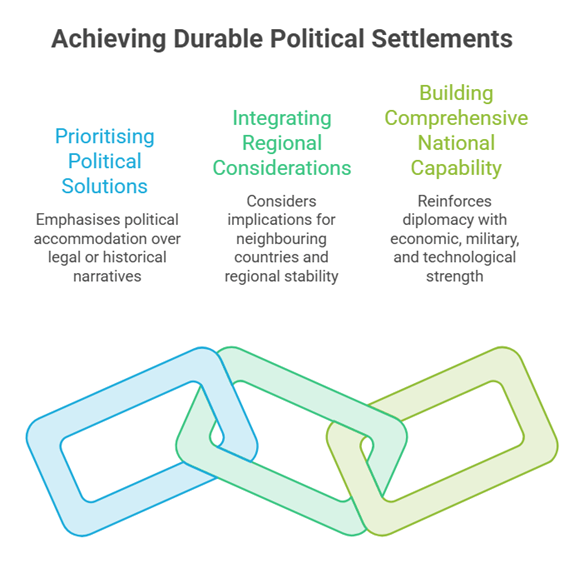
(a) Prioritising Political Solutions Over Purely Legal or Historical Narratives
- Competing interpretations of treaties, maps and historical records have proven insufficient to resolve the dispute conclusively.
- A permanent settlement requires political accommodation that balances sovereignty concerns with contemporary strategic realities.
- Example: Boundary settlements between countries such as China–Russia and China–Kazakhstan ultimately depended on political compromise rather than exclusive reliance on historical claims.
(b) Integrating Regional and Neighbourhood Considerations
- Boundary negotiations must consider implications for neighbouring countries and regional stability.
- Trijunction issues require consultation among all concerned states to avoid creating new disputes.
- Case Study – Bhutan-China Boundary Talks: Developments in western Bhutan have direct implications for India’s security environment, highlighting the interconnected nature of Himalayan geopolitics.
(c) Building Comprehensive National Capability Alongside Negotiations
- Successful diplomacy is reinforced by economic strength, military preparedness, technological capability and infrastructure development.
- Negotiating leverage increases when diplomatic engagement is backed by credible deterrence and domestic resilience.
- Government Initiatives: Expansion of border roads by the Border Roads Organisation, operationalisation of strategic tunnels such as Atal Tunnel, and enhanced surveillance networks improve India’s ability to safeguard frontier interests while engaging diplomatically
Conclusion:
- A permanent settlement of the India–China boundary question requires a careful balance between diplomatic engagement and strategic prudence. Tactical flexibility may be necessary during negotiations, but it must remain anchored in the broader objectives of territorial integrity, peace along the LAC, and a comprehensive political settlement.
- With India emerging as one of the world’s fastest-growing major economies and investing heavily in border infrastructure, connectivity and frontier development, the conditions are increasingly favourable for pursuing negotiations from a position of confidence.
- The path forward lies in combining stable border management, sustained political dialogue, neighbourhood coordination, and enhanced national capabilities, ensuring that any eventual settlement is durable, equitable and supportive of long-term regional stability.