
Introduction:
- The Sixth Schedule under Articles 244(2) and 275(1) of the Constitution provides for Autonomous District Councils (ADCs) to safeguard the administrative, cultural, and land rights of tribal communities through asymmetric federalism. Currently applicable to 10 tribal areas across four northeastern states, it represents India’s constitutional recognition that uniform governance may not adequately address region-specific vulnerabilities.
- Ladakh, where over 97% of the population is Scheduled Tribe, has increasingly demanded Sixth Schedule protection after its reorganization as a Union Territory (UT) in 2019, citing concerns over land alienation, demographic change, ecological fragility, and political underrepresentation. However, extending such protections raises complex constitutional, administrative, and strategic challenges, especially given Ladakh’s status as a non-legislature UT, its international border sensitivity, and evolving development priorities.
Body:
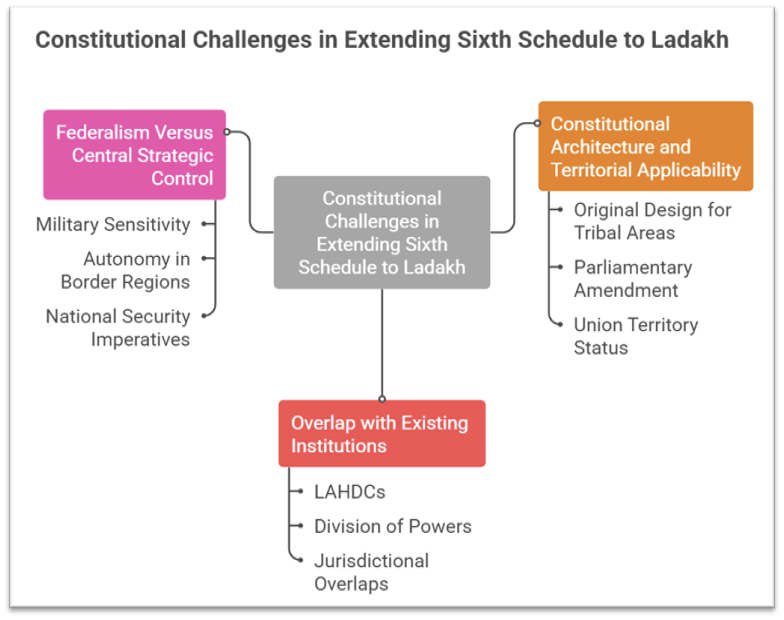
1. Constitutional challenges in extending Sixth Schedule to Ladakh
(a) Constitutional architecture and territorial applicability
- The Sixth Schedule was originally designed for “tribal areas” in Assam, Meghalaya, Tripura and Mizoram, making its extension beyond the Northeast constitutionally unusual and requiring Parliamentary amendment under Article 368 or innovative reinterpretation of Article 244.
- Ladakh’s present status as a Union Territory under Article 239, directly administered by the Centre, creates ambiguity because the Schedule presumes a state-based federal framework, not a centrally administered territory.
- Example: The Jammu & Kashmir Reorganisation Act, 2019 created Ladakh without a legislature, unlike Puducherry or Delhi, intensifying the representational vacuum.
(b) Overlap with existing institutions
- Ladakh already has Leh and Kargil Autonomous Hill Development Councils (LAHDCs) established under state legislation, creating potential institutional duplication if Sixth Schedule councils are introduced.
- Questions arise regarding division of powers between Hill Councils, District Administration, and proposed ADCs, particularly over land, taxation, customary law, and local planning.
- Case Study: Similar jurisdictional overlaps between traditional tribal councils and state institutions in Meghalaya have often led to legal disputes over administrative competence.
(c) Federalism versus central strategic control
- Ladakh borders China (LAC) and Pakistan (LoC), making it one of India’s most militarily sensitive frontier regions; the Centre fears that enhanced autonomy may reduce administrative responsiveness in security matters.
- However, India’s constitutional practice shows that strategic sensitivity has not prevented autonomy elsewhere, as seen in Arunachal Pradesh and Nagaland, both granted robust political institutions despite border vulnerabilities.
- The constitutional challenge therefore lies in balancing national security imperatives with democratic decentralisation.
2. Administrative and governance challenges
(a) Institutional capacity and governance complexity
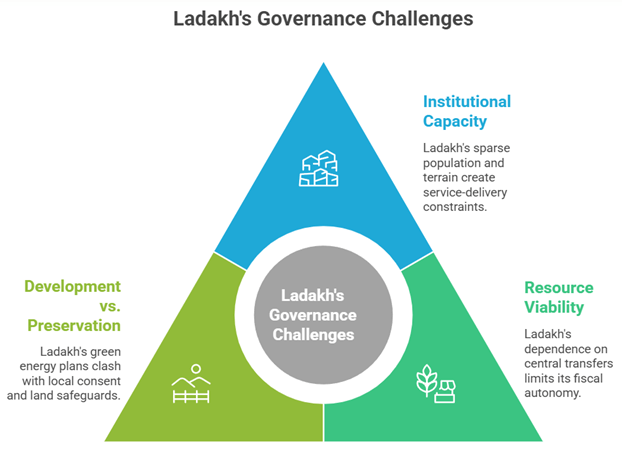
- Ladakh’s sparse population across ~59,000 sq. km and difficult terrain create severe service-delivery constraints, requiring governance models prioritizing administrative flexibility.
- Adding Sixth Schedule bodies may create multi-layered bureaucracy rather than efficiency unless mandates are clearly defined.
- Example: Remote blocks such as Zanskar and Changthang already face delays in public service delivery due to logistical barriers; fragmented authority could worsen coordination.
(b) Resource and fiscal viability
- Ladakh remains highly dependent on central transfers, with limited internal revenue due to its narrow economic base centered on tourism, defence-linked expenditure, and renewable energy potential.
- Autonomous councils under the Sixth Schedule require independent fiscal capacity, including local taxation and budget administration, which may initially be weak.
- Example: Several northeastern ADCs have faced chronic financial dependence on state governments, limiting actual autonomy despite constitutional protection.
(c) Development versus preservation dilemma
- Ladakh is central to India’s green energy plans, including proposed 13 GW solar projects in Changthang, large transmission corridors, tourism infrastructure, and strategic roads.
- Sixth Schedule protections could slow project approvals due to mandatory local consultation and land safeguards, creating tensions between national development priorities and local consent.
- Case Study: Similar tensions emerged in Hasdeo Arand (Chhattisgarh) and Niyamgiri (Odisha), where local community rights clashed with resource extraction projects.
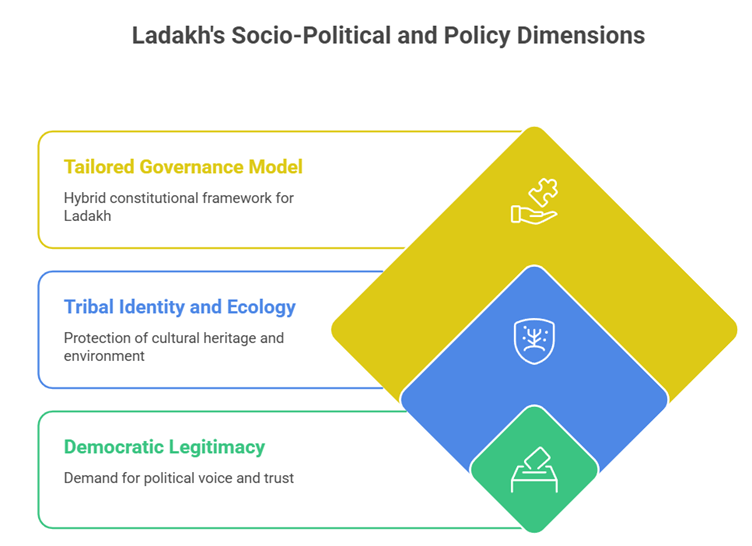
3. Socio-political and policy dimensions
(a) Demand for democratic legitimacy
- Since 2019, Ladakh has seen sustained demands from civil society groups such as the Leh Apex Body and Kargil Democratic Alliance for statehood, Sixth Schedule status, and constitutional safeguards.
- The issue reflects not merely administrative concern, but a demand for political voice, participatory governance, and trust-based integration.
- Example: Large-scale peaceful mobilisations led by local leaders and climate activist Sonam Wangchuk brought national attention to these concerns.
(b) Protection of tribal identity and ecology
- Ladakh’s indigenous communities—Changpas, Baltis, Brokpas, and Ladakhi Buddhists/Shia Muslims—fear erosion of customary land rights, cultural identity, and fragile mountain ecosystems.
- Sixth Schedule provisions could provide stronger safeguards over land transfer, customary practices, and local natural resources.
- Case Study: The Bodoland Territorial Region demonstrates how constitutional autonomy can strengthen identity preservation while remaining within the Union framework.
o (c) Need for a tailored governance model
- Ladakh’s conditions differ from both the Northeast and conventional UTs; therefore, a hybrid constitutional model may be more suitable than direct transplantation of the Sixth Schedule.
- Possible options include:
- strengthening LAHDCs with constitutional backing,
- creating a legislative assembly with limited powers, or
- a Ladakh-specific constitutional mechanism combining local autonomy with strategic oversight.
- Government Initiative: The High-Powered Committee on Ladakh (2023 onwards) reflects ongoing attempts to negotiate such an institutional framework
Conclusion:
- The debate on extending the Sixth Schedule to Ladakh is fundamentally about reconciling constitutional pluralism, frontier governance, and democratic legitimacy. India’s federal experience shows that inclusion deepens national integration more effectively than administrative centralisation.
- As multiple commissions on decentralisation have emphasized, durable governance in diverse regions depends on local participation and institutional trust.
- A calibrated solution combining tribal safeguards, strengthened self-governance, and strategic coordination can ensure that Ladakh evolves not merely as a protected borderland, but as an empowered constitutional stakeholder in India’s democratic project.