Introduction:
- Energy security refers to the uninterrupted availability of energy sources at affordable prices while ensuring long-term sustainability and resilience against geopolitical and market shocks. Recent disruptions in global supply chains, especially around the Strait of Hormuz, through which nearly one-fifth of the world’s petroleum trade passes, exposed the vulnerability of import-dependent economies.
- India imports nearly 85% of its crude oil requirement and more than 45% of its natural gas demand, making external disruptions a major macroeconomic concern. However, India’s deliberate expansion of diversified energy infrastructure, strategic reserves, refining capabilities, gas networks, and the rapid rise of ethanol blending from around 1.5% in 2014 to nearly 20% in 2025, significantly cushioned the impact of the crisis by ensuring supply continuity, moderating inflationary pressures, and reducing import dependence.
Body:
I. Role of Diversified Energy Infrastructure in Enhancing Energy Security
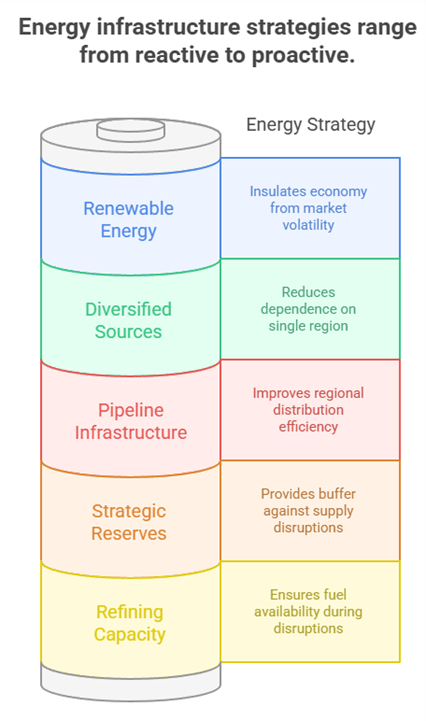
1. Expansion of Refining and Storage Capacity Reduced Supply Vulnerability
- India’s refining ecosystem, among the world’s largest, enabled domestic refineries to operate at over 100% capacity utilisation during the crisis, ensuring uninterrupted availability of petrol, diesel, LPG, and ATF despite disruptions in maritime supply routes. This reduced panic buying and prevented severe shortages witnessed in several developing economies.
- The creation of Strategic Petroleum Reserves (SPR) at locations such as Visakhapatnam, Mangaluru, and Padur provided an emergency buffer against sudden crude supply disruptions. India’s SPR capacity of over 5 MMT reflects a shift from reactive energy management to strategic preparedness.
- Example – COVID-19 Energy Stability: During the pandemic and subsequent global shipping disruptions, India maintained stable fuel supplies due to robust refining and storage infrastructure, unlike many countries that faced prolonged shortages and logistical bottlenecks.
2. Pipeline and Terminal Infrastructure Strengthened Distribution Efficiency
- Expansion of LPG import terminals from 11 to 22 and LPG pipeline infrastructure from about 2,300 km to over 6,200 km improved regional distribution efficiency and reduced dependence on road transport, thereby lowering logistical vulnerability during crises.
- Integrated energy transportation systems such as the Jagdishpur–Haldia–Bokaro–Dhamra Gas Pipeline (Urja Ganga Project) expanded access to cleaner fuels and strengthened domestic gas distribution networks, particularly in eastern India.
- Government initiatives like Pradhan Mantri Ujjwala Yojana (PMUY) increased LPG penetration in rural households, making uninterrupted LPG supply a critical governance priority. The ability to sustain LPG availability during global turbulence reflected the resilience of the expanded infrastructure base.
3. Diversification of Energy Sources Improved Strategic Flexibility
- India diversified crude sourcing beyond West Asia by increasing imports from countries such as Russia, the United States, Brazil, and Africa, thereby reducing overdependence on a single geopolitical region.
- Expansion of renewable energy capacity, which crossed 200 GW including non-fossil sources, reduced pressure on imported fossil fuels in electricity generation. This diversification strengthened macroeconomic stability during oil price spikes.
- Case Study – International Solar Alliance (ISA): India’s leadership in solar diplomacy and domestic renewable expansion demonstrates a long-term strategy to insulate the economy from fossil-fuel market volatility while advancing climate commitments.
II. Contribution of Ethanol Blending in Mitigating Global Energy Disruptions
1. Reduction in Crude Oil Import Dependence
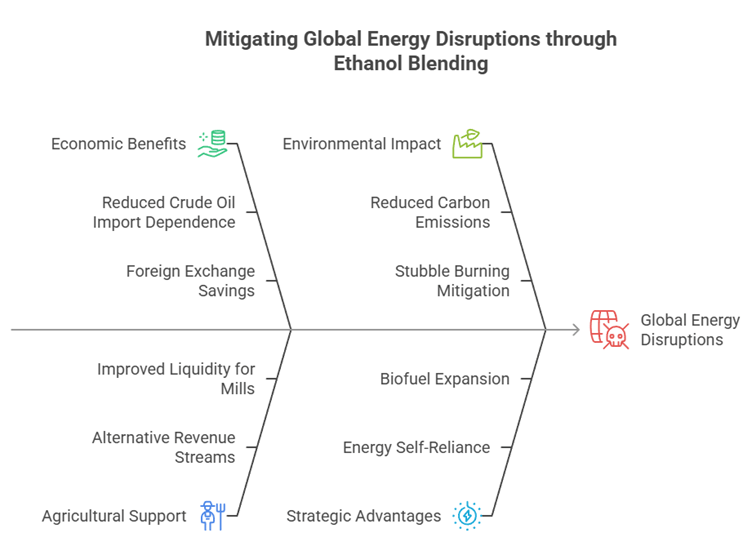
- The rise in ethanol blending from nearly 5% a decade ago to around 20% significantly reduced petrol consumption derived from imported crude oil. This lowered India’s exposure to international oil price fluctuations and foreign exchange pressures during the supply crisis.
- Ethanol blending reportedly generated savings exceeding ₹1.5 lakh crore in foreign exchange outgo, thereby helping stabilise the current account deficit amid rising global crude prices and rupee depreciation.
- The Ethanol Blended Petrol (EBP) Programme accelerated energy self-reliance by promoting domestically produced biofuels derived from sugarcane, maize, and damaged food grains.
2. Support to Farmers and Rural Economy During Energy Transition
- Ethanol production created an alternative revenue stream for sugar mills and farmers, particularly in states such as Uttar Pradesh, Maharashtra, and Karnataka, reducing dependence on cyclical sugar markets.
- Increased ethanol procurement improved liquidity for sugar mills and helped reduce pending cane dues, thereby linking energy security with agricultural sustainability and rural income enhancement.
- Example – Cooperative Sugar Mills in Maharashtra: Several cooperative mills diversified into ethanol production, enabling them to remain financially viable while contributing to national fuel blending targets.
3. Environmental and Strategic Benefits of Biofuel Expansion
- Ethanol blending reduced vehicular carbon emissions and contributed to cleaner combustion compared to pure fossil fuels, complementing India’s commitments under the Paris Climate Agreement and the goal of achieving net-zero emissions by 2070.
- The National Policy on Biofuels encouraged second-generation ethanol from agricultural residues, helping address stubble burning while enhancing fuel sustainability.
- Case Study – Panipat 2G Ethanol Plant: The establishment of second-generation ethanol facilities using crop residues demonstrates the integration of environmental management with energy diversification strategies.
III. Limitations, Challenges and the Way Forward for Long-Term Energy Resilience
1. Fiscal Burden and Sustainability Concerns
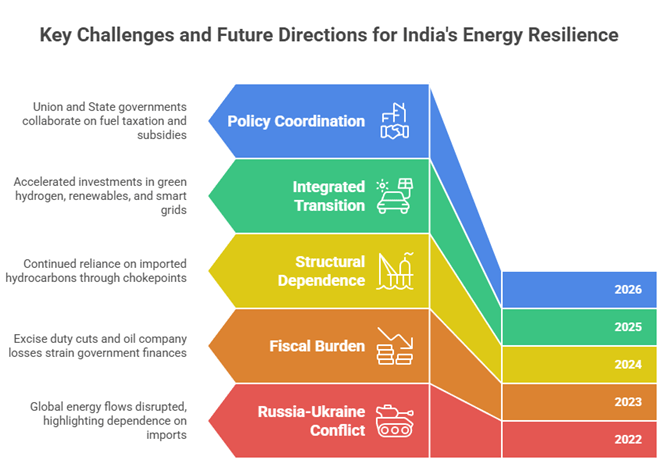
- Shielding consumers from rising global fuel prices through excise duty cuts and absorption of losses by oil marketing companies imposed substantial fiscal costs. Revenue losses from fuel tax reductions affected both Union and State finances.
- Public sector oil companies faced pressures on profitability and investment capacity, despite operating in a sector requiring continuous capital-intensive infrastructure expansion.
- Prolonged suppression of retail fuel prices can weaken balance sheets of energy companies, potentially delaying investments in storage, refining, green hydrogen, and renewable infrastructure.
2. Structural Dependence on Imported Hydrocarbons Persists
- Despite diversification, India remains heavily dependent on imported crude oil, particularly through vulnerable maritime chokepoints such as the Strait of Hormuz and Bab-el-Mandeb.
- Global supply-chain disruptions highlighted the strategic risks associated with shipping insurance costs, freight volatility, and geopolitical tensions in West Asia.
- Example – Russia-Ukraine Conflict: International sanctions, shipping disruptions, and energy market fragmentation demonstrated how geopolitical crises can rapidly reshape global energy flows and pricing structures.
3. Need for Integrated and Future-Oriented Energy Transition
- India must accelerate investments in green hydrogen, battery storage, electric mobility, offshore wind, and smart grids to reduce long-term fossil-fuel dependence.
- Expansion of strategic reserves, city gas distribution networks, and renewable-energy manufacturing ecosystems under initiatives such as National Green Hydrogen Mission, PM Gati Shakti, and Production Linked Incentive (PLI) schemes can deepen energy resilience.
- Greater coordination between the Union and State governments regarding fuel taxation, alongside targeted subsidies for vulnerable groups, is essential to balance consumer welfare with fiscal sustainability.
Conclusion:
- India’s response to recent global supply-chain disruptions demonstrates that energy resilience is built not merely through resource availability but through diversified infrastructure, strategic planning, and calibrated energy transition policies. Expanded refining capacity, pipeline networks, strategic reserves, and ethanol blending collectively insulated the economy from severe shortages and extreme consumer distress despite unprecedented geopolitical instability.
- Going forward, sustained investment in clean energy diversification, strategic storage, domestic biofuels, and technological innovation will be critical for transforming India from a vulnerable energy importer into a resilient and sustainable energy power. With the International Energy Agency projecting India as one of the largest drivers of future global energy demand, strengthening integrated energy security architecture will remain central to economic stability, environmental sustainability, and long-term strategic autonomy.