
Introduction:
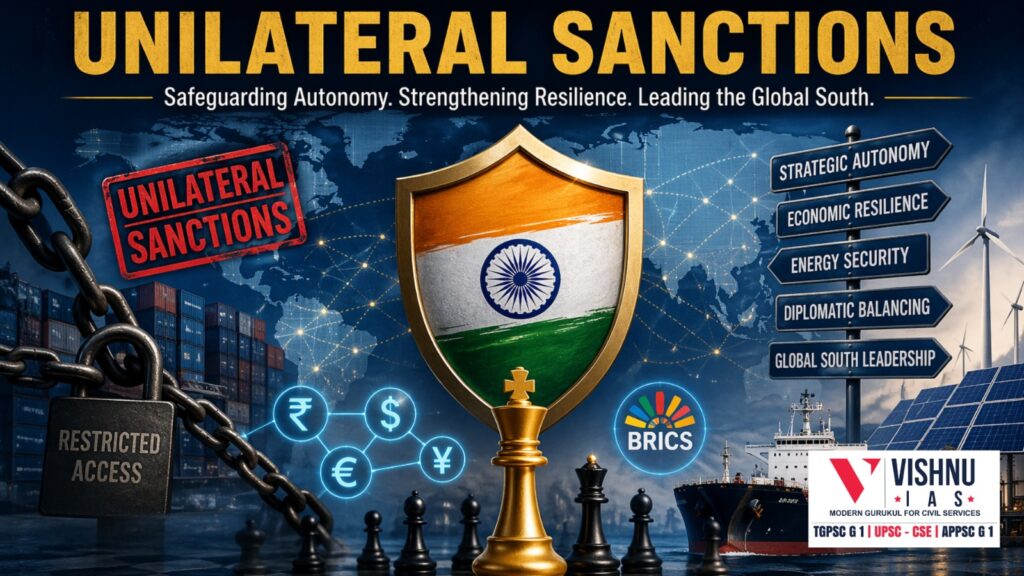
- Unilateral sanctions refer to coercive economic, financial, or trade restrictions imposed by a single country (or a small group) outside multilateral frameworks like the United Nations Security Council, often to influence the strategic behaviour of other states.
- In recent years, their frequency has increased sharply, with the United States emerging as the dominant sanctioning power, maintaining restrictions on over 20+ countries and multiple sectoral regimes.
- For India, a rapidly growing economy heavily dependent on energy imports (over 85% crude dependence) and integrated global supply chains, such sanctions especially amid geopolitical crises like West Asian conflicts have translated into rising import bills, inflationary pressures, currency volatility, and trade disruptions. At the same time, India’s long-standing doctrine of strategic autonomy and its leadership aspirations in the Global South necessitate a calibrated response that balances economic pragmatism with geopolitical independence.
Body:
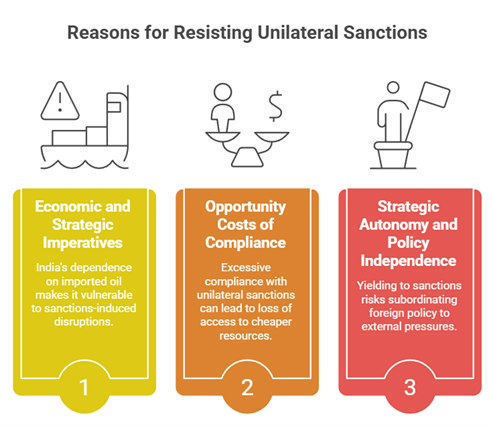
1. Economic and Strategic Imperatives for Resisting Unilateral Sanctions
(a) Energy Security and Economic Stability
- India’s dependence on imported oil especially from regions like the Gulf and Russia makes it vulnerable to sanctions-induced disruptions, as seen in higher freight, insurance premiums, and supply bottlenecks during crises affecting chokepoints like the Strait of Hormuz.
- Example: Continued purchase of discounted Russian crude (post-2022) helped India moderate inflation and sustain growth despite global price shocks.
- Government Initiative: Strategic Petroleum Reserves (SPR) expansion at Visakhapatnam, Mangaluru, and Padur reflects attempts to cushion external shocks, but inadequate diversification limits effectiveness.
(b) Opportunity Costs of Compliance
- Excessive compliance with unilateral sanctions can lead to loss of access to cheaper resources, reduced export competitiveness, and constrained industrial growth.
- Case Study: Curtailing Iranian and Venezuelan oil imports (2019–2024) deprived India of cost-effective “sweet crude”, increasing dependence on costlier suppliers.
- Real-life Illustration: Disruptions in fertilizer imports from sanctioned regions have indirect impacts on agriculture and food security.
(c) Strategic Autonomy and Policy Independence
- Yielding to sanctions risks subordinating foreign policy to external pressures, undermining India’s multi-alignment strategy.
- Example: Despite threats under CAATSA, India proceeded with the S-400 air defence system deal with Russia, demonstrating strategic assertiveness without facing punitive consequences.
- Implication: Selective resistance strengthens credibility as an independent global actor.
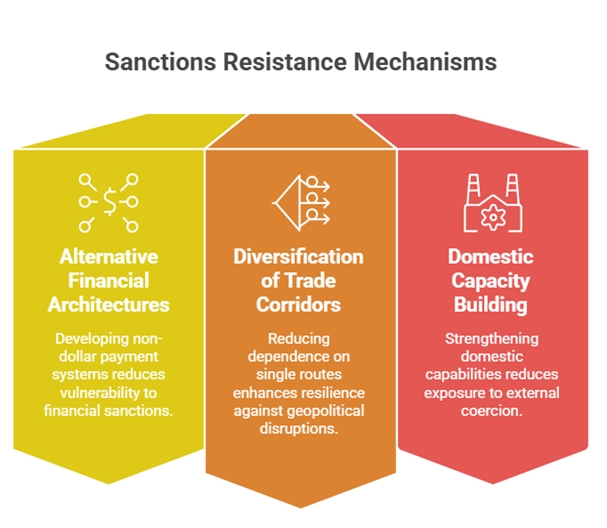
2. Institutional and Policy Mechanisms to Resist Sanctions
(a) Alternative Financial and Payment Architectures
- Developing non-dollar payment systems reduces vulnerability to financial sanctions dominated by Western institutions.
- Example: The rupee-rial trade mechanism with Iran and ongoing discussions on BRICS cross-border payment systems aim to bypass SWIFT dependency.
- Government Initiative: Promotion of Unified Payments Interface (UPI) internationalisation and bilateral currency settlement agreements with countries like UAE and Singapore.
(b) Diversification of Trade and Connectivity Corridors
- Reducing dependence on single routes or regions enhances resilience against geopolitical disruptions.
- Case Study: The Chabahar Port project in Iran provides India access to Afghanistan and Central Asia, bypassing Pakistan, while the International North-South Transport Corridor (INSTC) offers a shorter Eurasian trade route.
- Example: Delay in infrastructure development under sanctions reduced India’s ability to hedge against disruptions in traditional maritime routes.
(c) Domestic Capacity Building and Import Substitution
- Strengthening domestic capabilities reduces exposure to external coercion.
- Government Initiative: National Green Hydrogen Mission, solar energy expansion (target of 500 GW non-fossil capacity by 2030), and PLI schemes for manufacturing reduce long-term import dependence.
- Example: Ethanol blending programme (target 20%) reduces crude oil dependence while promoting rural income.
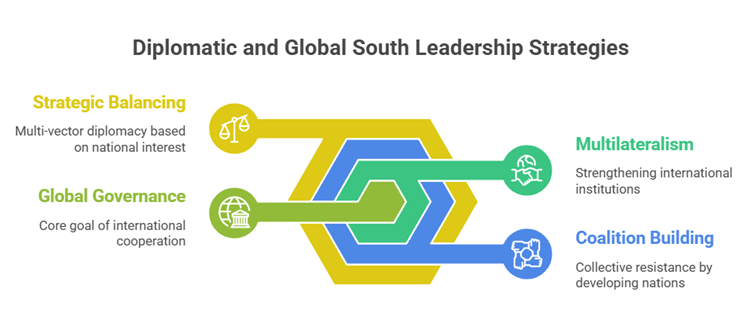
3. Diplomatic and Global South Leadership Strategies
(a) Strengthening Multilateralism and Norm-Based Order
- Advocating for sanctions only through multilateral institutions like the UN reinforces rule-based global governance.
- Example: India’s consistent emphasis on sovereignty, territorial integrity, and non-interference in global forums.
- Implication: Builds legitimacy for opposing unilateral coercive measures.
(b) Coalition Building within the Global South
- Collective resistance by developing nations can dilute the effectiveness of unilateral sanctions.
- Case Study: Platforms like BRICS, G20, and Voice of Global South Summit provide avenues to articulate shared concerns on economic coercion.
- Example: Efforts toward BRICS currency or settlement mechanisms aim to reduce overdependence on dominant financial systems.
(c) Strategic Balancing and Issue-Based Alignment
- India’s approach involves multi-vector diplomacy engaging with the U.S., Russia, Iran, and others simultaneously based on national interest.
- Example: Maintaining ties with the U.S. in technology and defence while continuing energy trade with Russia demonstrates pragmatic balancing.
- Real-life Illustration: India’s neutral stance in conflicts while prioritizing evacuation operations (e.g., Operation Ganga) highlights citizen-centric diplomacy.
Conclusion:
- India’s response to unilateral sanctions must be guided by a pragmatic blend of economic resilience, institutional innovation, and diplomatic balancing. Historical experiences from dependence on food aid in the 1960s to present-day energy vulnerabilities underscore the need for self-reliance and diversification.
- Going forward, accelerating renewable energy transition, expanding strategic reserves, strengthening regional trade architectures, and deepening South-South cooperation can enhance resilience.
- With India projected to remain among the world’s largest economies and a key voice of the developing world, a calibrated strategy that resists coercion while upholding global cooperation will reinforce both its strategic autonomy and leadership credibility in an increasingly fragmented international order.