Introduction:
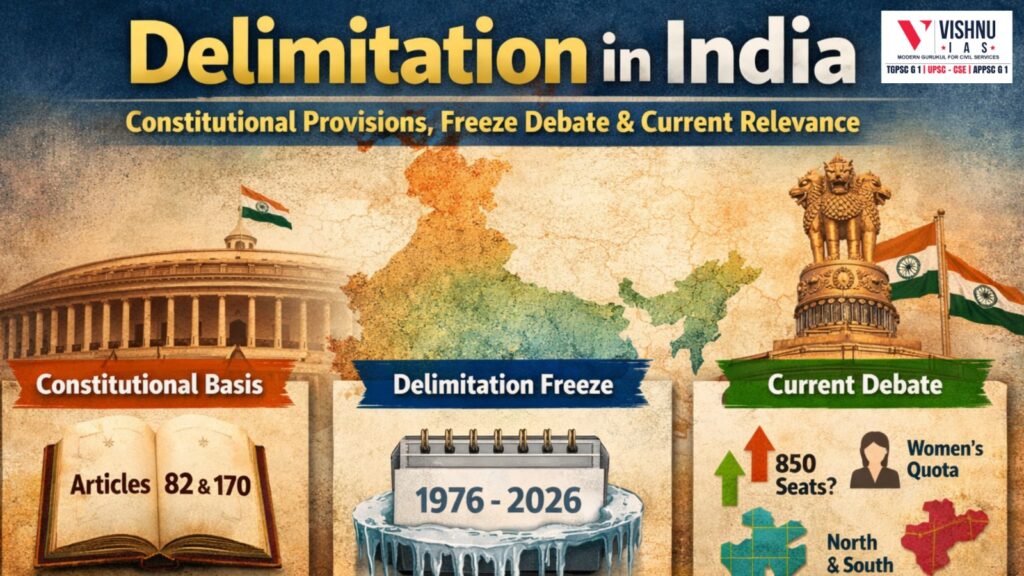
- Delimitation refers to the readjustment of electoral constituency boundaries and allocation of seats in legislative bodies based on population changes, ensuring the democratic principle of “one person, one vote, one value.” In India, this process is constitutionally mandated under Articles 82 and 170(3) after every Census.
- However, a freeze on delimitation—first imposed through the 42nd Constitutional Amendment (1976) and later extended by the 84th Amendment (2001) until after the first Census post-2026—has created a complex interplay between population control, federal balance, and democratic representation.
- With proposals to increase Lok Sabha seats (e.g., up to around 850 seats) and link women’s reservation to fresh delimitation, the debate has regained urgency in contemporary governance.
Body:
· 1. Constitutional Provisions and Legal Framework
1.1 Constitutional Mandate for Delimitation
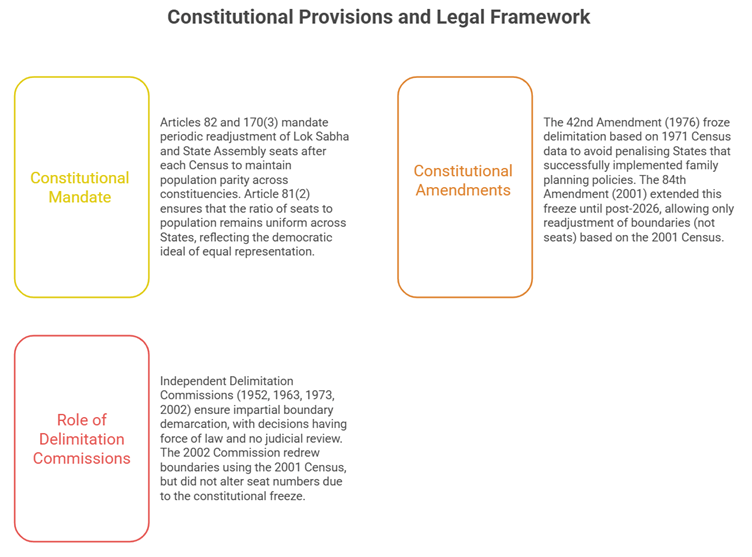
- Articles 82 and 170(3) mandate periodic readjustment of Lok Sabha and State Assembly seats after each Census to maintain population parity across constituencies.
- Article 81(2) ensures that the ratio of seats to population remains uniform across States, reflecting the democratic ideal of equal representation.
- Example: Post-1951 Census, India undertook delimitation aligning constituencies with updated population data, strengthening electoral legitimacy.
1.2 Constitutional Amendments and Freeze Mechanism
- The 42nd Amendment (1976) froze delimitation based on 1971 Census data to avoid penalising States that successfully implemented family planning policies.
- The 84th Amendment (2001) extended this freeze until post-2026, allowing only readjustment of boundaries (not seats) based on the 2001 Census.
- Example: States like Kerala and Tamil Nadu, which achieved early fertility decline, retained their representation despite slower population growth.
1.3 Role of Delimitation Commissions
- Independent Delimitation Commissions (1952, 1963, 1973, 2002) ensure impartial boundary demarcation, with decisions having force of law and no judicial review.
- The 2002 Commission redrew boundaries using the 2001 Census, but did not alter seat numbers due to the constitutional freeze.
- Case Study: The 2008 delimitation exercise corrected intra-state population imbalances caused by migration, especially in urban centres like Delhi and Mumbai.
2. Historical Context and Rationale for the Freeze
2.1 Population Control as a Policy Imperative
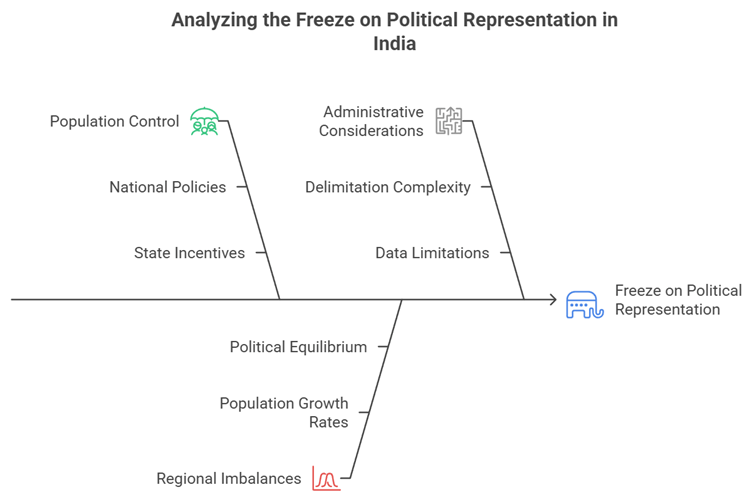
- The freeze emerged during a period when India prioritised population stabilisation under national policies like the National Population Policy (2000).
- It aimed to incentivise States to adopt family planning by ensuring they would not lose political representation.
- Example: Southern States reduced fertility rates to near replacement levels (~2.1) earlier than northern counterparts.
2.2 Regional Imbalances and Federal Concerns
- Without a freeze, States with higher population growth (e.g., Uttar Pradesh, Bihar) would gain more seats, potentially skewing federal balance.
- The freeze preserved political equilibrium between States with differing demographic trajectories.
- Case Study: The divergence between northern and southern States in population growth raised concerns of “political marginalisation” of the latter.
2.3 Administrative and Practical Considerations
- Frequent delimitation was administratively complex in the early decades due to data limitations and institutional capacity constraints.
- The initial delimitation (1950–51) even relied on estimated population figures due to urgency of conducting elections.
- Example: Early electoral exercises required balancing pragmatism with democratic ideals, leading to phased implementation of delimitation.
3. Relevance and Challenges in the Present Debate
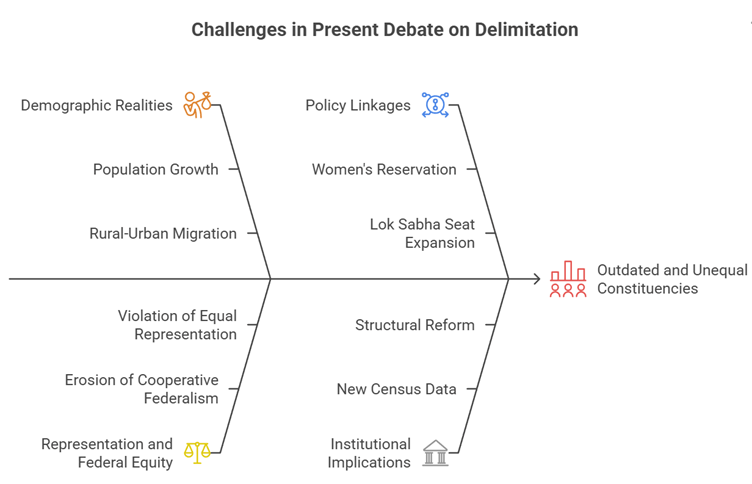
3.1 Changing Demographic Realities
- Population growth has not stabilised uniformly, with continued rural-urban migration and regional disparities.
- Using 2011 Census data for future delimitation risks creating outdated and unequal constituencies by the time implementation occurs.
- Case Study: Rapid urban expansion in cities like Bengaluru and Hyderabad has led to overcrowded constituencies, undermining voter parity.
3.2 Tension Between Representation and Federal Equity
- Lifting the freeze may increase seats for high-population States, raising concerns about erosion of cooperative federalism.
- Conversely, continuing the freeze violates the principle of equal representation, as population-rich constituencies remain underrepresented.
- Example: A voter in a densely populated constituency may have significantly less representational weight than one in a sparsely populated region.
3.3 Emerging Policy Linkages and Institutional Implications
- The implementation of women’s reservation in legislatures has been linked to fresh delimitation, making the issue more politically sensitive.
- Proposals to expand Lok Sabha seats (e.g., to ~850) open scope to balance representation without drastically altering inter-state seat shares.
- Government Initiative: The upcoming delimitation exercise post-2026 is expected to coincide with new Census data, offering an opportunity for structural reform.
Conclusion:
- The freeze on delimitation reflects a careful constitutional balancing act between demographic justice and federal stability, rooted in the historical need to promote population control without penalising progressive States. However, with India’s population exceeding 4 billion, increasing urbanisation, and evolving socio-economic realities, the continued reliance on outdated population benchmarks risks undermining the core democratic principle of equal representation.
- Going forward, a calibrated approach is essential combining updated Census data, possible expansion of legislative seats, and inclusion of additional criteria (such as development indicators or migration patterns)—to ensure both representational fairness and federal harmony. A transparent and consultative delimitation process can reinforce democratic legitimacy while preserving the unity of a diverse polity.