
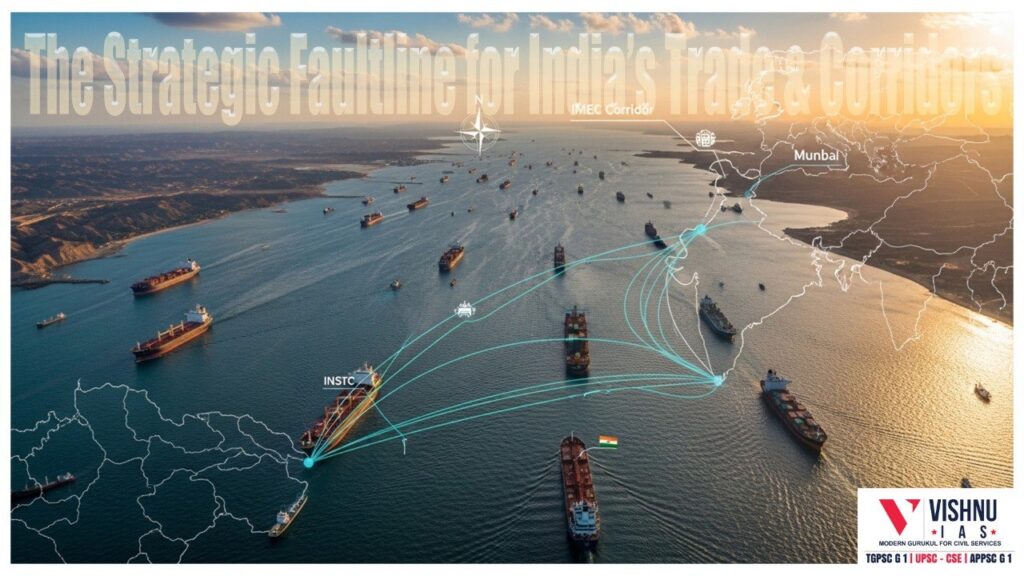
Weaponization of Strait of Hormuz: Challenges to India’s Maritime Trade, Chabahar and IMEC
Weaponization of Strait of Hormuz has emerged as a major geopolitical concern affecting global energy flows and maritime trade. The Strait of Hormuz connects the Persian Gulf to the Gulf of Oman and serves as one of the most vital maritime chokepoints in the world. For India, which depends heavily on energy imports and maritime trade, the militarization or potential blockade of this passage can create serious economic and strategic disruptions.
Introduction
The weaponization of critical maritime chokepoints refers to the strategic use of narrow sea passages to exert military, economic, or geopolitical pressure by controlling or threatening global trade routes. The Strait of Hormuz, connecting the Persian Gulf to the Gulf of Oman, is among the world’s most critical energy arteries.
Nearly one-fifth of global petroleum consumption passes through this narrow channel, and a substantial share of India’s crude oil and LNG imports depends on this route. As tensions escalate in West Asia and Iran increasingly signals the possibility of restricting passage, the militarization and potential blockade of the Strait pose complex challenges for India’s maritime trade, diaspora safety, energy security, and strategic connectivity initiatives, including the Chabahar Port and the India-Middle East-Europe Economic Corridor.
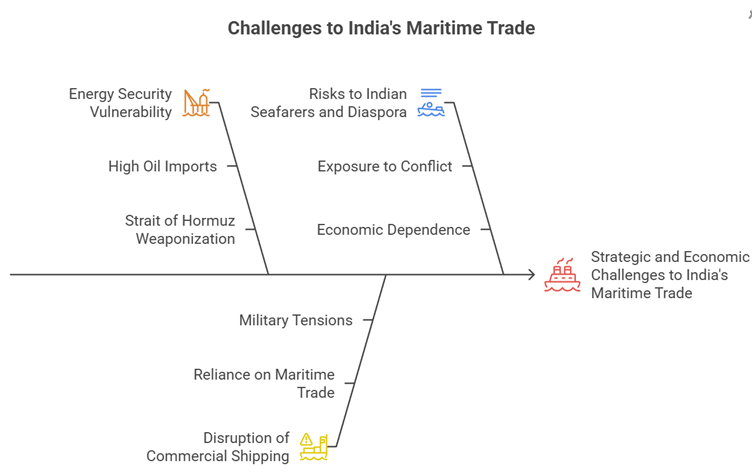
1. Strategic and Economic Challenges to India’s Maritime Trade
1. Energy Security Vulnerability
India imports over 80% of its crude oil, with a significant share coming from West Asian producers such as Saudi Arabia, Iraq, and the UAE, whose shipments transit through the Strait of Hormuz. Any disruption can trigger energy price volatility, supply shortages, and inflationary pressures across the economy.
The weaponization of the Strait through naval deployments, missile threats, or mining of sea lanes increases shipping insurance costs and freight rates, thereby raising the import bill and current account deficit.
Example – Tanker War during the Iran-Iraq conflict (1980s): attacks on oil tankers passing through the Strait caused global oil price spikes and forced naval escorts by major powers, illustrating how regional conflicts can disrupt global energy flows.
2. Disruption of Commercial Shipping and Trade Logistics
India relies heavily on maritime trade for nearly 95% of its trade volume, and the Strait serves as a major gateway for energy, fertilizers, petrochemicals, and container cargo.
Escalating military tensions and incidents such as seizure of merchant vessels or drone attacks on shipping increase insurance premiums, rerouting costs, and delays, affecting sectors dependent on imported inputs such as fertilizers and petrochemicals.
Example – Attacks on commercial vessels in the Gulf region (2019–2024): several oil tankers were targeted near the Strait, prompting shipping companies to adopt longer routes and causing temporary disruptions in regional supply chains.
3. Risks to Indian Seafarers and Diaspora
India contributes around 15% of the global seafarer workforce, many of whom operate on merchant vessels navigating the Persian Gulf region. Escalation in maritime conflict exposes them to detention, military confrontation, or hostage situations.
Nearly 10 million Indian expatriates live in West Asia, whose livelihoods depend on stable economic relations with Gulf economies linked through this maritime corridor.
Example – Evacuation operations such as “Operation Rahat” (Yemen crisis) demonstrated how regional instability necessitates large-scale rescue missions, highlighting the strategic importance of secure maritime routes.
2. Implications for India’s Regional Connectivity and Strategic Projects
1. Strategic Uncertainty for Chabahar Port and Eurasian Connectivity
The Chabahar Port project in Iran, developed by India, is a key gateway for trade with Afghanistan and Central Asia, bypassing Pakistan. Instability in the Strait directly affects the security and commercial viability of the port.
Increased sanctions risks and regional militarization may deter shipping lines and investors from using Chabahar as a logistics hub.
Example – India’s investment in Chabahar’s Shahid Beheshti terminal has enabled humanitarian shipments to Afghanistan and facilitated regional trade, but escalating Iran-U.S. tensions threaten long-term operational stability.
2. Challenges to Emerging Multilateral Corridors
The India-Middle East-Europe Economic Corridor (IMEC), envisioned as a strategic trade route linking India to Europe through Gulf states, rail networks, and Mediterranean ports, depends on stable maritime connectivity in West Asia.
Militarization of the Strait could undermine investor confidence and delay infrastructure projects, particularly if Gulf states become drawn into wider regional conflict.
Example – Infrastructure corridors like the Belt and Road Initiative faced delays in conflict zones, demonstrating how geopolitical instability can derail transregional connectivity initiatives.
3. Impact on Regional Energy and Supply Chain Integration
India has been promoting energy grid connectivity, cross-border pipelines, and maritime logistics cooperation with Gulf and Indian Ocean states.
Disruptions in the Strait could interrupt fertilizer imports, LNG shipments, and petrochemical supply chains, affecting agriculture and manufacturing sectors.
Example – Fertilizer supply disruptions during the Russia-Ukraine conflict previously forced India to diversify suppliers, highlighting the vulnerability of import-dependent sectors to geopolitical shocks.
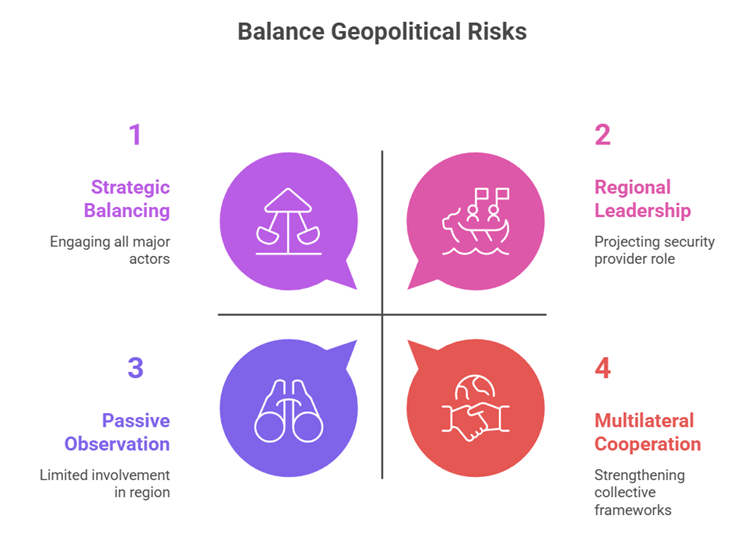
3. Maritime Security, Geopolitical and Diplomatic Challenges
1. Strategic Balancing in West Asian Diplomacy
India traditionally maintains a balanced foreign policy engaging all major West Asian actors, including Iran, Israel, and Gulf monarchies, to safeguard energy and diaspora interests.
Escalating confrontation in the Strait may force India into complex diplomatic balancing, particularly given its strategic partnerships with the United States and Israel while maintaining cooperation with Iran.
Example – India’s continued engagement with Iran despite sanctions pressures ensured continued progress on Chabahar while maintaining relations with Gulf partners.
2. Challenge to India’s Role as a Regional Security Provider
India has increasingly projected itself as a “net security provider” in the Indian Ocean, conducting anti-piracy patrols and humanitarian missions.
The presence of major power naval deployments in the Strait and surrounding waters complicates India’s maritime posture and reduces its ability to independently shape security outcomes.
Example – Indian Navy missions in the Gulf of Aden since 2008 have protected merchant vessels from piracy, demonstrating India’s capacity to safeguard maritime commons but also highlighting dependence on stable geopolitical conditions.
3. Need for Multilateral Maritime Governance
The weaponization of chokepoints highlights the need for collective maritime security frameworks and information-sharing mechanisms.
India has been strengthening regional cooperation through platforms such as the Indian Ocean Rim Association, the Colombo Security Conclave, and the Information Fusion Centre – Indian Ocean Region.
Example – IFC-IOR’s maritime domain awareness network shares shipping information among partner countries, improving early warning and coordination during maritime crises.
Conclusion
The potential weaponization of the Strait of Hormuz underscores the vulnerability of globalized supply chains and energy routes to geopolitical conflict. For India, whose economic growth and energy security are deeply intertwined with West Asia, the implications extend beyond trade disruptions to include diaspora safety, strategic connectivity corridors, and maritime security leadership.
Strengthening energy diversification, strategic petroleum reserves, maritime surveillance networks, and multilateral regional institutions will be essential to mitigate these risks.
By combining balanced diplomacy with proactive maritime cooperation, India can safeguard its economic interests while contributing to stable and open sea lanes across the Indian Ocean and West Asian maritime region, ensuring resilience for its trade networks and connectivity ambitions in the coming decades.
Recap: