
AI Surge and Global Labour Market: Socio-Economic Impact on Indian IT Sector
AI Surge is transforming the global labour market at an unprecedented pace, reshaping employment patterns, productivity structures and income distribution worldwide. Artificial Intelligence (AI) refers to computational systems capable of performing tasks that traditionally required human intelligence, such as learning, reasoning, perception and decision-making.
Recent advances in Large Language Models (LLMs), autonomous systems and data-driven automation have accelerated AI’s diffusion across sectors at a pace comparable to past industrial revolutions. Global labour assessments increasingly indicate that a significant share of existing jobs face partial or full task automation, even as new roles emerge around data, models, ethics and system integration.
This duality places AI at the heart of a profound socio-economic rupture, reshaping productivity, income distribution and employment structures worldwide. For economies deeply integrated into global digital value chains—such as India, whose IT and business services sector remains a major export and employment engine—the AI surge poses both disruptive risks and transformative opportunities.
I. Global Labour Market Disruptions Driven by AI
1. Employment Displacement and Task Reconfiguration
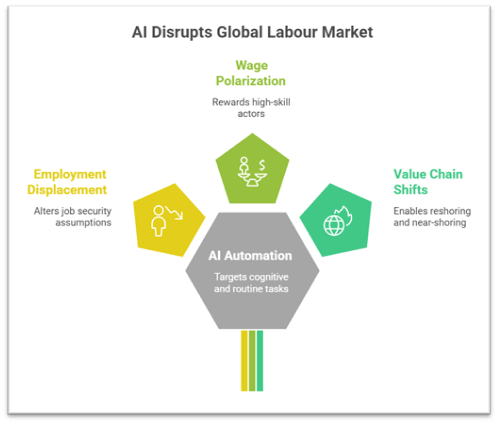
AI-driven automation is increasingly targeting cognitive and routine white-collar tasks, not just manual or repetitive work, altering long-held assumptions about job security in services; this has implications for clerical work, customer support, accounting, legal research and basic software services.
Example / Case Study – Advanced Economies: In the United States and parts of Europe, generative AI tools are already reducing demand for entry-level content creation, paralegal research and back-office processing, while increasing demand for AI supervisors, prompt engineers and compliance specialists.
The net employment outcome depends less on job loss alone and more on task substitution, where human roles are redefined toward judgment, creativity, and complex coordination—skills unevenly distributed across societies.
2. Wage Polarization and Inequality
AI disproportionately rewards high-skill, capital-intensive and data-rich actors, leading to widening wage gaps between advanced AI-skilled workers and those in automatable roles.
Example / Case Study – Platform Economies: Global digital platforms deploying AI at scale have increased productivity and profits while compressing wages in routine service roles, reinforcing the “winner-takes-most” dynamic.
This trend risks deepening North–South inequalities, as countries lacking compute infrastructure, datasets and advanced research ecosystems struggle to capture AI’s value.
3. Shifts in Global Value Chains and Power Structures
AI is enabling reshoring and near-shoring of services through automation, reducing the traditional advantage of low-cost labour in developing economies.
Example / Case Study – Global Services Trade: Automated code generation, AI-based customer interaction and self-healing IT systems reduce dependence on large offshore service teams.
The result is a redistribution of economic power toward nations and firms with sovereign digital infrastructure, compute capacity and control over foundational models.
II. Socio-Economic Consequences for India with Focus on the IT Sector
1. Revenue Pressures in Traditional IT Services
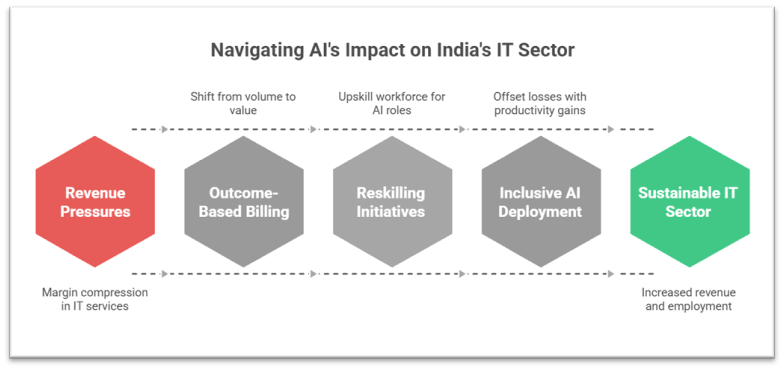
India’s IT sector, long dependent on labour-arbitrage-driven models, faces margin compression as global clients adopt AI to automate application maintenance, testing, helpdesks and basic analytics.
Example / Case Study – Indian IT Firms: Large service providers are witnessing slower growth in legacy contracts while clients renegotiate pricing, citing AI-led efficiency gains.
This threatens export revenues unless firms rapidly transition from volume-based billing to outcome-based and AI-led service models.
2. Employment Vulnerability and Skill Mismatch
Entry-level roles, which historically absorbed large numbers of engineering graduates, are most exposed to automation by generative AI and low-code platforms.
Example / Case Study – Workforce Restructuring: Increased internal reskilling initiatives coexist with reduced campus hiring, indicating a structural shift rather than a cyclical slowdown.
Without large-scale reskilling, the risk is a dual labour market—a small, highly paid AI elite alongside a large pool of underemployed digital workers.
3. Broader Socio-Economic Spillovers
Reduced IT hiring can dampen urban consumption, real estate demand and services employment in technology hubs, amplifying AI’s indirect economic effects.
Example / Case Study – Regional Economies: Cities heavily dependent on IT-led growth face greater exposure compared to more diversified urban economies.
At the same time, AI adoption across sectors such as healthcare, agriculture and governance offers potential productivity gains that can offset losses if inclusively deployed.
III. Measures to Navigate Revenue and Employment Risks
1. Strategic Repositioning of the Indian IT Industry
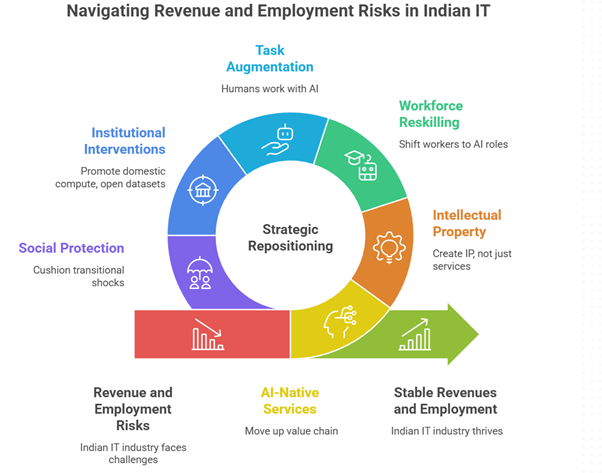
Firms must move up the value chain toward AI-native services, including system integration, model customization, cybersecurity, and AI governance.
Example / Case Study – Industry Transformation: Companies investing in proprietary platforms and sector-specific AI solutions are better placed to retain pricing power.
Emphasis on intellectual property creation, rather than pure services, can stabilize revenues in an AI-dominated market.
2. Workforce Reskilling and Human–AI Complementarity
Large-scale continuous learning ecosystems are essential to shift workers from automatable roles to AI supervision, domain-specialized analytics and human-centered design.
Example / Case Study – Skill Transitions: Collaborative training models involving industry, academia and digital learning platforms have shown higher redeployment success than ad hoc reskilling.
The policy focus must be on task augmentation, ensuring humans work with AI rather than being replaced by it.
3. Institutional and Policy-Level Interventions
Public initiatives promoting domestic compute capacity, open datasets and ethical AI frameworks reduce dependence on external technology monopolies.
Example / Case Study – National Initiatives: Investments in digital public infrastructure and indigenous AI models strengthen technological sovereignty while creating local employment.
Social protection mechanisms, portable skilling credits and labour market flexibility can cushion transitional shocks without stifling innovation.
Conclusion:
The AI surge is reshaping the global labour market through deep structural shifts rather than temporary disruptions, producing both efficiency gains and socio-economic risks. For India, particularly its IT sector, the challenge lies not merely in preventing job losses but in redefining growth itself—from scale-driven services to intelligence-driven value creation.
Evidence from global labour assessments suggests that economies investing early in skills, digital infrastructure and governance frameworks are better positioned to convert AI adoption into net employment and income gains.
A balanced path forward—combining industry transformation, workforce adaptability and proactive institutional oversight—can ensure that AI strengthens economic resilience rather than eroding livelihoods, allowing technological progress to align with inclusive and sustainable development.
Recap: