
Land Acquisition before EIA and Article 21: Dilution of Environmental Rights in India
Environmental justice in India refers to the equitable protection of ecological systems while ensuring that developmental benefits and burdens are fairly distributed. Over the decades, the judiciary expanded Article 21 to include the right to a clean and healthy environment, reading it alongside Articles 48A and 51A(g) to impose affirmative duties on the State and citizens. In this context, land acquisition before EIA and Article 21 has emerged as a critical constitutional concern.
This rights-based framework enabled courts to act as ecological sentinels, especially in a country that hosts nearly 8% of global biodiversity, supports over 17% of the world’s population, and faces accelerating pressures from mining, infrastructure expansion, and urbanisation.
However, the emerging policy shift that allows land acquisition prior to Environmental Impact Assessment (EIA) signals a move from precaution to post-facto justification, raising serious constitutional concerns about whether environmental protection is being subordinated to developmental expediency.
I. Constitutional Expansion of Environmental Rights and Judicial Legacy
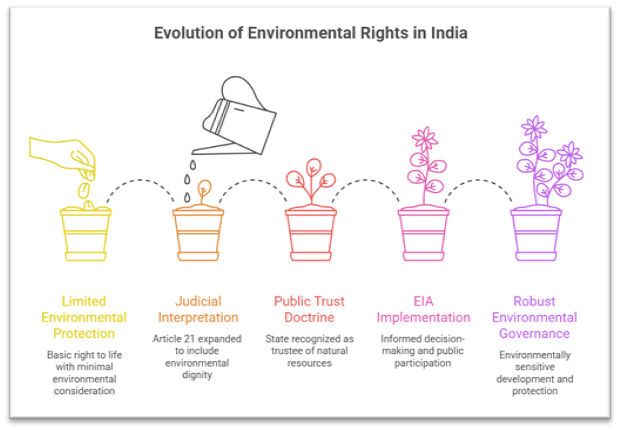
Evolution of Article 21 as an environmental guarantee: Judicial interpretation transformed the right to life into a right to live with human dignity, ecological balance, and pollution-free surroundings, embedding environmental protection into fundamental rights.
Example – Vellore Citizens’ Welfare Forum: The adoption of the precautionary principle and polluter pays principle shifted environmental governance from reactive remediation to preventive action. This jurisprudence aligned India with global environmental norms while recognising its own developmental vulnerabilities.
Public Trust Doctrine as a restraint on State power: Natural resources were held to be common heritage assets, with the State acting only as a trustee, not an absolute owner.
Case Study – M.C. Mehta vs Kamal Nath: Leasing riverbanks to private entities was struck down for violating intergenerational equity. This doctrine constitutionally limited the State’s discretion in diverting forests, rivers, and coastlines for private gain.
Environmental Impact Assessment as a constitutional safeguard: EIA evolved into a tool ensuring informed decision-making, public participation, and scientific evaluation before irreversible ecological change. Judicial insistence on prior clearance reinforced the idea that development must be environment-sensitive rather than environment-subsequent.
II. Land Acquisition before EIA: A Paradigm Shift in Environmental Governance
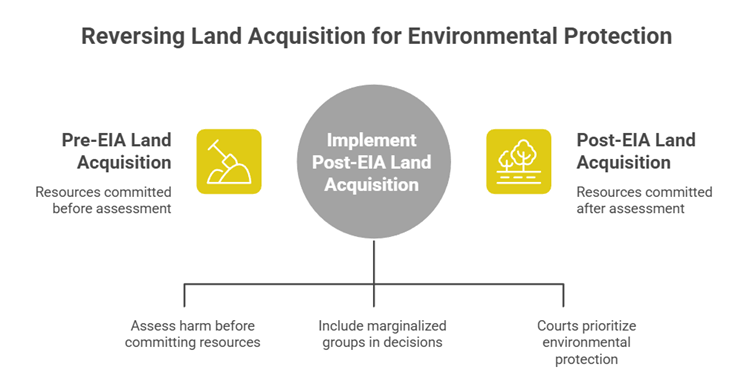
Erosion of the precautionary principle: Allowing land acquisition before environmental appraisal reverses the logic of prevention by committing resources and political capital before assessing harm.
Example – Mining and infrastructure corridors: Projects proceed with sunk costs, making later rejection economically and politically unlikely, converting EIA into a post-facto legitimising exercise.
Dilution of procedural fairness and transparency: Environmental decision-making increasingly marginalises local communities, forest dwellers, and coastal populations, despite their constitutional stake in natural resources.
Case Study – Coastal and mangrove clearances: Clearances granted with promises of compensatory afforestation ignore ecological specificity and time-lag effects, raising Article 14 concerns due to unequal bargaining power.
Judicial accommodation of developmental imperatives: Courts increasingly rely on mitigation assurances rather than strict compliance, especially in strategic or infrastructure projects, signalling a shift from deterrence to discretion.
III. Implications for Article 21 and Environmental Constitutionalism
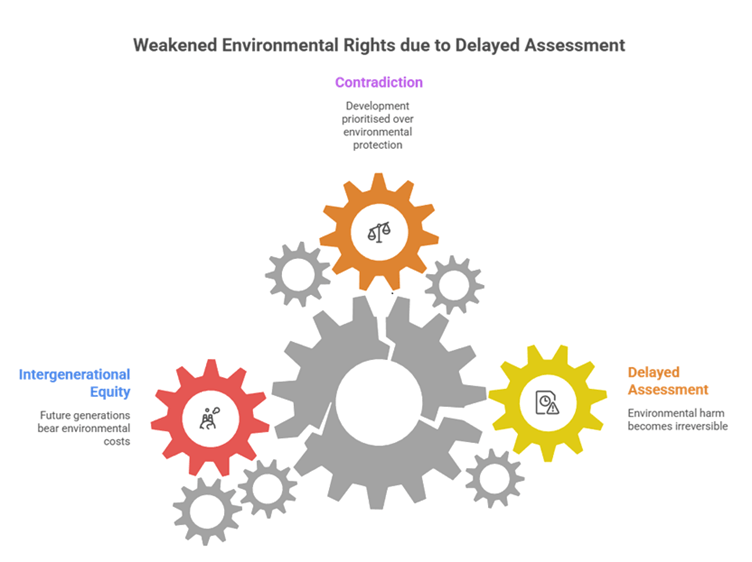
Substantive weakening of the right to a clean environment: When ecological assessment follows land acquisition, environmental harm becomes a fait accompli, reducing Article 21 to a symbolic guarantee.
Example – Fragile mountain ecosystems: Landslides and altered hydrology demonstrate how delayed assessments fail to prevent irreversible damage.
Contradiction with Directive Principles and Fundamental Duties: Article 48A’s mandate is undermined, and Article 51A(g) becomes hollow when institutional processes normalise environmental degradation.
Intergenerational equity and democratic legitimacy at risk: Environmental dilution transfers ecological costs to future generations, eroding democratic trust.
Case Study – Urban flooding and coastal erosion: Long-term ecological impacts expose governance failures masked by short-term economic gains.
Conclusion:
India’s environmental jurisprudence once stood as a global example of reconciling development with ecological integrity. Permitting land acquisition before EIA represents a structural retreat from this legacy, converting environmental rights into negotiable considerations. Restoring prior environmental appraisal, strengthening scientific independence, institutionalising specialised green benches, and deepening community participation are essential for sustainable and constitutionally legitimate development.
Recap: