

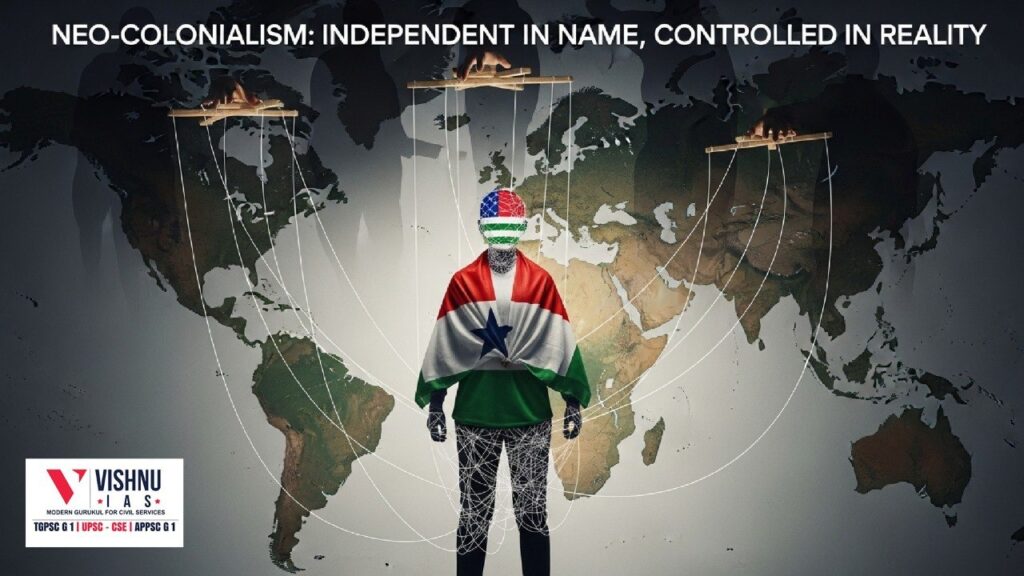
Neo-Colonialism: Independent in Theory, Directed from Outside
Neo-colonialism refers to a condition where a formally sovereign state retains constitutional independence, international recognition, and domestic institutions, yet its economic structures, policy choices, and strategic autonomy are decisively shaped by external powers. The term gained prominence during the post-decolonisation phase of the mid-20th century, when political freedom did not translate into economic self-determination.
Contemporary global political economy reflects this contradiction: despite over 85% of the world’s states being sovereign, global production, finance, technology, and energy flows remain concentrated. A small group of advanced economies accounts for a disproportionate share of foreign direct investment, global financial liquidity, sanctions power, and control over critical supply chains. This asymmetry sustains a system where sovereignty exists de jure, while autonomy is constrained de facto.
Structural Economic Dependence as the Core of Neo-Colonial Control
Resource-centric economic models often lock states into dependency on external capital, markets, and technology, limiting policy freedom.
- Example – Venezuela: Dependence on oil revenues created vulnerability to external sanctions, blockades, and investment conditionalities, forcing renegotiation of sovereign resource control under pressure.
Financial instruments and market access function as indirect levers of influence. External control over currency flows, payment systems, and investment approvals enables policy steering without formal governance.
- Case Study – African debt restructuring: Several mineral-rich economies negotiate fiscal priorities under lender-driven frameworks, reshaping welfare spending and development strategies.
Trade and investment asymmetries reinforce unequal exchange, where value addition and pricing power lie outside the producing state.
- Example – Global commodity chains: Primary exporters absorb volatility while downstream actors secure stable profits, narrowing domestic developmental choices.
Political Sovereignty Without Strategic Autonomy
Regime management rather than regime change reflects a shift from overt intervention to indirect governance, prioritising stability and compliance over ideological alignment.
- Case Study – Venezuela post-intervention: Retention of domestic political structures alongside externally negotiated economic terms illustrates functional sovereignty with constrained agency.
Sanctions regimes operate as coercive policy tools that bypass domestic democratic processes, compelling compliance through economic pain rather than legal authority.
- Example – Iran and Venezuela: Sectoral sanctions reshaped domestic political economy, redirecting trade, investment, and fiscal policy priorities.
Security dependencies further dilute autonomy, as military balance and deterrence remain asymmetrical.
- Case Study – Latin America: Regional militaries often operate within security architectures shaped by external strategic doctrines, limiting independent defence postures.
Limits of Multipolarity and Collective Resistance
Emerging powers’ selective engagement highlights the limits of multipolar protection. Strategic restraint prevents escalation within declared spheres of influence.
- Example – China and Russia: Economic engagement continues, but without direct confrontation when hegemonic interests are asserted.
Institutional fragmentation of the Global South weakens bargaining power, enabling divide-and-rule dynamics in trade, finance, and diplomacy.
- Case Study – Non-aligned coordination: Absence of unified platforms limits leverage against sanctions and conditionalities.
Policy space erosion persists despite domestic reform, indicating that diversification alone is insufficient without collective insulation mechanisms.
- Example – Oil diversification attempts: Structural constraints remain when access to markets, shipping, insurance, and finance is externally controlled.
Conclusion:
Neo-colonialism persists not through territorial rule, but through economic leverage, financial gatekeeping, strategic coercion, and asymmetrical interdependence. This validates the assertion that states may be independent in theory yet directed from outside.
However, the pathway forward lies in regional integration, coordinated Global South diplomacy, diversification beyond commodities, and collective financial instruments that reduce exposure to unilateral pressures. South-South trade now accounts for over a quarter of global trade, and regional development banks are expanding non-conditional lending.
Strengthening these trajectories, alongside strategic autonomy in energy, finance, and technology, offers a constructive route to convert formal sovereignty into substantive self-determination.
Recap: