
Removal of High Court Judges in India: Constitutional Framework, Independence and Accountability
Introduction
The removal of High Court judges in India represents one of the most delicate constitutional questions in Indian democracy, situated at the intersection of judicial independence and democratic accountability. The Constitution consciously adopts the term “removal” rather than “impeachment” for judges, underscoring the exceptional nature of this process and the high threshold required to protect judicial autonomy.
Articles 217, 124(4), and 124(5), read with the Judges (Inquiry) Act, 1968, establish a layered mechanism intended to prevent arbitrary executive or legislative interference while ensuring that judges guilty of proved misbehaviour or incapacity do not remain in office.
Recent parliamentary attempts to invoke this mechanism have renewed debate on whether the existing framework adequately balances these twin constitutional imperatives.
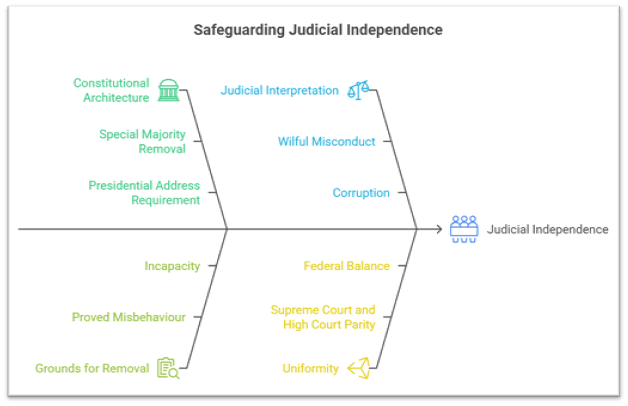
I. Constitutional Architecture: Safeguarding Judicial Independence
Embedded constitutional safeguards
- The Constitution mandates removal only through a special majority in both Houses of Parliament—requiring not merely numerical strength but broad political consensus—thereby insulating judges from transient political pressures.
- The requirement that the President acts only after parliamentary address reinforces the principle that removal is an institutional, not executive, decision.
- Example – Constitutional Design: The framers’ rejection of executive-led removal models, unlike in several presidential systems, reflects an intentional bias towards independence.
Narrow and elevated grounds for removal
- Removal is permitted solely on proved misbehaviour or incapacity, deliberately excluding errors of judgment or unpopular decisions.
- Judicial interpretation has clarified that misbehaviour entails wilful misconduct, corruption, lack of integrity, or moral turpitude, thereby protecting adjudicatory freedom.
- Case Study – Judicial Interpretation: Supreme Court rulings have consistently distinguished between judicial fallibility and culpable misconduct, preventing misuse of removal proceedings.
Uniformity across superior judiciary
- By extending the same procedure applicable to Supreme Court judges to High Court judges, the Constitution ensures institutional parity and avoids hierarchical vulnerability.
- This uniform framework strengthens public confidence that High Court judges are not more susceptible to political retaliation than their counterparts at the apex level.
- Example – Federal Balance: Uniform removal standards prevent States or regional politics from exerting disproportionate influence over High Court judges.
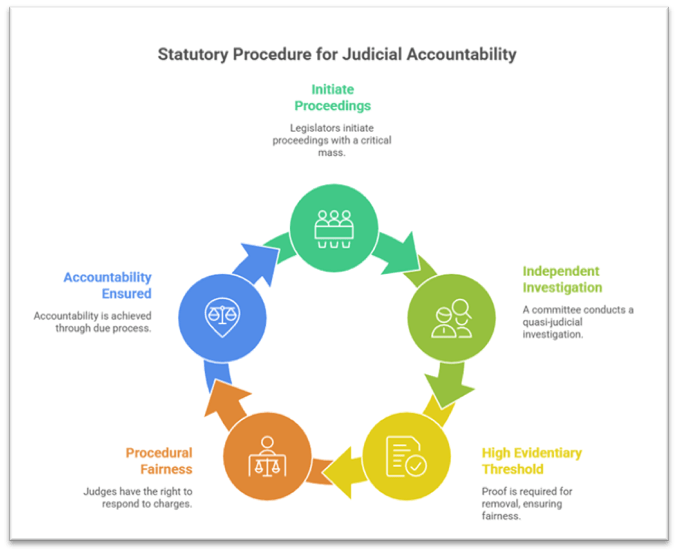
II. Statutory Procedure: Ensuring Accountability through Due Process
Initiation through parliamentary will
- The Judges (Inquiry) Act requires a critical mass of legislators to initiate proceedings, filtering out frivolous or motivated complaints.
- This collective initiation embeds political accountability while ensuring that concerns about judicial conduct gain institutional seriousness.
- Case Study – Parliamentary Initiatives: Past notices of removal, even when unsuccessful, have served as signals of institutional concern rather than instruments of punishment.
Independent investigative mechanism
- Upon admission, a three-member inquiry committee—comprising a Supreme Court judge, a High Court Chief Justice, and a distinguished jurist—conducts a quasi-judicial investigation.
- The committee’s composition ensures expertise, neutrality, and credibility, distancing fact-finding from partisan politics.
- Example – Institutional Design: This mirrors other constitutional bodies where technical expertise is prioritised over political discretion.
High evidentiary threshold
- The requirement of “proof” after investigation ensures that removal is evidence-based and not perception-driven.
- Judges are afforded procedural fairness, including the right to respond to charges, aligning the process with principles of natural justice.
- Case Study – Failed Removal Attempts: Several past proceedings collapsed at the evidentiary stage, demonstrating the robustness of safeguards against wrongful removal.
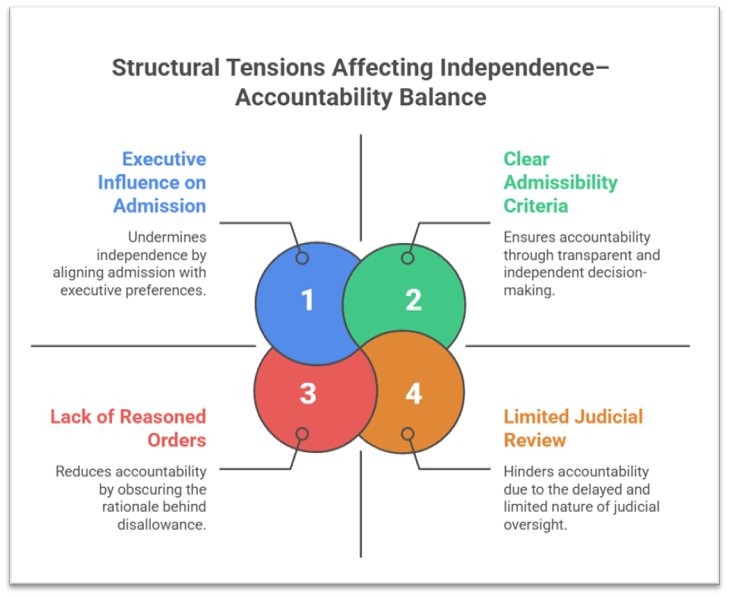
III. Structural Tensions: Gaps Affecting the Independence–Accountability Balance
Discretion at the admission stage
- The statutory power of the Speaker or Chairman to admit or disallow a motion introduces a critical gatekeeping stage not explicitly envisaged by the Constitution.
- Absence of clearly defined admissibility criteria risks perceptions of arbitrariness, particularly when large numbers of legislators support the motion.
- Example – Procedural Bottleneck: Motions lapsing at the threshold effectively nullify the investigative safeguard built into the framework.
Potential for executive influence
- Given the political position of presiding officers, the admission power may inadvertently align with executive preferences, undermining legislative independence.
- This creates an asymmetry where accountability mechanisms exist in theory but can be stalled in practice.
- Case Study – Controversial Non-Admissions: Past instances where motions did not proceed beyond notice stage illustrate how accountability may be procedurally constrained.
Limited transparency and public confidence
- The lack of mandatory reasoned orders for disallowance weakens transparency and fuels suspicion regarding institutional motives.
- While judicial review remains theoretically available, its delayed and limited nature reduces its corrective effectiveness.
- Example – Comparative Practice: Other constitutional democracies increasingly emphasise reason-giving as a core element of institutional legitimacy.
Conclusion:
The constitutional and statutory framework for the removal of High Court judges in India reflects a deliberate constitutional choice to privilege judicial independence while embedding accountability within a rigorously structured process. The requirement of supermajorities, narrowly defined grounds, and independent investigation collectively ensure that judges are protected from political vendetta while remaining answerable for serious misconduct.
However, the discretionary gatekeeping role at the admission stage under the Judges (Inquiry) Act creates a structural imbalance, enabling accountability mechanisms to be neutralised before investigation begins. A calibrated reform—such as codifying admissibility criteria, mandating reasoned decisions, or limiting discretion where numerical thresholds are met—would strengthen institutional credibility without diluting independence.
Empirical assessments of judicial trust in India consistently show high public confidence in courts; preserving this trust demands a system where independence is shielded, but accountability is never illusory.
Recap: