
Reverse Remittances and Brain Waste in Indian Student Migration: Rethinking Migration as National Wealth Creation
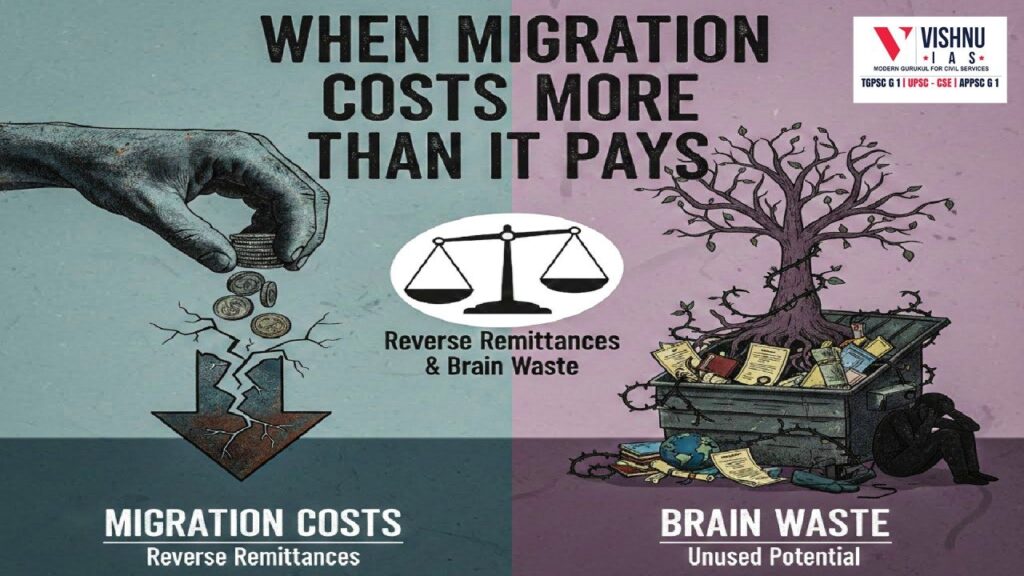
Reverse remittances and brain waste in Indian student migration have emerged as defining features of India’s contemporary mobility landscape, challenging the long-held assumption that migration automatically contributes to national wealth creation.
Introduction
Student migration from India has undergone a structural transformation in the last decade, shifting from a narrowly elite, scholarship-driven phenomenon to a mass, self-financed movement dominated by middle-class households. By 2024, over 13.35 lakh Indian students were enrolled across more than 70 countries, making India one of the world’s largest exporters of international students.
This mobility is increasingly funded through family savings, property mortgages, and education loans, with individual students often investing ₹40–50 lakh per degree. While traditional migration theory frames such flows as engines of human capital formation, remittances, and national wealth creation, emerging outcomes such as reverse remittances—where domestic households subsidise foreign economies—and brain waste, defined as the underutilisation or deskilling of educated migrants, complicate this narrative.
The phenomenon therefore demands a reassessment of whether contemporary student migration continues to deliver net developmental gains for India.
1. Reverse Remittances: Financial Outflows and Household-Level Distress
Structural shift from inflows to outflows
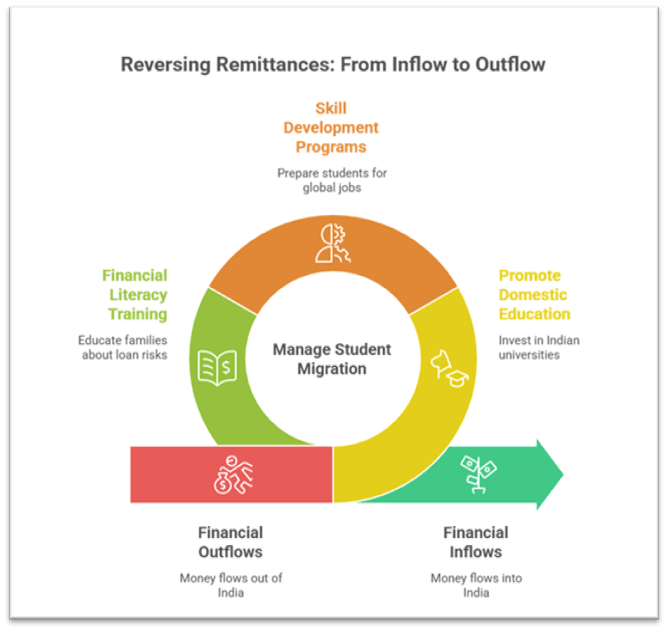
Unlike labour migration to the Gulf, where migrant wages generate sustained inward remittances, self-financed student migration produces persistent outward financial flows, covering tuition, housing, healthcare, and subsistence in high-cost OECD economies.
Example – Kerala Case Study: The Kerala Migration Survey illustrates how student-related outward remittances have grown to nearly one-fifth of total inward remittances, reflecting a reversal of the traditional remittance cycle where families now fund foreign economies rather than benefit from them.
Debt-led mobility and risk transfer to households
Education loans backed by family assets have converted migration risk into intergenerational financial exposure, particularly when post-study employment fails to materialise.
Example – Education Loan Stress: Rising non-performing assets in education loans reported by public sector banks highlight how unsuccessful overseas education outcomes translate into domestic financial fragility rather than wealth creation.
Macroeconomic subsidy to host economies
Indian students constitute a significant source of revenue for host countries’ universities, housing markets, and local labour ecosystems, effectively functioning as exported consumers rather than skilled contributors.
Example – Canada Case Study: International students contribute tens of billions of dollars annually to GDP and job creation, with Indian students forming the largest cohort, underscoring how the economic surplus accrues disproportionately outside India.
2. Brain Waste: Deskilling, Underemployment, and Lost Human Capital
Mismatch between qualifications and employment outcomes
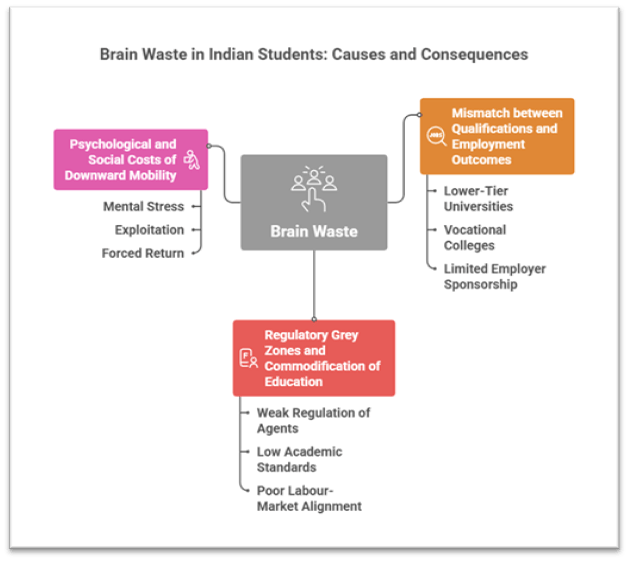
A large proportion of Indian students are enrolled in lower-tier universities and vocational colleges, often through recruitment agents prioritising commissions over academic fit.
Example – UK Post-1992 Universities: Many Indian postgraduates remain confined to low-wage service jobs due to limited employer sponsorship, reflecting how formal qualifications fail to translate into skilled employment.
Regulatory grey zones and commodification of education
Weak regulation of education agents and private foreign colleges has allowed the expansion of programmes with low academic standards and poor labour-market alignment, converting education into a migration intermediary rather than a skill-building process.
Example – Recruitment Network Model: Tie-ups between agents in India and marginal colleges abroad illustrate how education becomes a transactional pathway to visas, increasing the risk of long-term underemployment.
Psychological and social costs of downward mobility
The inability to secure skilled employment, coupled with restrictive visa regimes and rising living costs, has resulted in mental stress, exploitation, and forced return, further eroding the value of acquired education.
Example – Care Visa Route Closure in the UK: The withdrawal of alternative visa pathways eliminated a survival strategy for students, pushing many into irregular work or premature return without returns on investment.
3. Rethinking Migration as Wealth Creation: Structural and Policy Dimensions
From national gain to private gamble
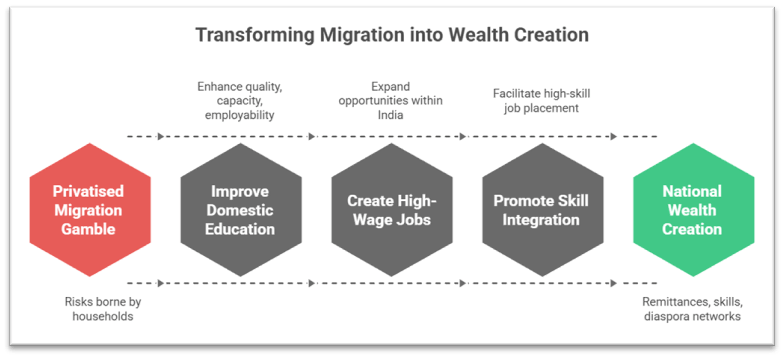
Traditional migration narratives assumed that individual mobility aggregates into national gains through remittances, skill transfers, and diaspora networks. The current wave, however, increasingly resembles a privatised gamble, where risks are borne by households while benefits accrue abroad.
Example – Middle-Class Aspiration Trap: Student migration reflects aspirations for permanent residency and social mobility rather than skill acquisition alone, weakening the developmental feedback loop to India.
Domestic push factors and institutional gaps
Persistent concerns over quality, capacity, and employability outcomes in domestic higher education, combined with limited high-wage job creation, continue to propel outward mobility.
Government Initiative – National Education Policy (NEP) 2020: While reforms aim to internationalise Indian universities and improve quality, outcomes remain uneven, sustaining the appeal of overseas education.
Labour substitution in advanced economies
Indian students increasingly function as a flexible, low-cost labour pool for OECD economies, similar to Gulf labour migration but without remittance benefits.
Example – Part-time Work Dependency: Students juggling multiple low-paid jobs to offset costs reveal how education migration is intertwined with precarious labour markets rather than high-skill integration.
Conclusion:
The rise of reverse remittances and brain waste fundamentally challenges the classical view of migration as an unambiguous tool for national wealth creation. While student migration continues to expand India’s global footprint and reflects legitimate aspirations for mobility, its current self-financed, weakly regulated form has produced asymmetric outcomes, where financial risks, deskilling, and social costs are internalised domestically, while economic gains are externalised to host countries.
A constructive way forward lies in strengthening regulation of education agents, institutionalising pre-departure counselling linked to labour-market outcomes, and negotiating bilateral accountability frameworks that align education with employability.
Simultaneously, accelerating domestic higher education reforms and quality job creation can rebalance migration from a debt-driven necessity to a genuine developmental choice. Only through such systemic recalibration can student mobility evolve from a source of brain waste into a sustainable channel of human capital enrichment and shared prosperity.
Recap: