India’s Nuclear Governance Needs Regulatory Independence to Build Public Trust and Investor Confidence
India’s nuclear governance regulatory independence has emerged as a critical prerequisite for scaling nuclear power safely and sustainably. Nuclear governance refers to the institutional, legal and regulatory framework that governs the safety, licensing, liability, oversight and accountability of civil nuclear activities. In India, despite possessing one of the world’s most advanced indigenous nuclear science ecosystems, nuclear power contributed only about 3% of total electricity generation in 2024–25, underscoring its underutilisation in the national energy mix.
Recognising nuclear energy’s role in clean baseload power, net-zero commitments and energy security, the government has set an ambitious target of 100 GW nuclear capacity by 2047, including indigenous Small Modular Reactors (SMRs).
Recent legislative reforms seek to widen participation beyond state monopolies, but this expansion has sharpened the debate on whether regulatory independence is adequate to inspire public trust and long-term private investment, especially given nuclear energy’s high-risk, high-capital and socially sensitive nature.
I. Why Regulatory Independence Is Central to Nuclear Governance
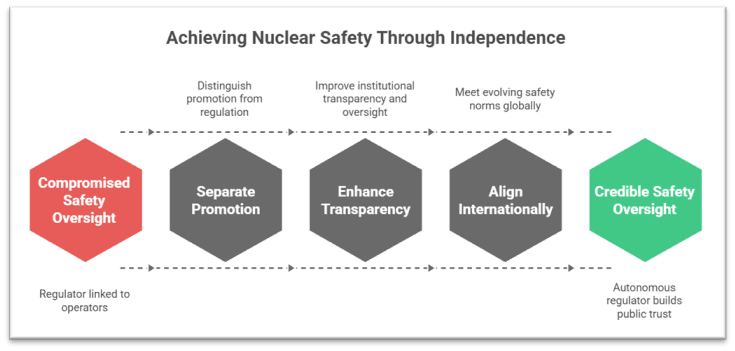
Ensuring credible safety oversight in a high-risk sector
- Nuclear power involves low-probability but high-impact risks, where independent regulation is globally recognised as essential for preventing regulatory capture and conflicts of interest.
- When the promoter, operator and regulator are closely linked institutionally, public perception of compromised safety oversight intensifies.
- Case Study – Fukushima Daiichi (Japan): Post-disaster investigations revealed regulatory proximity to operators, leading to major reforms that separated promotion from regulation, highlighting why independence is foundational to safety credibility.
Building public trust and social licence
- Nuclear installations require community acceptance over decades, especially in densely populated or ecologically sensitive areas.
- A regulator perceived as autonomous reassures citizens that safety enforcement, emergency preparedness and environmental monitoring are not subordinated to production targets.
- Example – Kudankulam Nuclear Power Plant: Protests were driven less by technology itself and more by distrust in institutional transparency and oversight, illustrating the governance–trust linkage.
Aligning with international nuclear best practices
- Global nuclear regimes emphasise an “arm’s length” regulator distinct from policy-makers and operators to meet evolving safety norms.
- Regulatory independence enhances India’s credibility in international nuclear cooperation and technology partnerships, particularly in advanced reactor ecosystems.
II. Investor Confidence, Capital Mobilisation and the Role of an Independent Regulator
Reducing policy and regulatory uncertainty for private capital
- Achieving 100 GW nuclear capacity requires massive upfront capital with long gestation periods, making investors sensitive to governance clarity.
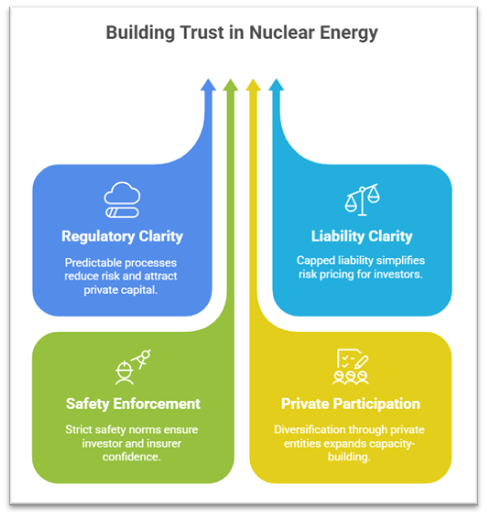
- An independent regulator provides predictable licensing, safety approvals and enforcement processes, reducing project risk premiums.
- Case Study – Renewable Energy Sector in India: Strong, relatively independent regulators in power markets helped unlock large-scale private investment, offering a transferable lesson for nuclear power.
Balancing liability clarity with accountability
- Capped operator liability simplifies risk pricing for investors, but without a visibly independent regulator, concerns arise over whether safety enforcement might be diluted to protect commercial interests.
- Regulatory autonomy ensures that liability caps do not translate into safety complacency, maintaining confidence among both financiers and insurers.
- Example – Global Nuclear Insurance Pools: Investor participation typically increases when regulators are trusted to strictly enforce safety norms irrespective of ownership structure.
Facilitating private participation without compromising safety
- Allowing licensed non-government entities into plant construction and operation expands capacity-building, but this diversification demands stronger, not weaker, regulatory distance.
- Independent oversight reassures investors that competition is fair, standards are uniform and enforcement is not discretionary.
III. Governance Challenges and the Need for Structural Reform
Institutional overlap between policy, promotion and regulation
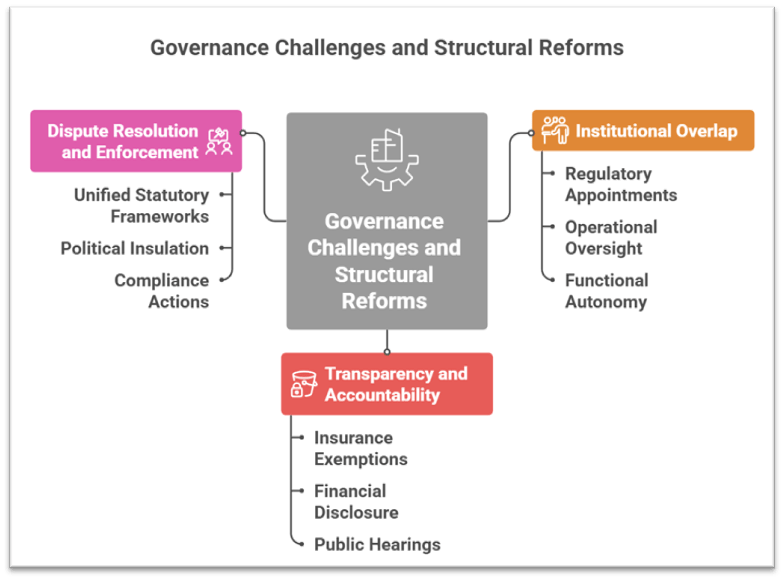
- When regulatory appointments and operational oversight remain closely aligned with executive authorities and atomic energy bodies, perceptions of partiality persist.
- True independence requires transparent appointments, security of tenure and functional autonomy for the regulator.
- Case Study – Telecom Regulatory Reforms in India: Enhanced autonomy significantly improved investor confidence and sectoral expansion, demonstrating governance reform dividends.
Transparency, accountability and public scrutiny
- Exemptions from insurance and financial disclosure obligations for state installations heighten the need for robust public accounting and independent audits.
- An autonomous regulator can institutionalise transparency through mandatory disclosures, safety reports and public hearings, reducing mistrust.
Strengthening dispute resolution and enforcement credibility
- Unified statutory frameworks that combine licensing, safety enforcement and dispute resolution are effective only when regulators are insulated from political and operational pressures.
- Independent enforcement ensures that compliance actions are seen as technically driven rather than administratively influenced.
Conclusion:
India’s nuclear expansion is indispensable for meeting long-term clean energy goals, grid stability and climate commitments, especially as electricity demand is projected to nearly double by 2047. However, scaling nuclear capacity from 3% of current generation to a meaningful share of the energy mix is not merely a technological or financial challenge—it is fundamentally a governance challenge.
Strengthening regulatory independence through transparent appointments, functional autonomy and enhanced accountability can simultaneously rebuild public trust and unlock investor confidence.
By aligning governance structures with global best practices while preserving sovereign control over sensitive fuel cycles, India can ensure that nuclear energy evolves as a safe, credible and scalable pillar of its sustainable development trajectory.
Recap: