
Checks and Balances vs Legislative Supremacy: Supreme Court Advisory Opinion on Gubernatorial Powers
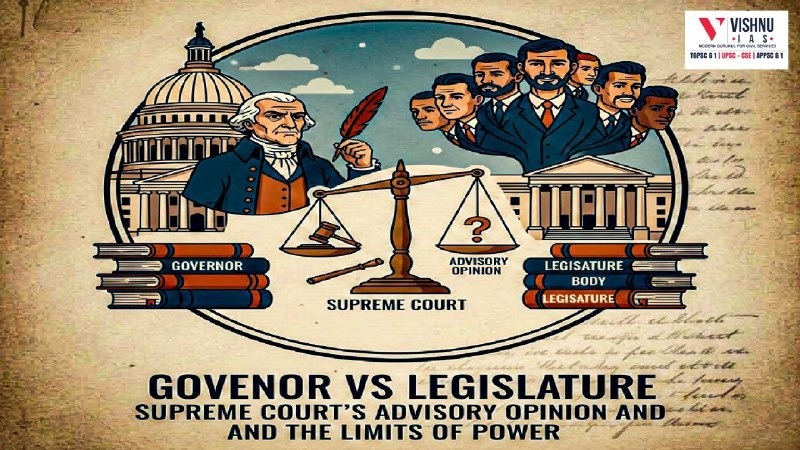
Checks and balances vs legislative supremacy has emerged as a defining constitutional debate in India following the Supreme Court’s advisory opinion on gubernatorial powers. The issue raises fundamental questions about democratic mandate, executive discretion, and judicial intervention within India’s federal framework.
Introduction
The constitutional design of India rests on a careful balance between legislative supremacy in law-making and institutional checks and balances to prevent constitutional excesses. Articles 200 and 201 situate the Governor and the President within this framework by granting them assent-related powers over State legislation.
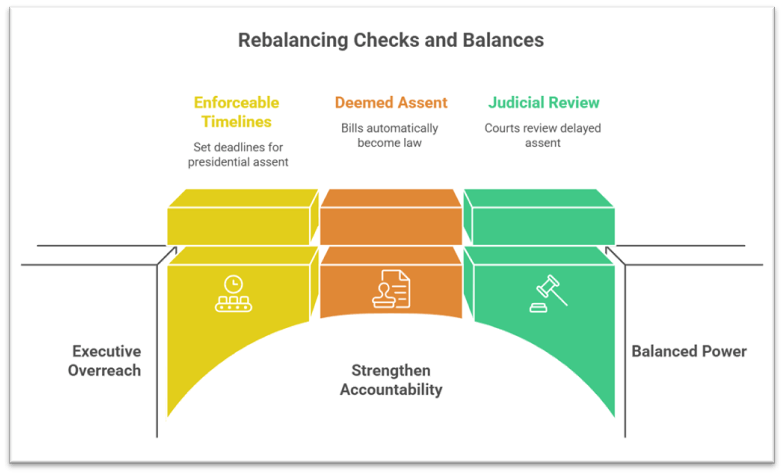
However, recent constitutional practice—marked by prolonged delays by Governors in assenting to Bills—has strained this balance. The Supreme Court’s April 2025 judgment in State of Tamil Nadu vs Governor of Tamil Nadu sought to restore equilibrium by imposing timelines and enabling judicial remedies against inaction.
Shortly thereafter, the Court’s advisory opinion in Special Reference No. 1 of 2025 recalibrated this position by emphasising textual fidelity and executive discretion, reigniting a fundamental debate: do expansive checks safeguard constitutionalism, or do they erode the primacy of elected legislatures? This tension lies at the heart of contemporary Centre–State relations and cooperative federalism in India.
Legislative Supremacy and Democratic Mandate
Primacy of Elected Legislatures in Law-Making
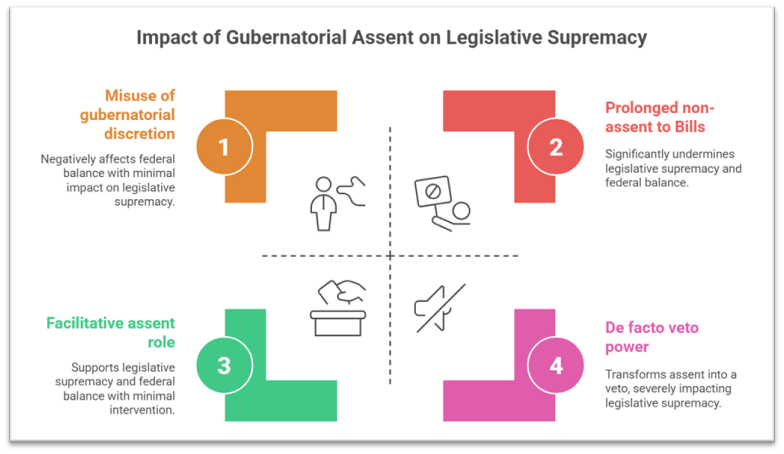
Legislative assemblies derive authority directly from popular sovereignty under Articles 168–170, making them the principal forum for articulating public will. When assent is delayed indefinitely, the substantive outcomes of electoral mandates are procedurally neutralised, undermining democratic accountability.
Example: Prolonged non-assent to Bills on public universities and administrative reforms in certain States led to policy paralysis despite clear legislative backing.
Assent as a Procedural, Not Substantive, Check
Constitutionally, the Governor’s role in assent is meant to be facilitative rather than adjudicatory. Elevating assent into a de facto veto or preliminary constitutional review risks transforming Raj Bhavan into an unelected supervisory authority over legislatures.
Case Study: The April 2025 ruling reinforced this distinction by treating silence as constitutionally suspect rather than a neutral choice.
Impact on Federal Balance and State Autonomy
Legislative supremacy at the State level is a core feature of India’s quasi-federal structure. Recurrent obstruction dilutes fiscal, administrative, and policy autonomy, particularly in Opposition-ruled States, aggravating asymmetries in Centre–State relations.
Example: Issues flagged by States before the Sarkaria Commission regarding misuse of gubernatorial discretion continue to resonate in current constitutional conflicts.
Checks and Balances: Constitutional Safeguard or Executive Leverage
Rationale Behind Checks and Balances
The doctrine of checks and balances aims to prevent majoritarian excesses and constitutional violations by diffusing power among institutions. The advisory opinion stresses that Articles 200 and 201 embed such safeguards by allowing reconsideration and presidential reference.
Example: Referral of Bills affecting High Court jurisdiction or inter-State interests has historically been justified on constitutional prudence.
Elastic Discretion and the Problem of Motivated Silence
By rejecting judicially enforceable timelines and deemed assent, the advisory opinion expands discretionary space without proportionate accountability mechanisms. This creates room for motivated silence, where delay achieves indirectly what direct refusal cannot.
Case Study: Re-enacted Bills being repeatedly reserved for the President despite legislative reiteration exemplify how discretion can morph into obstruction.
False Equivalence Between Legislative Error and Executive Delay
While unconstitutional laws can be invalidated through judicial review, denial or delay of assent lacks an equally effective corrective. Treating both as equivalent “checks” ignores this asymmetry and disproportionately burdens the legislative process.
Example: Courts routinely strike down unconstitutional statutes, whereas stalled Bills often lapse into irrelevance without adjudication.
Judicial Role, Advisory Opinions, and Constitutional Clarity
Judicial Intervention as a Constitutional Stabiliser
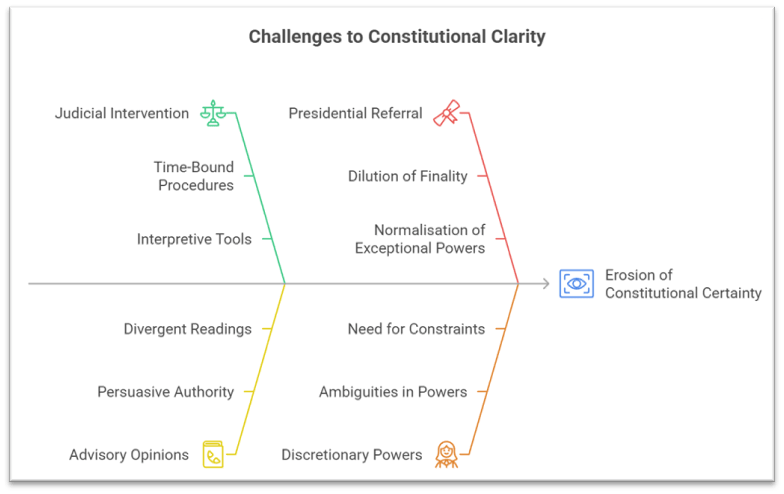
The April 2025 judgment positioned courts as guardians against institutional deadlock, recognising that prolonged inaction corrodes constitutional morality. Timelines were framed as interpretive tools rather than textual insertions.
Example: Courts have previously imposed procedural disciplines—such as time-bound floor tests—to preserve democratic outcomes.
Advisory Opinion and Persuasive Authority
Though not formally overruling precedent, a Constitution Bench advisory opinion carries substantial persuasive weight, especially when it clarifies contested constitutional terrain. This creates uncertainty about the operative balance between restraint and intervention.
Erosion of Constitutional Certainty
Allowing referral to the President even after legislative reiteration dilutes the finality envisaged in the first proviso to Article 200. The absence of clear outer limits risks normalising exceptional powers, weakening rule-based governance.
Example: Similar ambiguities in discretionary powers under Article 356 prompted judicial course correction in S.R. Bommai, underscoring the need for principled constraints.
Conclusion:
The advisory opinion on gubernatorial powers underscores a deeper constitutional dilemma: how to preserve checks and balances without hollowing out legislative supremacy. While safeguarding the Constitution from potential legislative overreach is essential, empowering unelected functionaries with open-ended discretion risks democratic dilution and federal imbalance.
A sustainable way forward lies in constitutional conventions backed by minimal but firm judicial guardrails, greater transparency in assent-related decisions, and renewed commitment to cooperative federalism. Reinforcing this equilibrium—where checks restrain excess without enabling obstruction—is vital to ensuring that constitutional morality, democratic mandate, and federal harmony advance together.
Recap: