

How the Absence of Timelines in the Anti-Defection Law Weakens Democracy: A Critical Analysis of the Tenth Schedule
Introduction
The absence of timelines in the anti-defection law under the Tenth Schedule, inserted through the 52nd Constitutional Amendment Act (1985), seeks to curb political defections that undermine democratic stability. However, the Constitution does not prescribe any statutory timeline for the Speaker or Chairman to decide disqualification petitions. This design flaw has produced significant distortions in legislative functioning, allowing prolonged pendency of defection cases. Studies by multiple parliamentary committees and analyses of recent political events highlight that over one-third of disqualification petitions between 2016–2023 remained pending beyond one year, sometimes extending for the entire tenure of the House. The absence of timelines thus raises concerns about constitutional morality, separation of powers, and the integrity of the democratic mandate.
1. Systemic Consequences of No Timelines
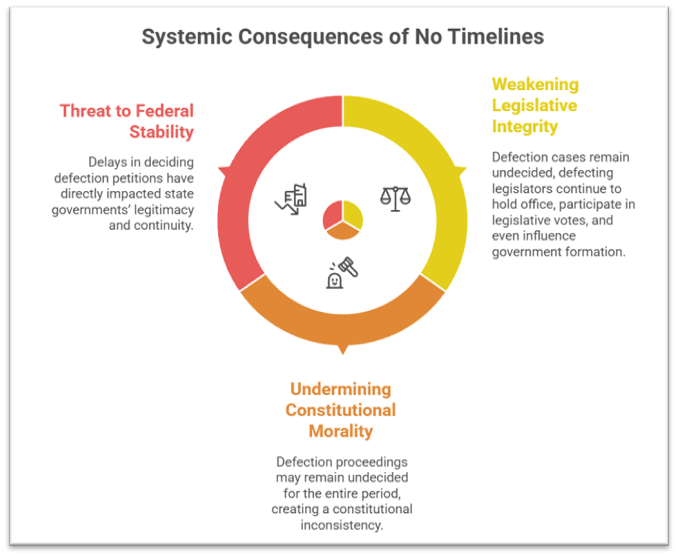
1.1 Weakening of Legislative Integrity
- Erosion of voter mandate: When defection cases remain undecided for long periods, defecting legislators continue to hold office, participate in legislative votes, and even influence government formation.
Example: Karnataka 2019 crisis, where resignations and defections altered government stability while proceedings lingered. - Dilution of anti-defection objectives: The original intent of the Tenth Schedule—to prevent opportunistic floor-crossing—is compromised, as delays enable MLAs to evade accountability.
- Rise in politically strategic defections: Parties exploit the absence of timelines, engineering defections close to elections knowing they will not be decided before the House term ends.
Case study: Manipur and Telangana Assemblies, where petitions remained pending beyond two years.
1.2 Undermining Constitutional Morality and Governance
- Contradiction with fixed tenure governance: While legislatures have a fixed five-year term, defection proceedings may remain undecided for the entire period, creating a constitutional inconsistency.
- Moral hazard for Speakers: As Speakers are usually from the ruling party, prolonged delays may be used to protect party interests.
Case study: Arunachal Pradesh 2016, where the Speaker’s actions and delays intensified political instability. - Diminished public trust: Citizens perceive anti-defection proceedings as politically manipulated exercises, undermining faith in representative democracy.
1.3 Threat to Federal Stability
- Distortion of State governance: Delays in deciding defection petitions have directly impacted state governments’ legitimacy and continuity.
Example: Puducherry 2021, where defections shaped political outcomes before proceedings concluded. - Federal confrontations: Defection-related instability invites central intervention under Article 356, even if indirectly, pressuring the judiciary to intervene.
Case study: Judicial interventions in Uttarakhand (2016) and Maharashtra (2022). - Disruption of cabinet functioning: Legislators facing disqualification have held ministerial positions, influencing state policy without clarity on their legal status.
2. Judicial, Political and Administrative Implications
2.1 Judicial Burden and Reactive Adjudication
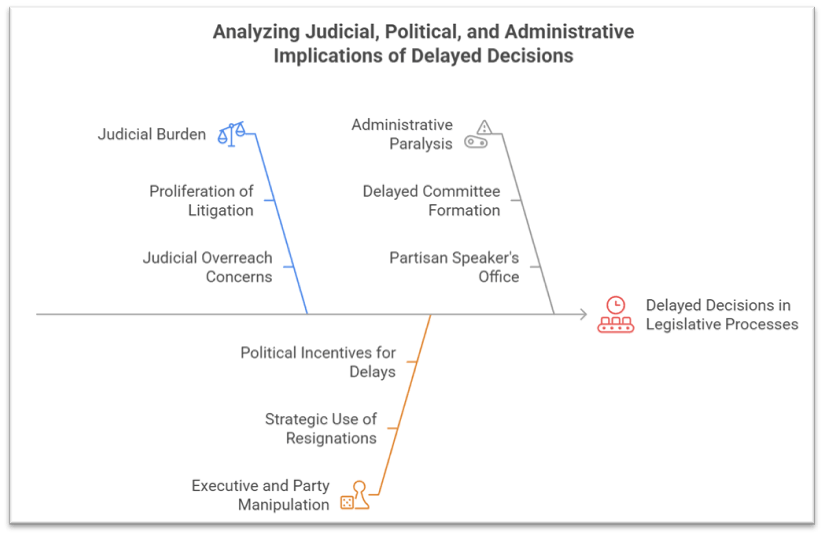
- Proliferation of litigation: With Speakers delaying decisions, petitioners approach the High Courts and Supreme Court seeking directions, adding to judicial burden.
Example: Supreme Court directives in Keisham Meghachandra Singh (2020) emphasising reasonable time. - Judicial overreach concerns: Courts are forced to prescribe outer limits (e.g., three months) in some cases, even though the Constitution is silent.
- Case-by-case inconsistency: Absence of uniform statutory timelines leads to varied judicial outcomes, creating uncertainty in constitutional practice.
2.2 Executive and Party Manipulation of Legal Loopholes
- Strategic use of resignations: MLAs resign to evade disqualification and re-contest elections, exploiting delays.
Case study: Karnataka MLAs (2019) who used resignation to bypass anti-defection action. - Political incentives for delays: Parties often prefer slow proceedings to secure legislative majorities during confidence votes.
- Disincentive for accountability: Without strict timelines, leaders are not compelled to uphold the spirit of the Tenth Schedule, promoting transactional politics.
2.3 Administrative Paralysis within Legislatures
- Delayed committee formation and legislative processes: Uncertain membership hampers functioning of House Committees and key financial approvals.
- Impacts on budget and policy decisions: Legislators whose status is unclear may influence key votes affecting public finance and governance.
Example: Voting on crucial appropriation bills in northeastern legislatures. - Speaker’s office becoming partisan: Instead of being neutral adjudicators, Speakers often operate under political pressure, undermining the legislature’s administrative autonomy.
3. Need For Structural Reform and Constitutional Clarity
3.1 Strengthening the Design of the Tenth Schedule
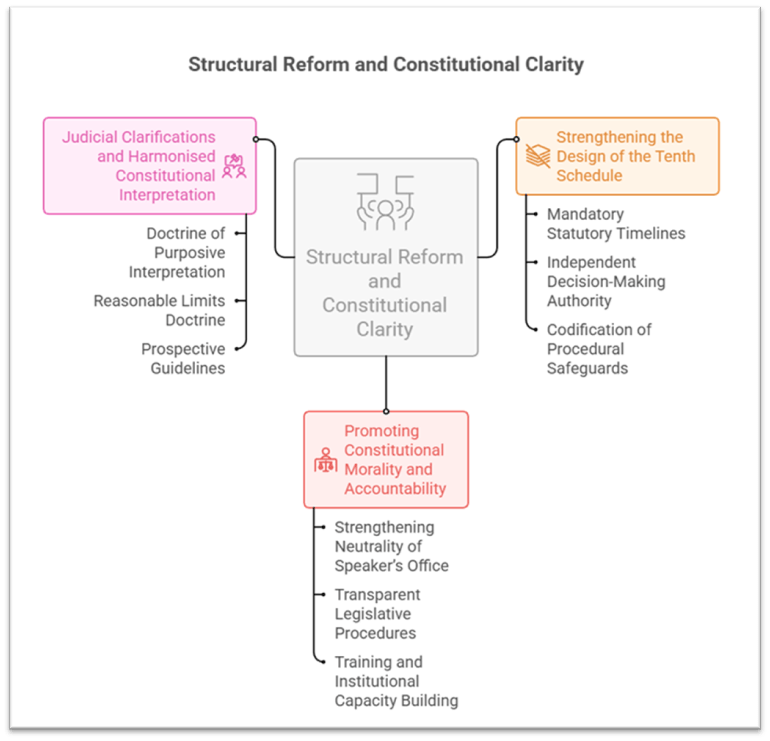
- Mandatory statutory timelines: Expert bodies like the Law Commission have suggested fixed timelines (e.g., 3–6 months) for Speakers to decide petitions.
- Independent decision-making authority: Transferring adjudicatory power to an external constitutional body, such as the Election Commission, could reduce partisanship.
Case study: International best practice in South Africa, where independent bodies handle party-switching rules. - Codification of procedural safeguards: Clear rules for evidence submission, hearings, and interim measures will reduce delays.
3.2 Promoting Constitutional Morality and Accountability
- Strengthening neutrality of Speaker’s office: Reforms such as fixed tenure, removal protection, and full-time impartial Speakers can reduce political influence.
Example: UK House of Commons Speaker model. - Transparent legislative procedures: Publishing timelines and status updates on anti-defection cases enhances accountability.
- Training and institutional capacity building: Regular orientation for presiding officers on quasi-judicial responsibilities under the Tenth Schedule.
3.3 Judicial Clarifications and Harmonised Constitutional Interpretation
- Doctrine of purposive interpretation: Courts may interpret silence in the Constitution in ways that uphold democratic values and prevent constitutional perversion.
- Reasonable limits doctrine: Courts may hold that withholding decisions for excessive periods violates Articles 14 and 21 due to arbitrariness and denial of due process.
- Prospective guidelines: The Supreme Court could adopt uniform nationwide norms, similar to guidelines it has framed in matters such as sexual harassment (Vishaka) and police reforms (Prakash Singh).
Conclusion:
The absence of timelines for deciding defection petitions under the Tenth Schedule has led to systemic distortions that compromise democratic stability, constitutional morality, and legislative integrity. Parliamentary data shows that delayed decisions routinely stretch beyond one year, allowing defecting legislators to influence governance without accountability. A balanced approach that introduces clear statutory timelines, strengthens the neutrality of the Speaker, creates independent adjudicatory mechanisms, and ensures judicial harmonisation is essential for preserving the anti-defection law’s purpose. A timely, transparent, and constitutionally guided framework will reaffirm public trust in representative democracy and uphold the founding ideals of the Constitution.
Recap: