
Disaster Financing in India: Outdated Relief Norms, Ambiguous Classifications and Procedural Delays
Introduction
India’s disaster-financing architecture and overall disaster financing in India, anchored in the Disaster Management Act, 2005, was designed to uphold cooperative federalism, ensure timely inter-governmental transfers, and provide predictable financial support to States during calamities. However, the increasing frequency and intensity of climate-related disasters, as indicated by India recording a 55 per cent rise in extreme weather events in the last decade, have exposed structural weaknesses in this system.
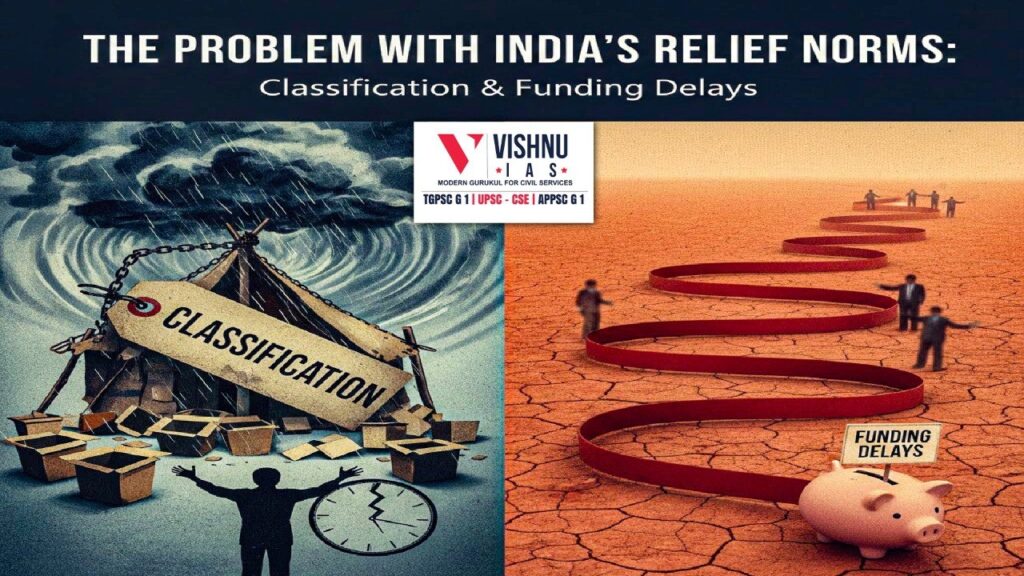
The widening gap between assessed losses and actual disbursements, seen during major events such as the Kerala floods and landslides, Cyclone Gaja, and the 2019 Karnataka floods, indicate deep institutional, financial, and procedural challenges. The most critical among these are outdated relief norms, ambiguous classifications, and procedural delays—all of which undermine fiscal stability, weaken State capacity, and strain the federal compact envisioned in the Constitution.
1. Outdated Relief Norms and Inadequate Compensation Framework
Inability to meet present-day reconstruction costs
- Relief norms such as ₹4 lakh compensation for loss of life and ₹1.2 lakh for a fully damaged house have remained largely unchanged for nearly a decade despite rising construction and livelihood restoration costs.
- This mismatch forces States to divert funds from development expenditure, as seen during events like the Wayanad landslides where reconstruction costs far exceeded permitted ceilings.
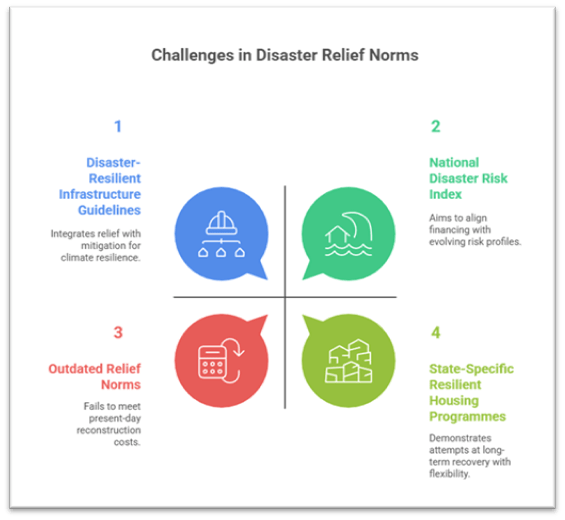
- Initiatives like PMAY-Gramin, National Cyclone Risk Mitigation Project, and State-specific resilient housing programmes demonstrate attempts at long-term recovery, but SDRF norms remain disconnected from actual economic losses.
Rigid spending rules that limit State flexibility
- SDRF rules allow spending only on immediate relief, not long-term livelihood restoration, climate-resilient reconstruction, or infrastructure recovery.
- States like Uttarakhand (2013 floods) and Himachal Pradesh (2023 cloudburst events) had to seek repeated special approvals due to excessive rigidity in norms.
- Government efforts such as disaster-resilient infrastructure guidelines, National Building Code updates, and Climate Adaptation Funds highlight the need to integrate relief with mitigation.
Norms failing to reflect climate-induced risk escalation
- Increasing variability in rainfall, glacial melt, and cyclone intensity has made disasters more destructive, yet norms are not indexed to inflation or climate risk.
- The IPCC’s regional climate estimates show rising multi-hazard exposure for Himalayan and coastal States, but allocation continues to use outdated parameters.
- The push for a National Disaster Risk Index, supported by the National Disaster Management Authority, aims to align financing with evolving risk profiles.
2. Ambiguity in Classifying Disasters and Overdependence on Central Discretion
Absence of clear criteria for declaring a ‘severe’ disaster
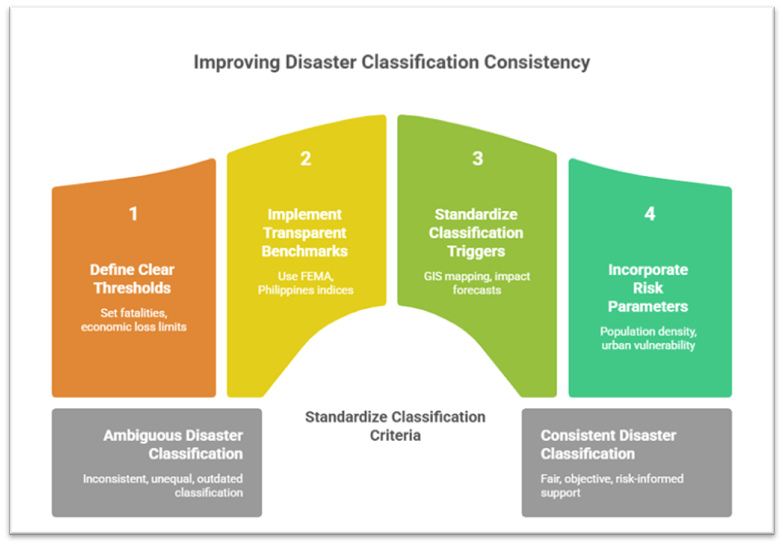
- The Disaster Management Act does not define thresholds (fatalities, economic loss, area affected, or loss-to-GSDP ratio) for triggering National Disaster Response Fund (NDRF) support.
- This creates inconsistencies, as seen when landslides in Kerala received lower classification despite comparable severity to incidents in Assam and Himachal Pradesh.
- By contrast, global practices like FEMA’s per capita damage thresholds or Philippines’ rainfall and fatality indices show the value of transparent benchmarks.
Inconsistent and unequal treatment among States
- States with high disaster burden (Tamil Nadu, Odisha, Assam, Uttarakhand) often report mismatches between assessed losses and Central support due to variable interpretation of severity.
- Events such as Cyclone Gaja (2018) and Karnataka floods (2019) illustrate the tension between political discretion and objective assessment.
- Efforts like GIS-based hazard mapping, IMD’s impact-based forecasts, and NDMA’s early warning systems can help create standardised classification triggers.
Lack of alignment with modern risk parameters
- Classification does not incorporate metrics like population density, critical infrastructure exposure, urban vulnerability, or social vulnerability indexes.
- Rapid urbanisation, particularly after disasters such as the Chennai floods (2015) and Mumbai rainfall events, demands new classification parameters.
- The Sendai Framework for Disaster Risk Reduction emphasises risk-informed financing, which India’s classification system has yet to fully adopt.
3. Procedural Delays, Bureaucratic Fragmentation, and Inefficient Fund Flow Mechanisms
Lengthy multi-stage approval system delaying disbursement
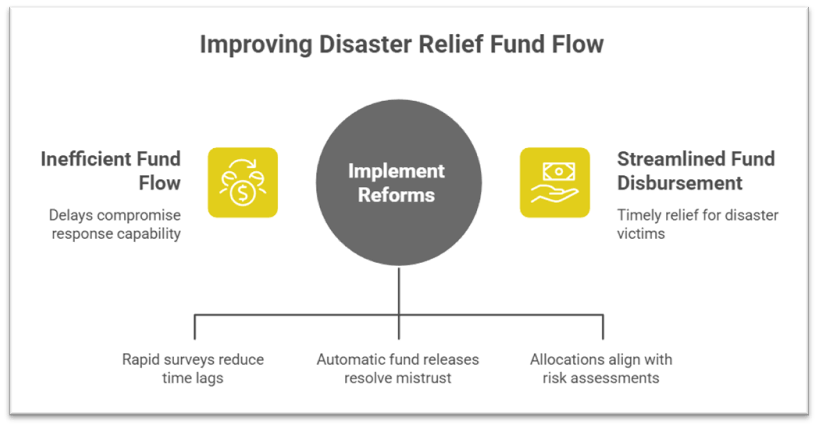
- The current procedure—State memorandum submission, inter-ministerial Central team assessment, high-level committee approval—delays urgent relief.
- In fast-onset disasters such as cloudbursts in Uttarakhand or cyclones on the eastern coast, weeks-long delays compromise response capability.
- Reforms like digital damage assessment platforms, drones for rapid surveys, and State Disaster Management Authorities’ field units are helping reduce time lags.
Central scrutiny over State spending leading to fund withholding
- Instances where the Centre withheld NDRF support citing unspent SDRF balances reflect a shift towards conditional transfers.
- States argue that balances often reflect committed but not yet disbursed works, especially because SDRF instalments themselves arrive late in the fiscal year.
- The introduction of a Public Finance Management System (PFMS)-linked expenditure tracking model can resolve mistrust and allow automatic fund releases.
Misalignment between Finance Commission allocations and vulnerability
- Criteria such as population and geographical area do not accurately capture hazard exposure, especially for States like Sikkim, Arunachal Pradesh, or Goa, which face high per-capita vulnerability.
- Using poverty as a proxy for vulnerability ignores real hazard trends like landslides, coastal erosion, or recurrent droughts.
- Proposals for a comprehensive Disaster Vulnerability Index, integrating hazard, exposure, and capacity indicators, aim to bring allocations in line with scientific risk assessments.
Conclusion:
India’s disaster-financing architecture is at a critical turning point. As climate shocks intensify and India witnesses over 7–10 major extreme weather events every month on average, outdated relief norms, opaque classifications, and procedural bottlenecks increasingly undermine rapid response and fiscal trust between the Union and States.
A forward-looking reform agenda must include updating relief norms to current economic realities, adopting transparent and objective triggers for classification, ensuring time-bound and predictable fund flows, and recalibrating Finance Commission criteria based on a scientific vulnerability index. Strengthening cooperative federalism through rules-based, data-driven, and decentralised disaster financing will ensure that both tiers of government can protect lives and livelihoods effectively.
A resilient, modernised financial architecture is essential to ensure that the next disaster does not become a test of negotiation, but a demonstration of national solidarity and institutional preparedness.
Recap: