
Assent of State Bills: Constitutional Provisions, Judicial Interpretation and Impact on State Autonomy
The assent of State Bills by Governors and the President is a crucial constitutional process that shapes India’s quasi-federal balance, influencing State autonomy, legislative competence, and the overall functioning of cooperative federalism.
• The Indian Constitution establishes a quasi-federal structure, where powers are divided between the Union and States, but with a strong unitary tilt. One of the most critical areas affecting this balance is the process of assent to State Bills by Governors and the President, governed primarily under Articles 200 and 201.
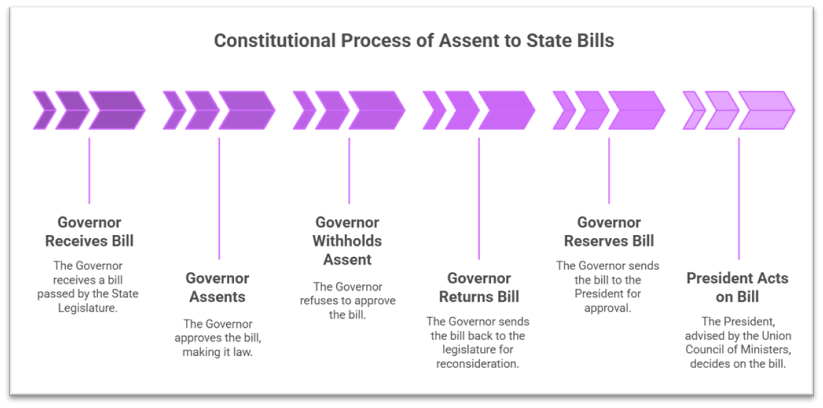
• Constitutional scope: The Governor may assent, withhold assent, return the Bill (if not a Money Bill), or reserve it for the President. However, the Constitution does not prescribe explicit timelines.
• Federal dynamics: When a Bill is reserved, the President acts on the aid and advice of the Union Council of Ministers, effectively shifting control to the Union.
• Discretionary power is not absolute: Judicial pronouncements consistently establish that Governors are constitutional heads, required to act on the aid and advice of the Council of Ministers except in narrowly defined situations.
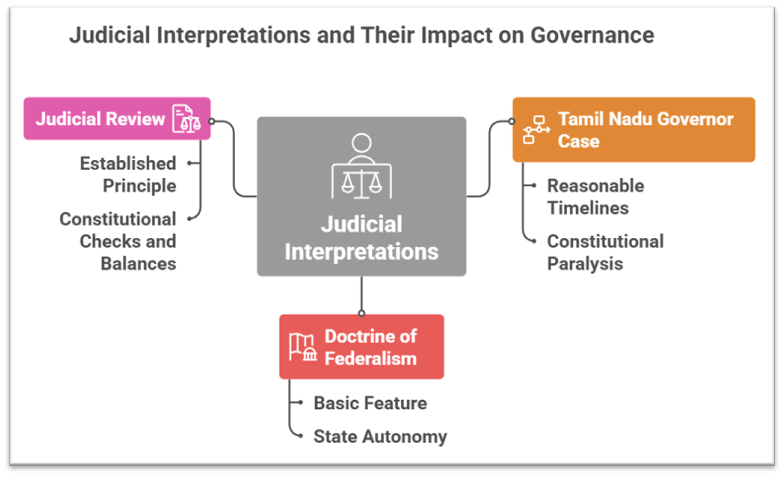
• Judicial intervention: A two-judge Bench mandated reasonable timelines for Governors to act on Bills to prevent constitutional paralysis. This was seen as strengthening federalism.
• Judicial stance: Federalism has been repeatedly upheld as a basic feature (e.g., SR Bommai Case, 1994). Any interpretation eroding State autonomy is subject to judicial scrutiny.
• Established principle: Judicial review is an inseparable part of the constitutional framework. No authority, including the Governor or President, is immune.
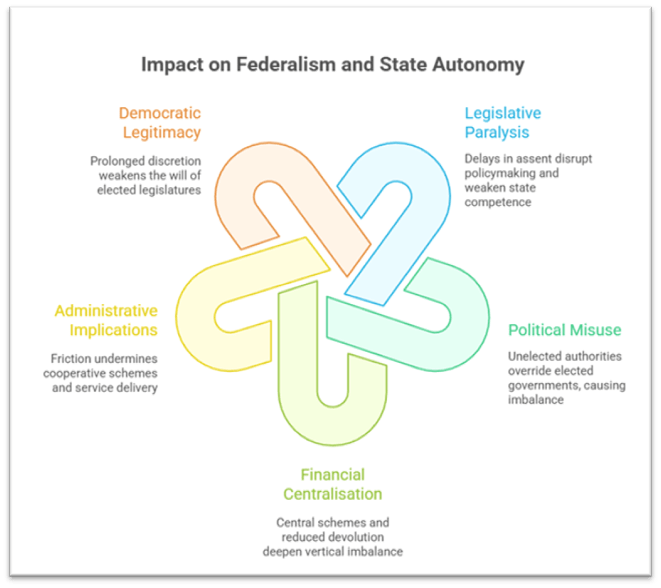
• Delays in assent disrupt policymaking and delay implementation of welfare schemes such as State-specific agricultural reforms or education policies.
• Pattern observed: Increasing cases where Bills from Opposition-ruled States face longer delays.
• Threat to cooperative federalism: Friction undermines schemes requiring joint Union-State cooperation such as disaster management, health, and social security.
• The constitutional scheme envisages balance, not subordination, between the Union and States. While Articles 200 and 201 provide necessary safeguards, their recent interpretation has enabled expanded discretionary space, risking the dilution of State autonomy, a core element of India’s federal basic structure. With several States experiencing prolonged delays in gubernatorial assent and increasing institutional tensions, the need for reform is evident. Recap:Introduction
• In recent years, multiple constitutional controversies, litigation, and judicial pronouncements, including the 16th Presidential Reference, have brought renewed scrutiny to this framework. The increasing frequency of Bills being withheld, delayed, or reserved indefinitely has raised concerns regarding the erosion of State autonomy, which the Supreme Court has repeatedly recognised as part of the basic structure through federalism.
• With several States reporting significant delays (ranging between 6 months to over a year) in receiving gubernatorial assent, the institutional tensions highlight the urgent need to evaluate constitutional provisions and their evolving judicial interpretation.
I. Constitutional Framework Governing Assent to State Bills
1. Article 200: Options Available to the Governor
• Practical implications: Absence of a time limit has resulted in prolonged inaction. Example: Tamil Nadu Legislative Bills Case (2023), 12 Bills were pending for up to two years, reflecting administrative paralysis.
• State autonomy concerns: Frequent reservation of Bills relating to State List subjects (e.g., universities, law and order, public health) undermines the legislative competence of States under Article 246 read with the Seventh Schedule.
2. Article 201: Presidential Assent and its Implications
• Case study: Bills on police reforms and land acquisition in Telangana were held up due to prolonged pendency under Article 201, delaying key governance reforms.
• Governance impact: States face uncertainty in policy implementation, particularly in sectors where they enjoy exclusive legislative competence, such as agriculture and public order.
3. Role and Limits of Gubernatorial Discretion
• Example: Nabam Rebia Judgment (2016) limited discretionary powers by holding that the Governor cannot interfere with legislative functioning.
• Recent concerns: Expanded discretionary interpretation in the 16th Presidential Reference risks elevating unelected offices over elected legislatures, contradicting the principle of representative democracy.
II. Judicial Interpretations and Their Impact
1. Tamil Nadu Governor Case and the Issue of Timelines
• Impact on governance: By prescribing time-bound action, it sought to ensure that governance is not stalled by administrative inaction.
• Subsequent developments: The 16th Presidential Reference diluted these timelines by granting broader space for gubernatorial discretion, contributing to institutional uncertainty.
2. Doctrine of Federalism as Part of Basic Structure
• Example: Punjab Governor Case (2023), the Supreme Court held that Governors cannot indefinitely withhold Summoning of the Assembly as it violates democratic principles.
• Tension created: Divergent judicial opinions in recent cases (between Benches) have created ambiguity on the limits of discretion, making States vulnerable to central intervention.
3. Judicial Review of Governor and President’s Actions
• Case study: Rameshwar Prasad Case (2006) underscored that gubernatorial decisions are subject to judicial review if mala fide or extraneous considerations are evident.
• Recent interpretations: Expanding “limited direction” doctrine, which shields certain actions from judicial scrutiny, risks weakening constitutional checks and balances.
III. Impact on Federalism and State Autonomy
1. Legislative Paralysis and Erosion of State Competence
• Case study: Several Bills passed by Kerala and Punjab faced prolonged delays, weakening legislatures’ ability to address local needs.
• Structural imbalance: By enabling unelected constitutional authorities to override elected governments, State autonomy suffers.
2. Political Misuse and Centralisation Concerns
• Example: National Commission to Review the Working of the Constitution highlighted that Governors must act impartially; deviation amplifies political friction.
• Financial centralisation: Coupled with conditional central schemes, reduced devolution, and rising cesses, institutional delays in Bill assent deepen vertical imbalance.
3. Administrative and Democratic Implications
• Governance uncertainty: Bureaucratic hesitation increases when legislation remains pending, affecting service delivery.
• Democratic legitimacy: The will of the directly elected legislature is weakened when subject to prolonged or opaque constitutional discretion.
Conclusion:
• As India moves towards a $5 trillion economy with complex governance needs, safeguarding federal balance is vital. A transparent, accountable, and time-bound assent process is not only a constitutional necessity but essential to the democratic ethos and cooperative federalism that anchor India’s unity in diversity.