
Effectiveness of the POSH Act 2013 in Educational Institutions: Critical Analysis & Reforms for 2025
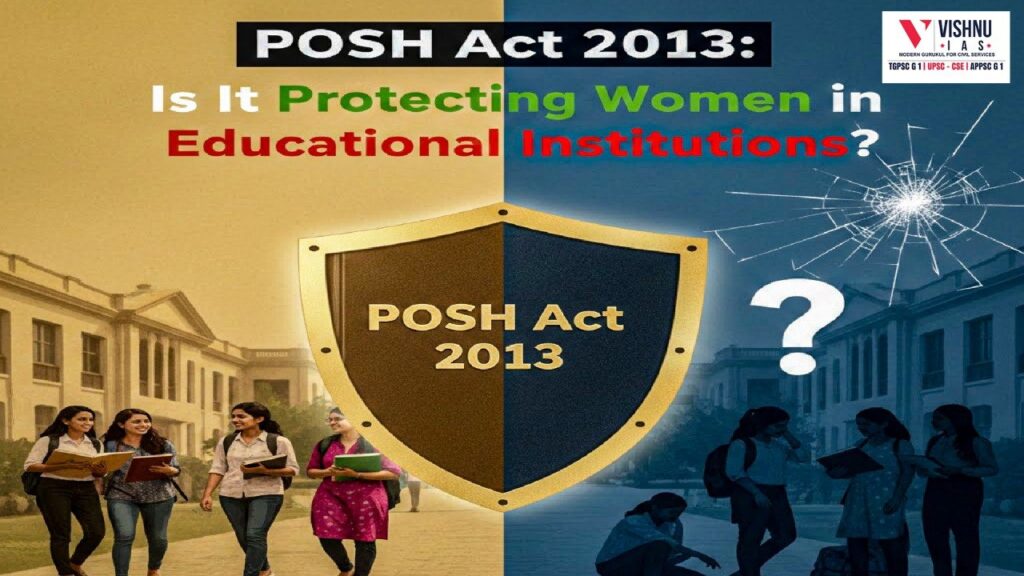
The POSH Act 2013 was enacted to ensure a safe, inclusive and dignified workplace for women, including those in educational institutions. Built upon the Vishaka Guidelines, it created institutional mechanisms such as ICCs to address harassment. However, despite its progressive intent, multiple assessments reveal gaps in implementation, uneven justice delivery, and challenges specific to educational ecosystems where power hierarchies deeply shape survivor experiences.
• The Sexual Harassment of Women at Workplace (Prevention, Prohibition and Redressal) Act, 2013 — popularly known as the POSH Act — was enacted to provide a safe, inclusive and dignified work environment for women across formal and informal workplaces, including educational institutions. It was built on the principles laid down in the Vishaka Guidelines and aimed to strengthen institutional redressal mechanisms through Internal Complaints Committees (ICCs).
• Mandatory ICC formation ensures every workplace with 10+ employees, including colleges and universities, establishes a complaint mechanism. In several institutions, ICCs have provided accessible forums where students and staff could report misconduct without approaching criminal courts.
• The Act’s broad definition of sexual harassment covers physical, verbal, and non-verbal conduct, enabling ICCs in educational settings to address harassment during fieldwork, internships, or off-campus academic events.
• Many universities have integrated POSH training into induction modules for new students and researchers.
• The law’s definition of consent does not explicitly include informed or non-coerced consent, which is crucial in teacher–student dynamics.
• Many ICCs lack training in legal interpretation, psychology, and digital forensics.
• Students fear academic retaliation, grade manipulation, or delayed evaluations.
• Expand the Act to address informed consent and power imbalance in academic settings.
• Mandate certified training for ICCs in trauma-informed procedures and digital evidence.
• Strengthen awareness programs, peer-led initiatives, and gender climate surveys.
• The POSH Act remains a landmark legislation, but its ability to deliver consistent and empathetic justice in educational institutions is still limited by conceptual ambiguities, procedural weaknesses, and institutional resistance. Recap:Introduction
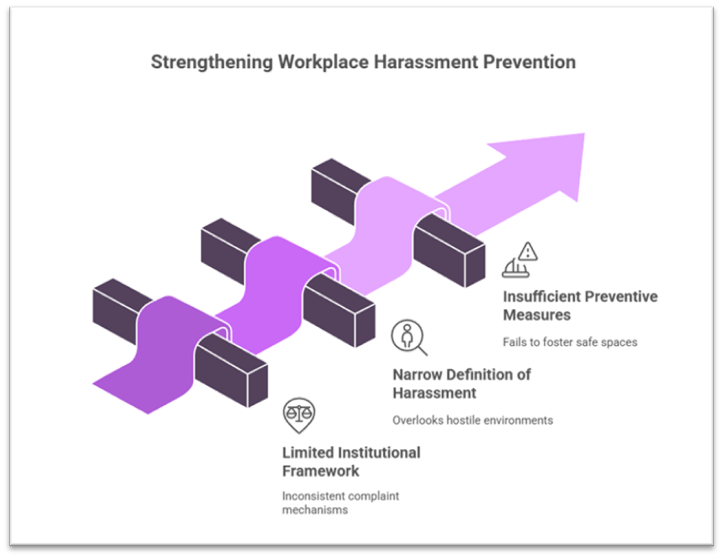
• However, more than a decade later, the Act’s effectiveness remains uneven. Multiple assessments, including parliamentary reviews and workplace safety surveys, indicate persistent under-reporting, low conviction rates, weak institutional capacity, and procedural gaps.
• Educational institutions, where power hierarchies between faculty and students are deeply entrenched, reveal especially sharp implementation challenges. The resulting justice outcomes often depend more on the institution’s culture and committee’s capacity than on the Act’s structural design.
Structural Strengths and Positive Outcomes of The POSH Act
1. Codifying a Mandatory Institutional Framework
• Time-bound inquiry provisions, including 90-day investigation norms, encourage quicker disposal compared to conventional judicial processes, illustrated by cases in some central universities where prompt ICC inquiries resulted in swift disciplinary action.
• Confidentiality requirements have helped encourage complainants, especially in campuses where fear of social backlash is high; several women’s collectives have reported that confidentiality motivated survivors to report repeated misconduct by senior faculty.
2. Expanding Recognition of Hostile Environments
• ICCs have increasingly considered power asymmetries inherent in teacher–student relationships, recognising that even seemingly consensual interactions may involve coercion or undue influence.
• Institutions adopting gender-sensitisation programs and mandatory orientation workshops have reported improved awareness and reduced tolerance for inappropriate behaviour.
3. Supporting Preventive Measures Across Institutions
• Annual reporting requirements to district authorities have pushed institutions to maintain detailed case records and compliance audits.
• The Act has indirectly strengthened campus safety through student-led campaigns and Women’s Development Cells monitoring unsafe spaces.
Gaps and Limitations in the Act’s Implementation in Educational Institutions
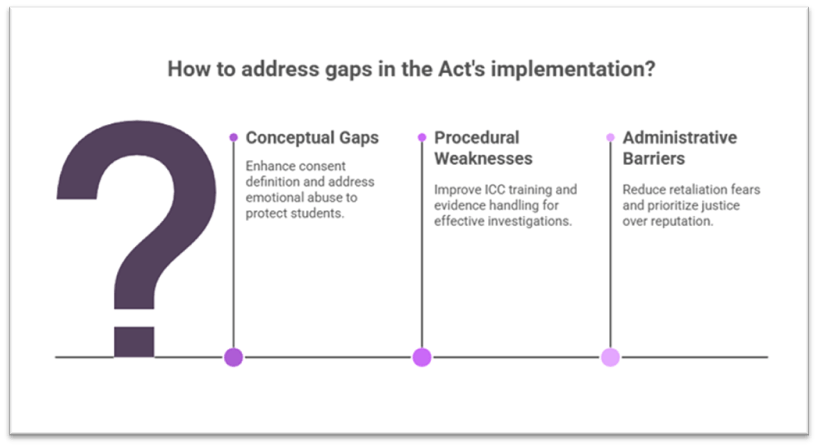
1. Conceptual Gaps: Consent, Power Imbalance and Emotional Abuse
• Emotional harassment, manipulation, deceit or coercive behaviour often fall outside the Act’s narrow definitional scope.
• The three-month limitation period restricts justice, especially for students who realise manipulation much later.
2. Procedural and Institutional Weaknesses
• Heavy dependence on direct evidence causes subtle abuse and grooming cases to be dismissed.
• The term “respondent” softens perception of wrongdoing within faculty circles, reducing seriousness of proceedings.
3. Administrative Barriers and Fear of Retaliation
• Institutions often prioritise reputation management, causing delays and biased inquiries.
• The “malicious complaints” clause creates a chilling effect, deterring genuine survivors.
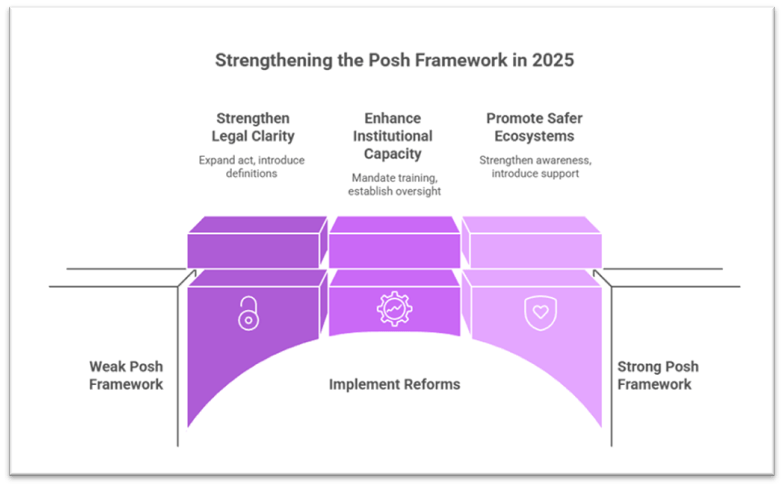
Reforms Needed in 2025 to Strengthen the POSH Framework
1. Strengthening Legal and Conceptual Clarity
• Legally recognise emotional manipulation, digital harassment, and coercive control.
• Remove or extend the three-month limitation period.
2. Enhancing Institutional Capacity and Accountability
• Establish independent oversight bodies to review ICC decisions.
• Create centralised databases (anonymous) to track patterns of misconduct across institutions.
3. Promoting Safer Educational Ecosystems
• Provide survivor-support systems including counselling, academic protection, and non-retaliation guarantees.
• Ensure transparency through compliance reports and ICC performance reviews.
Conclusion:
• Strengthening the Act with clear definitions, survivor-centric processes, and digital evidence protocols is essential to ensure justice is not dependent on a survivor’s endurance or committee discretion.
• With rising campus harassment incidents and widespread under-reporting, urgent reforms in 2025 are crucial to make educational institutions truly safe spaces where learning—not fear—defines student life.