
How the Absence of Timelines for Gubernatorial Assent Impacts Legislative Autonomy & Cooperative Federalism in India
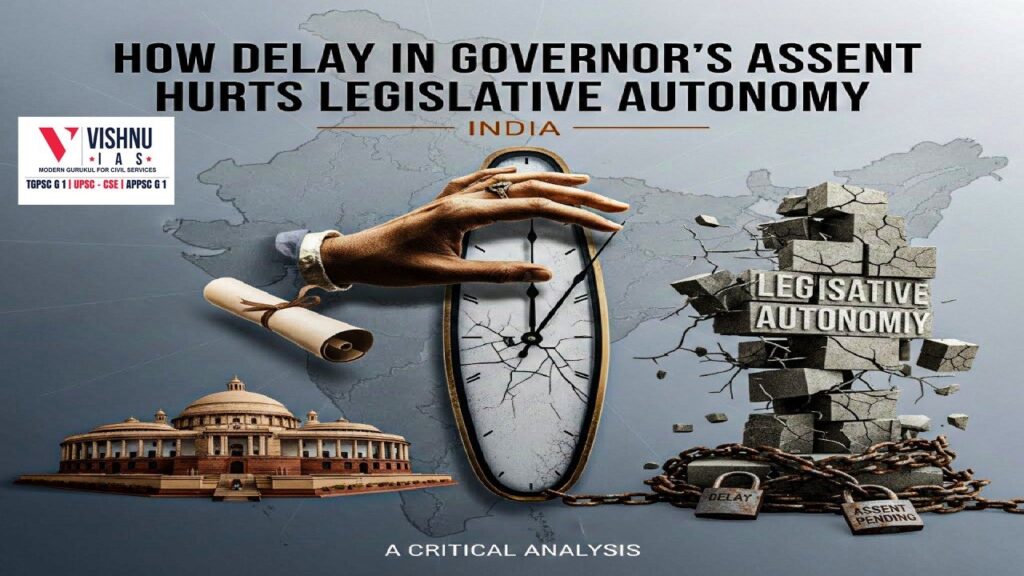
The absence of timelines for gubernatorial assent has become a major constitutional debate in India, significantly affecting legislative autonomy and cooperative federalism. This blog critically analyses how the lack of a fixed timeframe for Governors to act on Bills shapes Centre–State relations, disrupts policy implementation, and challenges the federal balance.
Introduction
• The office of the Governor, envisioned as a constitutional sentinel, plays a central role in the legislative process under Article 200, which deals with assent, withholding, returning, or reserving Bills for Presidential consideration. However, the Constitution does not prescribe any specific time frame for the Governor or the President to act on Bills.
• This structural vacuum has increasingly generated friction within the federal framework. Data from various State governments over the past decade indicates prolonged pendency of Bills, with some cases exceeding three to seven years, reflecting a significant bottleneck in the legislative process. The issue has acquired sharper relevance as more States and the Union are governed by different political parties, heightening constitutional tensions.
• The debate must therefore examine how this absence of timelines affects legislative autonomy, shapes Centre–State relations, strains cooperative federalism, and triggers litigation before constitutional courts.
1. Effect On Legislative Autonomy of States
1.1 Erosion of the Legislature’s Functional Sovereignty
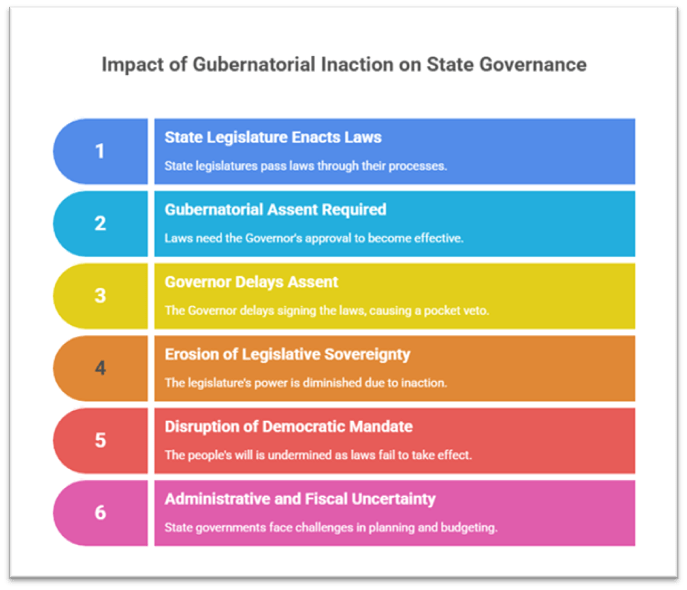
• State legislatures, as constitutionally empowered bodies, depend on timely gubernatorial assent for operationalising their legislative will.
• Prolonged inaction prevents duly enacted laws from coming into force, effectively constituting a pocket veto, despite its absence in the text of the Constitution.
• The friction seen in States such as Tamil Nadu, Kerala, Punjab, and Telangana—where critical Bills on higher education, local governance, and public service reforms remained pending—illustrates institutional stalling that undermines legislative competence.
• This delays State policymaking even in areas of exclusive State jurisdiction under the State List, compromising policy responsiveness.
1.2 Disruption of Democratic Mandate and Accountability
• Legislatures are directly accountable to the electorate, unlike the Governor, who is appointed and not elected.
• Delays dilute the democratic mandate because laws supported unanimously or by strong majorities fail to take effect, weakening representative governance.
• For instance, the health sector reform Bills passed by certain States to regulate fees in private institutions saw undue delays at the Raj Bhavan level, hindering welfare-oriented interventions.
• It also creates a constitutional anomaly wherein an indirectly appointed officeholder can stall the functioning of an elected body indefinitely.
1.3 Administrative and Fiscal Uncertainty
• State governments face uncertainty in planning and implementing budgets, schemes, and regulatory frameworks when key Bills remain unresolved.
• This affects sectors like education, land governance, and cooperative societies, where timely legislation is essential for fiscal mobilization and long-term planning.
• Examples include delays in assent to Bills intended to reform the recruitment process of universities or modify taxation procedures.
• Such uncertainty triggers governance paralysis and affects administrative efficiency.
2. Implications For Cooperative Federalism
2.1 Rise in Centre–State Friction
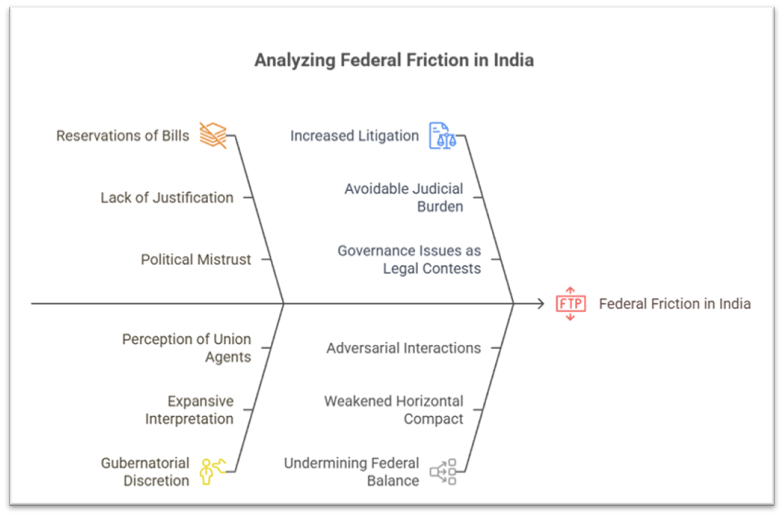
• Reservations of Bills for Presidential consideration, often without reasoned justification, deepen political and institutional mistrust.
• The number of Bills pending with the President, at times reaching beyond 70 in certain review years, points to systemic strain between the Union and States.
• States allege that reserved Bills, especially in politically sensitive sectors like university regulation or State investigative powers, amount to central oversight through gubernatorial procedure.
• This contradicts the spirit of cooperative federalism that India's federal design intends to cultivate.
2.2 Undermining of Federal Balance Through Discretion
• Expansive interpretation of alleged gubernatorial discretion has widened uncertainties in the legislative process.
• Constitutional commissions such as Sarkaria, Punchhi, and Venkatachaliah explicitly recommended limiting discretionary space and prescribing timelines to reduce federal friction.
• Continuing ambiguity encourages perception of Governors acting as agents of the Union, especially when political alignment differs.
• This weakens the horizontal federal compact and generates adversarial rather than cooperative interactions.
2.3 Increased Litigation and Constitutional Adjudication
• States increasingly approach the Supreme Court to resolve disputes arising from delayed assent.
• This creates an avoidable burden on the judiciary and reflects institutional inability to settle issues within the executive domain.
• Cases involving the prolonged pendency of Bills in Tamil Nadu, Punjab, and Telangana highlight how unresolved constitutional processes convert governance issues into legal contestations.
• Overreliance on judicial directions contradicts the spirit of political federalism where institutions must work in good faith.
3. Governance And Policy Consequences
3.1 Policy Paralysis and Administrative Bottlenecks
• Bills dealing with regulation of universities, local body reform, or state capacity enhancement often have direct administrative implications.
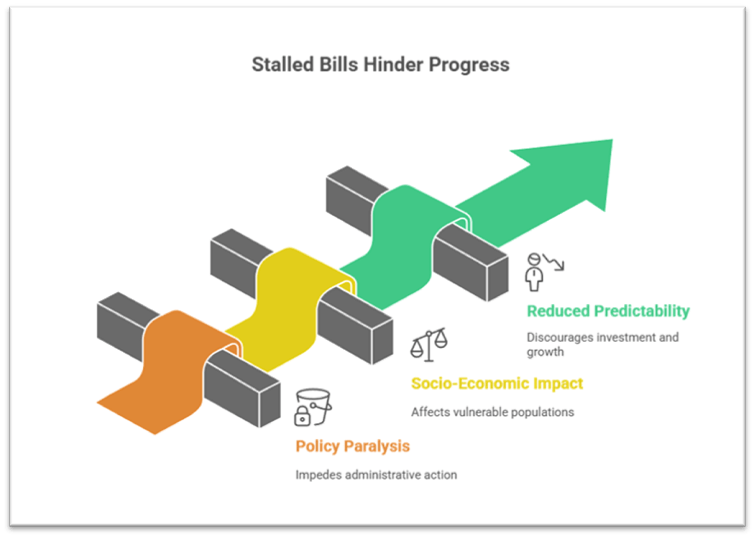
• Without timely assent, executive departments cannot frame rules, operationalise schemes, or carry out mandated reforms.
• In sectors requiring rapid response—such as public health, digital governance, or disaster management—delays significantly undermine preparedness.
• This affects citizen welfare and overall development outcomes.
3.2 Impact on Socio-Economic Development
• Many State Bills directly impact socio-economic parameters such as employment, education quality, pricing of services, and local governance efficiency.
• Legislative stalling affects vulnerable groups most, as redistributive or regulatory measures cannot be operationalised.
• Developmental schemes that require statutory backing, including reforms in cooperative banking or municipal finance, face delays that weaken growth and service delivery.
• This obstructs progress on national development objectives, including those aligned with SDGs.
3.3 Reduced Predictability for Investors and Institutions
• Legal certainty is critical for business and institutional stakeholders.
• When Bills on land regulation, fiscal incentives, labour reforms, or ease of doing business remain pending, investors face unpredictability.
• It discourages investment in sectors where State-level reforms are vital, such as manufacturing, MSMEs, and renewable energy.
• This has cascading effects on employment and long-term economic planning.
Conclusion:
• The absence of constitutionally mandated timelines for gubernatorial or Presidential assent has become one of the most prominent friction points in Indian federalism. While the framers expected constitutional morality, conventions, and a non-partisan gubernatorial role to ensure smooth functioning, evolving political dynamics have exposed vulnerabilities in the system. Strengthening cooperative federalism requires ensuring that the legislative intent of elected State Assemblies is not thwarted by indefinite delays.
• A constructive way forward includes introducing constitutional timelines for assent, implementing long-pending recommendations on Governor appointments, promoting transparency in gubernatorial decisions, and codifying processes for returning or reserving Bills. Evidence from multiple federal democracies shows that time-bound assent enhances predictability and institutional harmony.
• As India continues to evolve as a robust parliamentary federation, ensuring timely legislative processing will uphold democratic accountability, legal certainty, and intergovernmental cooperation, reinforcing the foundational vision of a balanced and responsive federal structure.
Recap: