Stagnation in the Subordinate Judiciary in India: Causes, Consequences & Reforms
Introduction
The subordinate judiciary forms the backbone of India’s justice system, handling nearly 90 percent of the nation’s litigation. Yet it remains burdened by systemic stagnation, reflected in the 4.69 crore pending cases in district and subordinate courts as per the latest National Judicial Data Grid.
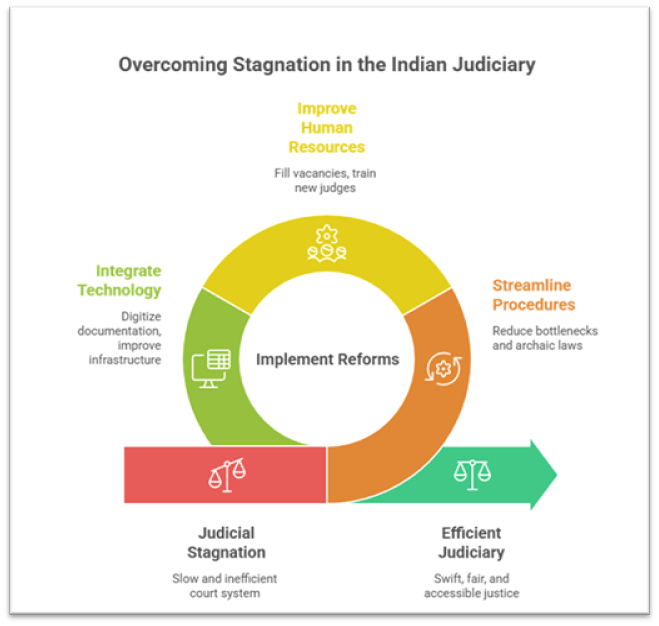
Stagnation refers to a condition where judicial processes become slow, inefficient, and unable to keep pace with rising caseloads due to structural, procedural, and human-capacity factors. This persistent backlog undermines citizens’ access to justice, weakens the rule of law, and erodes trust in institutions. A comprehensive understanding of the causes, consequences, and reforms becomes essential for strengthening the world’s largest democracy.
Body
1. Structural And Administrative Causes of Stagnation
a. Procedural Bottlenecks and Archaic Legal Framework
- Cumbersome procedures under the Code of Civil Procedure, including practices like preliminary and final decrees in partition suits and excessively technical execution proceedings under Order XXI, cause long cycles of adjournments.
- Mandatory requirements such as pre-suit mediation under commercial law and the six-month cooling-off period in mutual consent divorce proceedings often prolong cases even when parties prefer swift resolution.
- Clerical burdens on judges, such as issuing summons, receiving vakalatnamas, and routinely calling cases, consume substantial court time. For instance, in many district courts, case calling continues until noon daily, reducing time available for actual adjudication.
b. Inadequate Human Resources and Poor Recruitment Patterns
- Judicial vacancies in subordinate courts often hover around 20–25 percent, leading to disproportionate caseloads for serving judges.
- The shift from recruiting experienced legal practitioners (with 7–10 years of practice) to fresh graduates has created capacity gaps. Many new judges enter service without adequate exposure to court craft or case management.
- Training deficits are reflected in recent instances where higher courts directed lower court judges to undergo fresh training due to lack of basic legal knowledge.
c. Lack of Technological Integration and Administrative Reforms
- While the e-Courts Mission Mode Project is progressing, many district courts still rely heavily on manual systems for documentation, summons issuance, and scheduling.
- Poor court infrastructure – limited staff, inadequate digital facilities, and shortage of courtrooms – results in slow administrative processing.
- Absence of specialized ministerial courts or judicial officers dedicated solely to pre-trial and clerical work leads to senior civil judges losing prime hours for adjudication.
2. Consequences Of Stagnation for Justice Delivery
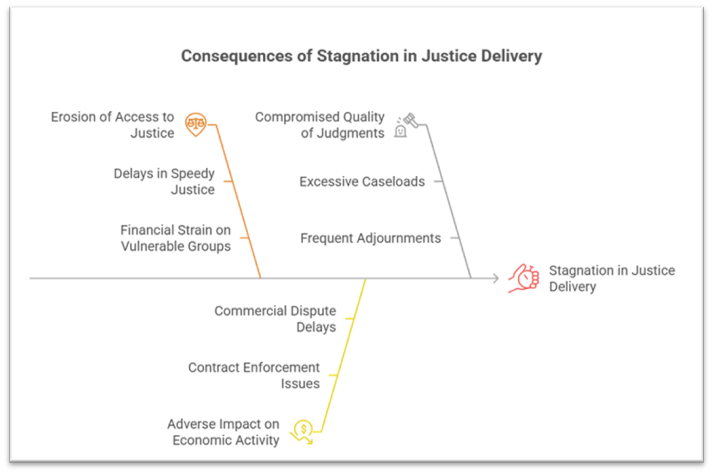
a. Erosion of Access to Justice and Public Trust
- Long delays weaken the constitutional guarantee of speedy justice under Article 21, reducing citizens’ faith in courts as effective dispute resolution forums.
- Vulnerable communities, small businesses, and tenants often face financial and emotional strain due to prolonged disputes, leading to settlements under pressure or abandonment of rightful claims.
- The credibility of the judiciary suffers when litigants witness cases continuing for decades, illustrated by delays in land acquisition disputes and rent control litigations.
b. Adverse Impact on Economic Activity and Investment Climate
- Judicial delay significantly affects contract enforcement; India continues to struggle in global rankings concerning dispute resolution timelines.
- Commercial disputes, especially those requiring pre-suit mediation, often slow the functioning of small and medium enterprises.
- Stagnation affects sectors such as real estate, family businesses, and financial services where clear and timely judicial outcomes influence economic decisions.
c. Compromised Quality of Judgments and Judicial Work Culture
- Judges burdened with excessive caseloads often have limited time to conduct detailed hearings, affecting reasoned and well-researched judgments.
- Frequent adjournments become normalized practice, further contributing to pendency.
- Clerical overload and limited courtroom management training leads to judicial burnout, reducing efficiency and leading to inconsistent orders.
3. Measures To Improve Quality and Efficiency of Justice Delivery
a. Institutional and Procedural Reforms
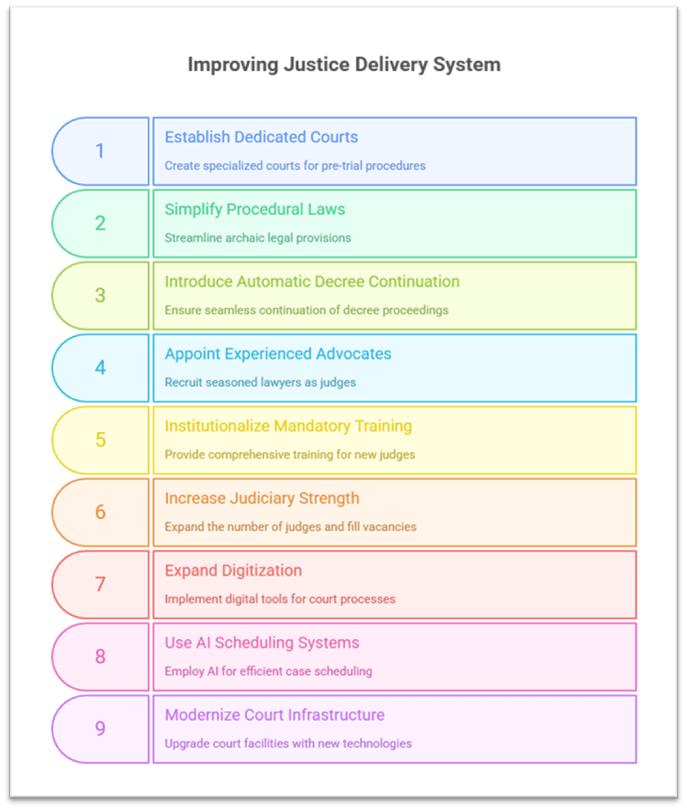
- Establish dedicated ministerial courts or judicial officers for pre-trial procedures, summons, filing scrutiny, recording ex-parte evidence, and scheduling, allowing trial courts to focus solely on adjudication.
- Simplify archaic provisions in procedural laws, such as merging preliminary and final decrees where possible and rationalizing Order XXI to ensure swift execution of decrees and arbitration awards.
- Introduce automatic continuation of final decree proceedings after preliminary decrees without requiring fresh applications to reduce procedural redundancy.
b. Strengthening Human Resources and Capacity-building
- Revive the practice of appointing experienced advocates as civil judges and district judges through lateral entries.
- Institutionalize mandatory long-duration training for new judges at High Court benches, covering judgment writing, case management, court conduct, and technological tools.
- Increase the sanctioned strength of subordinate judiciary and ensure time-bound filling of vacancies through coordinated efforts between High Courts and State Public Service Commissions.
c. Leveraging Technology and Improving Court Infrastructure
- Expand digitization under the e-Courts Phase III programme, including e-summons, e-filing, virtual hearings for routine matters, and real-time case tracking dashboards.
- Use AI-based scheduling systems to auto-generate daily cause lists, streamline listing practices, and predict case progress timelines.
- Modernize court infrastructure by adding more courtrooms, support staff, video-conferencing facilities, and evidence recording technologies, especially in high-volume districts.
Conclusion:
Stagnation in the subordinate judiciary poses a deep structural challenge that affects governance, economic development, and the rule of law. With nearly five crore cases pending at the district level alone, India must adopt a comprehensive and coordinated approach involving procedural simplification, capacity enhancement, investment in technology, and professional judicial training.
A modernized subordinate judiciary—supported by efficient administrative systems and skilled human resources—can significantly reduce delays, improve public confidence, and fulfill the constitutional promise of timely justice. A future-ready justice system, aligned with global best practices, is achievable through sustained reforms, adequate funding, and a strong commitment to institutional integrity.