
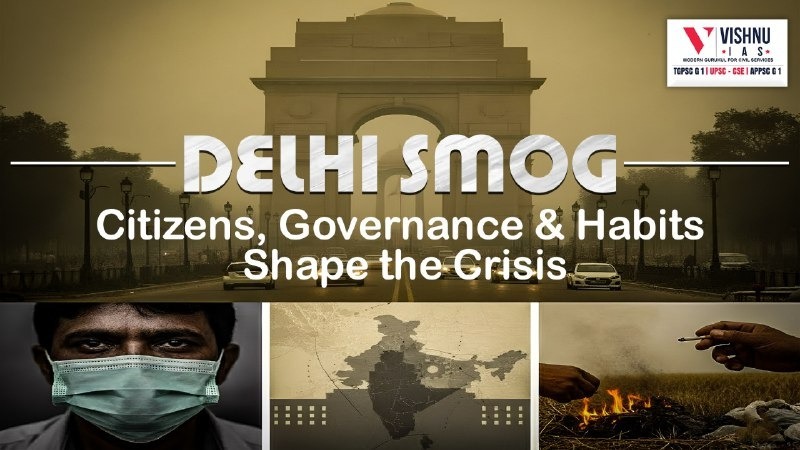
Air pollution in Delhi: Why the Delhi Air Crisis Is as Much a Behavioural Issue as a Governance One
Introduction
Air pollution in Delhi represents one of the gravest public health emergencies in India, with the Air Quality Index (AQI) frequently crossing 400–500 during winter, a range classified as “severe” and associated with significant disease burden. Long-term exposure to PM2.5 in Delhi is estimated to reduce life expectancy by nearly 10 years, reflecting the depth of the crisis.
Studies estimate that air pollution costs India over 1.3% of its GDP annually, due to healthcare expenditure, productivity loss, and premature mortality. While governance failures—poor enforcement, infrastructural gaps, and fragmented institutional action—undoubtedly aggravate the crisis, citizen behaviour, socio-economic choices, community practices, and institutional culture play equally crucial roles.
Therefore, the crisis must be understood not merely as a regulatory failure but as a behavioural challenge involving farmers, transport operators, industries, construction entities, and ordinary residents whose actions collectively worsen or can significantly improve Delhi’s air quality.
Body
1. Behavioural Drivers Behind Delhi’s Air Crisis
a) Agricultural Practices and Rural Behavioural Norms
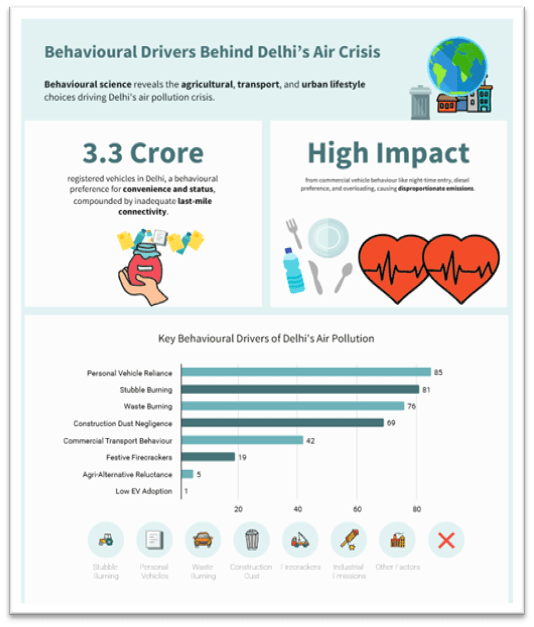
- Persisting stubble burning across Punjab, Haryana, and Western UP arises from entrenched seasonal practices, narrow harvesting windows, and economic constraints. Despite subsidies for Happy Seeders and bio-decomposers, behavioural reluctance persists due to perceived risks to crop yield and inadequate last-mile support. Case Study: Reduction of stubble burning in Ludhiana district after aggressive community-level engagement shows that behavioural nudges combined with financial alternatives can curb residue burning.
- Preference for traditional residue disposal methods reflects social imitation—farmers often follow practices adopted by their communities. Behavioural programmes like community-based farmer producer organisations have shown that collective adoption of mechanised alternatives improves compliance.
- Dependence on MSP-linked paddy cycles reinforces behavioural inertia, as farmers associate certain crop cycles with security. Reforms like the Crop Diversification Programme require behavioural transition supported by stable markets.
b) Transport Choices and Driving Behaviour
- High reliance on personal vehicles, especially two-wheelers and diesel cars, reflects behavioural preferences for convenience, status, and inadequate last-mile connectivity. Delhi has over 3.3 crore registered vehicles, and behavioural resistance to public transport remains a major contributor to NOx and PM2.5. Initiatives such as Delhi Metro expansion, Last-Mile E-rickshaw schemes, and Integrated Transport Corridors show that improving user experience increases modal shift.
- Commercial vehicle operators’ behaviour—night-time entry to avoid congestion fees, preference for diesel due to mileage advantage, and overloading—creates disproportionate emissions. The Graded Response Action Plan (GRAP) mandates restrictions, but compliance improves significantly only when behavioural monitoring and incentives like scrappage benefits are strengthened.
- Low adoption of electric vehicles often stems from range anxiety, misinformation, and resistance to shifting from known technologies. Delhi’s EV Policy 2020 demonstrated that combining incentives with awareness campaigns can substantially increase behavioural acceptance.
c) Urban Lifestyle, Construction, and Household Behaviour
- Negligence in waste disposal, including open burning of household waste by urban slum residents and small establishments, adds episodic spikes to PM2.5 levels. Behavioural alternatives—segregation, composting, and community waste bins—need sustained awareness.
- Construction stakeholders often ignore dust-control norms (covering material, using anti-smog guns, enforcing barriers) due to cost-saving behaviour. The real estate sector’s positive compliance under the Construction and Demolition Waste Management Rules was greatly improved in areas where strict monitoring was paired with behavioural compliance workshops.
- Festive and cultural behaviours, including the mass use of firecrackers despite restrictions, remain major short-term contributors. Behavioural resistance continues even with “green crackers,” showing that legal prohibitions alone cannot correct culturally embedded behaviour. Case Study: Sikkim’s behavioural ban on firecrackers succeeded through community-led campaigns rather than enforcement alone.
2. Governance and Institutional Behaviour in Addressing the Crisis
a) Fragmented Inter-State Coordination and Policy Behaviour
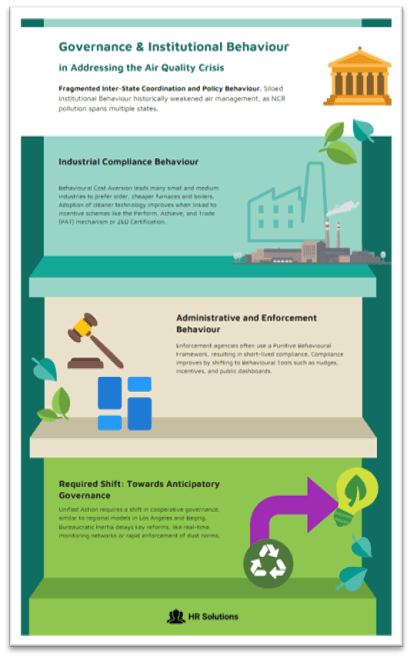
- Behavioural tendencies of government institutions to work in silos have historically weakened Delhi’s air management, as NCR pollution sources span multiple states. Coordination barriers persisted between Delhi, Haryana, UP, and Rajasthan despite the Commission for Air Quality Management (CAQM). With recent political alignment across states, a shift in cooperative governance behaviour can foster unified action akin to regional models followed in Los Angeles and Beijing.
- Bureaucratic inertia often delays implementation of emission-reducing reforms, such as real-time monitoring networks or rapid enforcement of dust norms.
- Reactive institutional behaviour, such as cloud-seeding or emergency school closures, replaces long-term preventive strategies. A behavioural shift toward anticipatory governance is essential for sustained progress.
b) Industrial Compliance Behaviour
- Many small and medium industries prefer older furnaces and boilers due to behavioural cost aversion, despite long-term savings from cleaner technology. Adoption improves when linked to schemes such as the Perform, Achieve, and Trade (PAT) mechanism or ZED Certification, which reward behavioural change.
- Units located in the NCR outskirts (brick kilns, diesel genset users, small manufacturing clusters) often violate emission norms due to weak behavioural incentives and limited monitoring. Case Study: Indore’s behavioural compliance model—strict monitoring plus financial incentives—shows how industries can shift practices.
- Behavioural apathy also affects fuel switching. Despite incentives for PNG transition, industries resist due to fear of operational downtime or cost misperception.
c) Administrative and Enforcement Behaviour
- Enforcement agencies often adopt a punitive rather than preventive behavioural framework, resulting in short-lived compliance. Shifting to behavioural tools—nudges, incentives, public dashboards—can improve everyday compliance.
- Lack of transparency in air quality data earlier discouraged informed citizen behaviour. With the expansion of monitoring infrastructure and open-data dashboards, behavioural participation from residents has improved.
- Municipal agencies’ behavioural constraints, including understaffing and outdated operational culture, hamper dust and waste control enforcement.
3. Citizen Behaviour and Community-Level Responsibility
a) Daily Lifestyle Choices and Consumer Behaviour
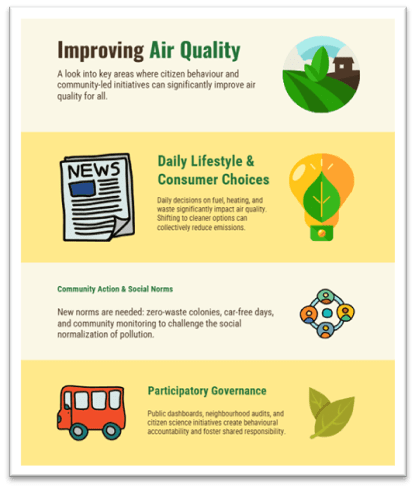
- Household choices—fuel consumption, indoor heating, waste burning, purchase of polluting vehicles—collectively shape air quality. Behavioural shifts toward energy-efficient appliances, cleaner fuels, and proper waste disposal can cumulatively reduce emissions.
- High willingness to pay for air purifiers but low willingness to adopt shared mobility reflects behavioural contradictions. Urban consumer behaviour often prioritises private welfare over collective public goods.
- Behavioural participation in public awareness platforms, such as AQI apps, remains limited. Locations with high digital engagement show better community-level compliance with alerts and advisories.
b) Community Action and Social Norms
- Pollution persists partly because it is socially normalised. Creating new norms—such as zero-waste colonies, car-free days, and community monitoring of construction sites—requires collective behavioural change. Case Study: Bengaluru’s citizen-led lake revival groups show how behavioural mobilisation can alter environmental outcomes.
- School programmes like Green Schools Programme (GSP) promote early behavioural conditioning toward environmental responsibility.
- RWAs play a major role in enforcing green norms, such as composting, controlled parking, and reduced-generator use. Behaviourally empowered RWAs show measurable improvements in local air quality.
c) Participatory Governance and Behavioural Accountability
- When citizens perceive pollution control as the government’s responsibility alone, behavioural disengagement increases. However, participatory models—public dashboards, neighbourhood pollution audits, and complaint platforms—create behavioural accountability.
- Citizen science initiatives, such as low-cost sensor networks and community monitoring, foster shared responsibility and data-driven behavioural change.
- Public pressure has historically accelerated environmental action, as seen in the successful behavioural movement behind Delhi’s 2001 CNG transition, highlighting how civic behaviour can transform policy implementation.
Conclusion:
Delhi’s air crisis is not merely the result of technological gaps or administrative failures but of deeply rooted behavioural patterns across farmers, operators, industries, institutions, and citizens. As multiple studies indicate, behavioural interventions combined with regulatory enforcement can reduce sectoral emissions by up to 30–40%, demonstrating the transformative potential of coordinated behavioural change.
A sustainable solution requires aligning incentives, embedding environmental norms in communities, mobilising citizens through awareness, and strengthening participatory accountability.
Ultimately, Delhi can achieve cleaner air only through a holistic approach that recognises that every stakeholder’s behaviour—collective, consistent, and conscious—will determine whether the city continues to struggle or begins to breathe freely again.